Cohort 25, week 4. Guest session recorded 7 October 2026.
JT Barnett on building the audience for a product that doesn’t exist yet
JT Barnett, former pro hockey player, creator and host of Core, with coaches Alex, Colin and Oren
The one idea
Build the audience around the category you’ll sell into, long before the product exists.
More context
JT plans to launch a physical product and doesn’t yet know what it will be. So he posts series about what he cares about: products he’d text a friend to buy, what he builds and hosts at home, and footage from his events. None of it is an ad, and each series reaches people who might one day buy. Colin put it to the cohort: next time you want to make an ad, make the series about the category instead, and let the integration wait weeks or months. This was the last week of Cohort 25. Slack access ends Tuesday 13 October, Kajabi stays open, and lessons on AI editing are being added. Alex shared a Notion content calendar to duplicate, with a warning to keep its properties few. Oren showed how creators make a common format their own, and Colin covered series. The homework is a post every day for the seven-day challenge, starting 8 October, with office hours most days. Then JT Barnett talked shop.
What this means for our clients
Read against the current client list. Check the dates before acting on one.
Test new hooks on Trial Reels before paying to boost them
- Post two or three of the week’s reels on each managed account as Trial Reels first, so non-followers see them before followers do
- Boost only the ones that win the trial
The hub says Ellen’s account only grows while a boost runs, that she boosts natively for now, and that Vos’s Matt is setting up a Business Manager. Nothing in the Marmur docs shows Trial Reels in use. JT said his first trial reel passed a million views, and that creators he knows in LA run short B-roll-and-text posts as trial reels where “some of those are just crushing.”
Trial Reels don’t replace Ellen’s boosts
Trial Reels only tell you which hook travels to non-followers; a boost still buys reach for the one that does. A medical claim in a hook needs the same compliance read either way.
The tactics
Post series about the category, not ads for the product
JT is building an audience for a product he hasn’t chosen yet, so he keeps his series broad enough to fit whatever it turns out to be.
He spent most of a decade helping founders of physical products get noticed. About a year and a half ago he decided he wanted a product of his own. His series cover products he’d text a friend to buy, what he builds and hosts at home, and his events. He keeps them varied on purpose. He knows the rooms (wellness, nightlife, homes) but not the product. Alex pointed out the side effect: one broad video reaches the buyer, the interior-design fan and the curator at once. The first “products I would text you to buy if we were homies” post reached a million views.
· · ·
Alex: It was like kind of reinvented yourself on, on social a bit, like starting to show so many other sides of, of what you're doing in your life. And not just like the, the educational side of it. Walk me through that process. Cause I'm in like a similar process where I'm making such different content than, you know, my first 200,000 followers, right? Like everything was just content about content or content about marketing. Now there's like this, this other side of like vlogging and brand building fitness dad side of things that i have to now put all into my content but meanwhile like my first 200 000 people that follow me just following me for the educational side
JT: yeah i mean totally this whole totally like ball game you got to play i think the decision for me was um i want i want to be a brand founder of a physical product like that's what I want to spend my time on the majority of my time for the past decade has been sitting with founders who have physical products and helping them get into the world culturally and uh when I was starting to do that I wanted to be like I was I love Gary V was very inspiring to me I was like I want to do an agency and I want to work with all these cool brands and be across all these different categories and just like really help all the people that I love and like the products that I love. And the more that I was doing that in the last couple of years, the more I was like, dude, I want to do this. Like I want to, I want the product myself. And for me, the way to do that is to have people be genuinely interested in your life, like genuinely interested in the things that you have to offer and why that product matters to you. And so I was like, all right, I need to start actually bringing people into my world and like showing them more about myself. And similar to you, like a lot of my stuff was education. So it was like telling you what's going on in the world, telling you how you can build something. And I was like, I want to turn this around and like have it be more about me so that people are interested in that. And then I can eventually launch things through my world. And so that's just been a decision that I made like in the last year and a half. And now that's where I'm headed. I feel like...
Alex: how did you start testing new content like what was your approach was it just like clean slate one day or were you like slowly starting to add things into the mix what did that look like
· · ·
Make the format yours, then make it hard to copy
Oren’s examples change one or two things about a common format: the look, the set, the font, something to do with your hands. JT goes further and builds in things even he can’t repeat.
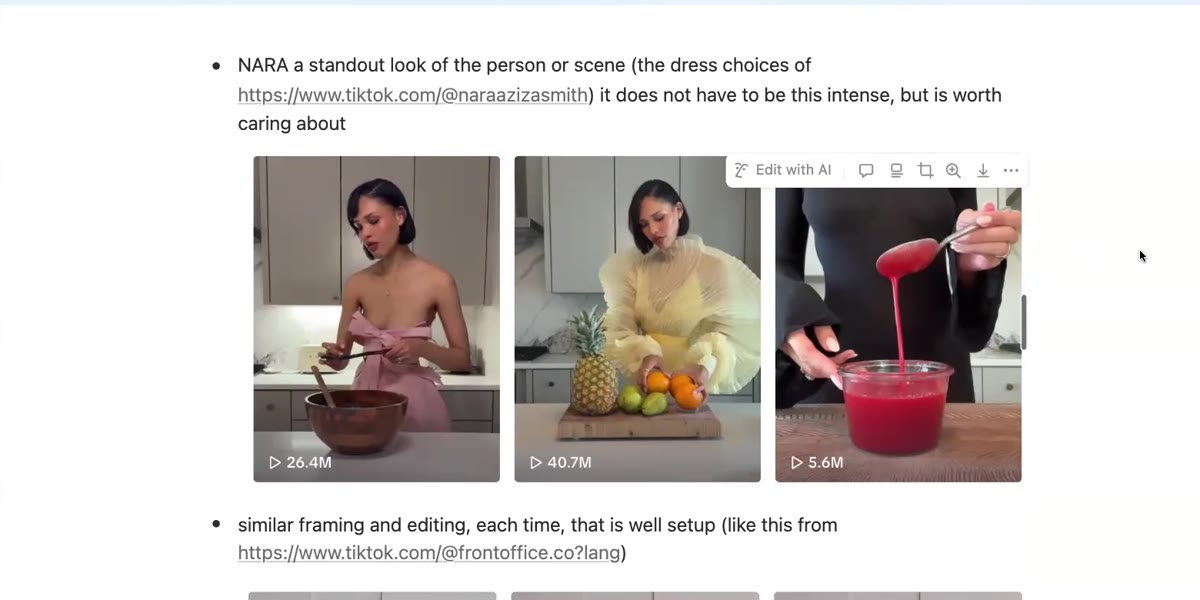
Nara Smith makes from-scratch recipes like plenty of others, but she does it in couture and with a particular voice. Oren’s friend Jess borrowed that slow, dressed-up delivery for tech videos. Thor talks about life while chopping with an axe. JT scrawls his on-screen text quickly with an odd pencil grip and does his lettering with his left hand, so it looks a little different and is hard to replicate. He spent about a week packaging the first homies post: the hook, the on-screen text, the first line, whether to use music. He landed on green screen with some B-roll.
· · ·
Alex: of course of course uh you know that started as a trial like how deep are you there like is that was that a month ago or how long you've been doing that
JT: series in particular i posted i've posted one that's only posted one of them i'm scripting my second one i literally was like i probably spent a week on packaging and all that for that one and now that I know like what I want to do something that I'm really trying like I think that this is applicable to this audience I'm really trying to do things that people cannot copy or makes it really hard for them to copy and I I'm I uh I think that it's I'm I get flattered if people use a similar style of anything I think that we all are learning from each other and like even subconsciously people pull from their inspirations but like what I mean by that is in a lot of my design, I do a lot of graphic design, I do a lot of different things from my experiences that are like physical media. In a lot of those things, I'm intentionally trying to do things that I can't even replicate. Meaning the text on my screen in that video is written very quickly. And it's not even my normal handwriting. I'm like holding a pencil differently. A lot of the graphic design that I do, I try and do the writing with my left hand. Just because I think there's something to it where it doesn't where it just like looks a little bit different and then it's hard for people to replicate and it stands out so something i've been trying to
Oren: you said you were working on the packaging for a week what did that what did that process look like
· · ·
Look for ideas away from the feed
JT puts scrolling on his calendar, keeps a separate account for each category he studies, and goes looking where the algorithm won’t send him.
He has about five accounts: one each for health and wellness, fashion, home and beauty, plus his main one. During a scrolling block he checks each in turn. Anything interesting goes to Cosmos or a Notion database called “interesting things.” On Sundays he goes back through all of it, plus his recorded meeting notes, and talks his reactions out loud into Granola. The coaches added a brand version: find a few customers on Instagram, see who they follow, and train an account until its feed looks like theirs.
· · ·
Oren: Yeah. And just for people's references, like I read my scripts a lot, like while I'm writing them, I'll like stop, I'll read the whole thing out loud. And like, it's, you know, kind of weird, but it really helps you kind of get the natural flow. Like, does this, is this awkward at any point, whatever it is. Any other kind of tips you have for ideation or any like other places you're finding like, okay, I get this video from here or there or things have inspired you recently?
JT: It's really like a lot of not, things on social. Like I'm going out and I'm looking at like right now I'm like looking at Garrett's art behind him on the wall. I'm looking at like Jono's art behind him on the wall. Like I like try to find things that are not on the internet right now. Or when I mean on the internet, I mean social. Like I think the internet's a great place to find inspo. I just think that algorithms are ruining our sense of individuality. And so I try and go places that people aren't and just like look through different things that are interesting there. So like Cosmos is a good place for references. I'll go through Cosmos and then I'll go to those actual websites and I'll like look into different things on those websites. On social, I'm sure you guys have talked about this. If not, I'm sure you will. But curating your algorithm as, curating new accounts algorithms as like individual accounts is a really helpful thing. So I have like five different accounts. I have one that's like health and wellness. I have one that's fashion. I have one that's home. I have one that's um I work with law before we were when I was consulting a ton I was doing a lot with beauty brands so I had one that was beauty and all of those are specifically for that category and so in that same time that I have on my calendar to go and scroll I'll go I'll like briefly jump into those algorithms like I'll open the other account I'll like scroll for a sec share the things that are interesting to Cosmos share it to my interesting list and then close that account go to the next one and kind of do that so I'll find interesting things there But I just feel like, I don't know, I feel like if you, when you're finding things from the algorithm, it's just, you just end up blending in more. So I'm like, I want to find things completely away from it.
Alex: It was like kind of reinvented yourself on, on social a bit, like starting to show so many other sides of, of what you're doing in your life. And not just like the, the educational side of it. Walk me through that process. Cause I'm in like a similar process where I'm making such different content than, you know, my first 200,000 followers, right? Like everything was just content about content or content about marketing. Now there's like this, this other side of like vlogging and brand building fitness dad side of things that i have to now put all into my content but meanwhile like my first 200 000 people that follow me just following me for the educational side
· · ·
Top of funnel is a sign on a busy street
For strangers the sign only has to stop them, so study the mass entertainment you’re competing with and take what fits you.
JT pictures top-of-funnel content as a sign held up where people who don’t know you walk past. Its job is to get looked at, not to get a phone number or a payment. So he breaks down the biggest shows in his category, such as Caleb Simpson walking into strangers’ homes and asking about the rent, and keeps the parts that feel like him. A coach added the short list of topics that reach almost everyone: money, relationships, health, and spirituality or bigger questions. Tie your niche to one of them.
· · ·
Alex: how would you start talking to either creators that are trying to increase reach or even brands are trying to increase reach that that don't understand that premise yet of like creating a top of funnel piece of content
JT: um i feel like i would be like i i try i try to picture uh analogies of like what what are we doing with marketing like what is this so i'm like okay if i'm like walking down a street like if this is top of funnel it's like brand new people that don't know me like what am i going to put on my sign like to try and reach the most amount of people how am i going to design that sign where am I going to hold it up when am I going to hold it up and uh and and and uh the way that I would look at like top of funnel versus bottom of the funnel is like the goal of this sign is to do different things like I might want people just to look at this sign and come say hi to me versus bottom of funnel being like I need them to stay I need them to give me their number I need them to pay me on the spot and so um I feel like that's how I think about it I'm like what am I trying to accomplish with this i just want as many people to see this as possible cool how can i make this loud how can i get this in front of them what are they watching what are they interested in what's other top of funnel things uh in my category you know a lot of top of funnel things are going to be like mass mass mass entertainment and so i'm like i'm competing with those all right like what do i need to do like what's going to be the what's going to be as entertaining in the first three seconds as you know architectural digests or like one of these shows where they're like the dude that's caleb simpson going into your house and like looking at you know how much do you pay for rent so i look at those things of like okay other top of funnel things that are mass how are they winning what are they i like break studying i break down their content like looking at it i'm like okay he like walks up to a random person that's intriguing he like talks about money then he like goes into a random person's house so i like look at those things and i'm like what what feels like me what's like too far that it's like really not on brand for me and like me doing this wouldn't feel good for me and it wouldn't lead to what i want in the end and uh what like attributes in this or little pieces of this are actually like really interesting um that i actually do want to take in like try and use in my own life
Oren: and just a quick a quick note on that that like when you really look at the human condition and like what's top of funnel it is basically money things about money. What did you spend? How much did it cost? Whatever that looks like. It is relationships between people, male, female dynamics, friendship dynamics, like family dynamics. And then there is health. Like if you have some sort of like health condition or a problem or fitness or wellness, and then you kind of have like spirituality or like greater things. And there's sort of everything else is like still popular, but those are like the core things to stretch across everybody. And you look at really top of all content, they probably have one of those as a through line. So it's worth kind of thinking about like, how do I attach, you know, your niche to kind of one of those kind of core, core ideas. And I want to, I want to pivot a little bit slightly on this, because I know you also, you for a long time helped brands hire creators, right? And I've kind of been inside that relationship. If people here are either want to do that for brands or like, Hey, I'd actually prefer to just like outsource this to somebody else. Like, where does that process stand now? I know it's kind of a lot different than it was a few years ago any recommendations there on either side
· · ·
Post the clip while you’re still feeling it
JT’s biggest recent hit was a one-shot of him in Copenhagen that he expected to get 10,000 views. It got about 8 million.
He was riding a high from the trip and put the clip on his feed instead of his story. People in America and in Copenhagen argued in the comments about why things are the way they are there, which a coach called content as a vehicle for the conversation. He plans more of what he calls filler content: six to eight seconds of B-roll with text and a song. A coach added a habit to go with it: shoot short clips wherever you are, because you can’t go back for the shot later and it takes six seconds. JT wishes he’d filmed more during his hockey years.
· · ·
Alex: Was this Copenhagen?
JT: Yes. Yeah. I mean, literally like that one, I did not expect, I thought that was going to get 10,000 views. You know, not be a big thing. And I was just like, you know, I'll post it. I want people to know I'm here.
Oren: And it's a good example. Like you don't quite know what's going to happen. Right. So like that video plays into the dynamics of Copenhagen. So people who live there are arguing about it. You're like in a bike.
· · ·
1 more tactics and the vocabulary
A journey series needs a constraint that raises the stakes
“Day one of quitting my job” won’t carry a series now. The ones that work add a filter that makes the viewer wonder whether it will work.
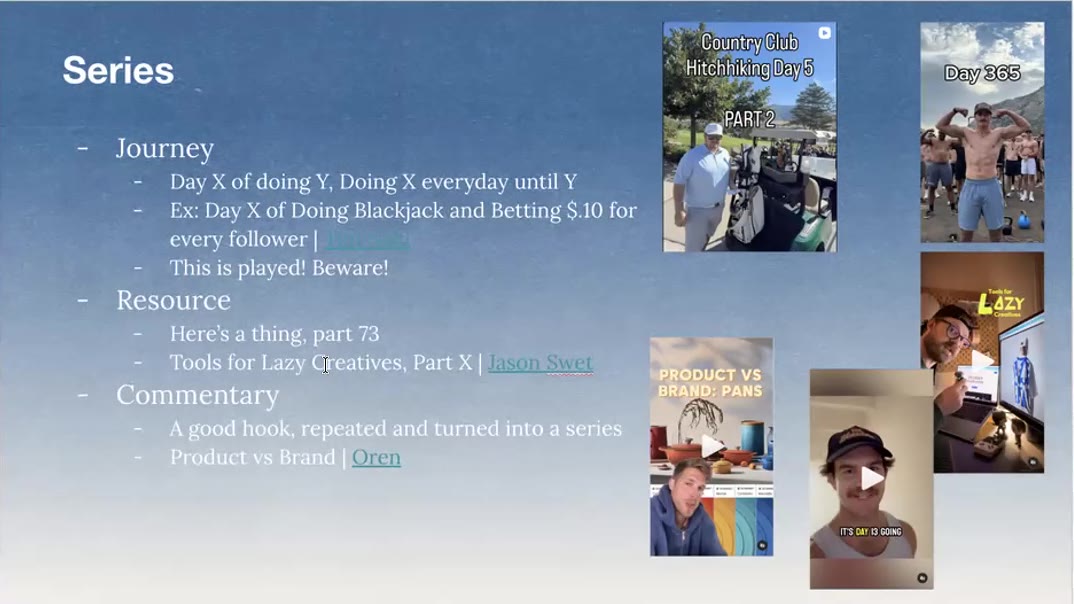
Colin’s examples: a creator who hitchhikes into country clubs by goading members into a bet, and “day X of working out for 20 minutes to see if I get jacked.” The 20-minute limit makes it feel doable and invites the doubt that it won’t. He named two other shapes. A resource series is one: a Cut30 alum’s “tools for lazy creatives, part X” started as one good video and became his biggest running series. Commentary is the other: Oren’s product-versus-brand videos never number themselves but have run well past 17 parts. Most good series start as one video whose hook works, and then you keep pulling on it.
· · ·
Oren: Yep. Let me get my screen up here. And I'm trying to find an example in the background. Got it. Okay. All right. So we have talked a lot about different types of content that you can make this time. So you've talked about 10 shots. We've talked about vlogs. You've gotten some light experience with all of them. And then during the seven-day challenge, we want you to get more experience with them. Our goal kind of by the end of this 30 days is you've started to be like, hey, I really like this format or two. You know, I have a light plan of things I enjoy making. But then the bigger challenge once you start wrapping your head around this week, now that you have an idea of what you like and what might be working a little bit, is how to make content uniquely your own. Like, how are you going to stand out in the feed versus a lot of other creators that are out there? So sharing this here for some examples. So many of you might know Nara Smith. She's one of the most famous kind of creators. So she makes content very similar to other people, right? She makes recipes from scratch, but she does it in her unique way. Everything is from scratch. She's always wearing couture while she's doing it. She talks in a very particular voice, has a very particular look. So she's taken something relatively similar and applied her own unique format for it. An example here, my friend Jess did something similar in tech. She said, hey, I like Nara Smith's format. I want to do something similar, but I'm not a food creator. I'm a tech creator. So she did the same thing where she's kind of dressing a little like an interesting way. And she's very slowly talking, but she's making tools. She's making like wrathful, like female revenge tech. I think it's probably the right way to classify it, which is an awesome way to like make a unique approach to explaining AI, right? I know we're talking about like what software does now. And it's an example of kind of using some of these ideas to find your own format. Other examples is kind of this sit down talking format with graphics over it, similar to what I do on a lot of videos like this guy Ken does. This video here about a manufacturer, they cut open like basically a garment every time. They start most of their videos, like cutting something opens with a really cool visual hook. They have their own title style. You'll see we have a ton of examples like this inside their curriculum. Some people will use their set to be kind of more unique. They'll use their green screen. Can they use a particular font? Hans uses kind of lighter lighting. This guy kind of cuts himself out in a bubble in his green screen. You'll see I shouted out Yuri in Content Winds yesterday. He's using a particular kind of font and color and style for his one shots. That's unique. That was his format. He chose our friend Thor cut stuff with an ax and he'll talk about life while he's using his ax. This is what we want you to think about this week. Just look at, okay, with my content, with what I like to do, how can I make it unique? How can I have some graphic treatments? Where do I want to set it? What could I be doing during my content? Is there a unique way I could dress or approach this? This is your opportunity to get creative now that you have a foundation. And along those lines, Colin's going to talk about series as well.
Colin: All right. Series time. So as you sit down to make seven videos over the next week or make a video every single day for the rest of your life, if you can lock down on Fridays, I do X. That takes a big chunk of your week and makes the decision for you, right? It's a very useful tool. When we say series, we're talking about social shows. We're talking about repeatable, brandable hooks that you can just reuse and keep running with. Or something as simple as a recurring concept or format like Oren was just covering. We had a guest last session, Anushka, who's definitely a Cut30 legend, hundreds of thousands of followers. And she always wanted to talk about the stuff she sees going on in brand marketing in India. And so she made a format that was just a vehicle for her to talk about the stuff she had seen that week. think of this as both a way to make compelling content as well as to start filling up the old calendar. Examples of this are, of course, the classic journey. This is the day X of doing Y, the doing X every day until Y. Big note on this. I quit my job. Day one of quitting my job to start a business is not going to cut it, right? When you see these working these days, they are severely, severely may not be the word. They're very escalated compared to the most basic ideas that start floating around in our heads, right? The examples I have here are country club hitchhiking day five. This guy goes to country clubs and sees if he can hitchhike his way in. That means like hop in with a member by taunting them into a bet to go and play him. You've got our 20 minute workout guy who did day X of working out for 20 minutes to see if I get jacked, right? The thing you see about both these is they have constraints and a huge filter on them that makes it much more compelling, much more interesting, right? You've seen day X of working out a million times, but you add the constraint of in only 20 minutes, you make it relatable to the viewer. You make it, you trigger this like, oh, wait, I could maybe do that. Is this actually going to work, right? And you also add the kind of the contrarian that won't actually work. And you have several additional levers there for your journey. So if you're doing that kind of content, take it up several notches. You also, of course, have the classic resource video. part 73. All right. So the, our favorite example in here is tools for lazy creatives. Part X is from a cut 30 lum Jason. This started as one good video called tools for lazy creatives. He kept doing it. He kept running with it and it becomes part of his brand. I can't remember if it was a Friday thing or what have you, but it absolutely becomes part of his brand and probably his biggest running series that there is. And then you have the classic commentary. This is like your unique angle on a thing. Maybe this is the formats we were just looking at. We have a classic from Oren, his product versus brand videos here, right? Which is a unique angle or a novel approach to looking at something in your category, your niche, so on and so forth with a good hook that you've proven. A lot of great series start by just trying something, discovering that you've got a hook there, and then keep pulling on that thread and keep iterating on it. For example, Oren's product brand does not label itself as part 17. But there's definitely been more than 17 parts to the series. That is all on series to recap what our homework is for this week. Sorry, let me unshare here. To recap homework for the week, it is simply to make a video every single day starting tomorrow. And that is a grind, but you've got an excellent tool set at your disposal here, right? You've got one shots, which are low lifts. You've got green screens. You've got 10 shots. You've got, you've got all kinds of different posts to make that up. And having those lower lift things that you can bang out quickly on a busy day is absolutely a part of the grind. It doesn't matter if you think that your ultimate workflow does not involve posting every day. There is unlimited upside in creating this habit and getting these reps. And over the next month, getting 30 reps. And over the next three months, getting almost a hundred reps, everything will change on, um, on this content journey of yours. Um, and with, without further ado, is JT here or do we have two minutes to go? So I may have gone a little faster than plan there. JT, you in the building? Is he here?
Oren: He's not. Let's talk about the office hours. So we will be doing office hours Wednesday, Thursday, Friday, um, Monday, Saturday, Monday. Saturday, Monday. And so those will be besides Saturday. Those will all be at that kind of regular 8 a.m. Pacific time. Maybe we were slightly just like 10 minutes, 15 minutes, one way or the other. We will let you know in Slack and post the links. Those are not recorded. They're just there to show up and talk shop. They're a little shorter. We just want to give you an op every day to get any questions you have out there. I want to do it at an alternate time zone to this one for our international people who can't make the night.
· · ·
The vocabulary
- Homies series
- “Products I would text you to buy if we were homies”: taste as a top-of-funnel series
- Filler content
- Six to eight seconds of B-roll, text and a song
- The sign test
- Top of funnel only has to stop strangers
- Escalated journey
- Day X plus a constraint that makes people doubt it will work
Who this is
Core
JT Barnett, a former pro hockey player, spent years helping health-and-wellness brands work with creators. He hosts Core, invite-only gatherings for people building culture, and has 165K followers on Instagram and 313K on TikTok.
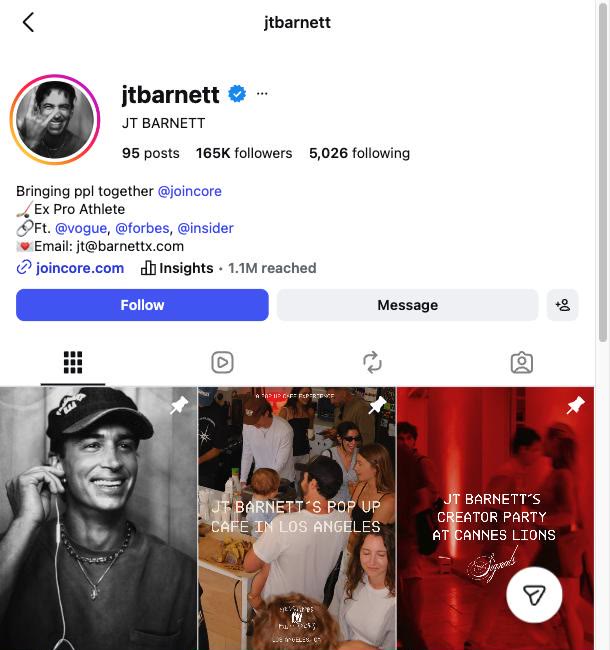
@jtbarnett TikTok, 312.9K · @joincore Instagram, 4.9K
Full background
JT Barnett was born in Los Angeles and played professional hockey below the NHL on month-to-month contracts, including stints in Russia, France, China and Sweden. Filming behind the scenes as a player got him hooked on content. He retired, became a personal trainer and filmed his workouts, which led to brand work. For seven or eight years he helped health-and-wellness CPG brands work with creators; the ones he named were heard as Poppy, Once Upon a Farm and Chomps. His companies include BarnettX. He now splits his days into admin in the morning and content from about noon to seven. He has 165K followers on Instagram and 313K on TikTok (checked 8 October 2026).
Accounts they pointed at
- Nara SmithOren’s example of owning a common format: from-scratch recipes, cooked in couture.
- Oren JohnProduct vs Brand, the commentary series Colin used as his example.
- Caleb SimpsonJT’s example of mass top-of-funnel entertainment: asking strangers what they pay in rent. Handle unconfirmed.
More accounts (2)
- Jason Murray (@jason_swet)A Cut30 alum’s resource series, ‘Tools for Lazy Creatives’. The slide credits ‘Jason Swet’, which is his Instagram handle.
- CosmosWhere JT saves visual references.
On screen in the session
The source
Watch offlineOpen in the Drive app → ⋯ → Make available offline. Streams from johnny’s own Drive copy; if it asks you to sign in, ask him to share it.
Read the full transcript (91 passages, auto-transcribed)
Coaches: evening y'all what's up what's up y'all i'm gonna drop this in slack i forgot to do that I feel like have we done any fireflies jokes this session? Shout out all my, shout out all my, my otters, my fireflies. Big ups on my granola. Granola. I haven't seen a granola in a while. HQ, my HQ is no fun. It needs a mascot. That's not what I meant, Jacob. HQ is tons of fun. Can we prompt inject HQ from the note taker? All right. That would be a mate. Strange times ahead. Welcome in, y'all. Welcome to week four, which is where this gets exciting. We'll give them another minute or two for people to hop on the call or send their note takers, whichever they prefer. Yeah, they're still flowing in. all right thanks for joining us from the road you bet yeah that's awesome
Oren: we won't i think we won't delay any longer we got a lot we want to hit today so this is the this is the last week of cut 30 we're going to hit some some housekeeping around that um we are going to talk about calendaring from here on out we're going to talk about some strategy around your kind of unique voice. We are going to talk about series. We're going to prep for the seven day challenge of posting kind of seven pieces of content in seven days coming up here. And then JT is going to be on the Zoom to talk shop, similar to how we did with KD last week. So without further ado, logistics of this being the last week. So you have Slack access until this time next week. So it goes through next Tuesday. You have access to the Kajabi forever. And we updated all the time. This curriculum this month is very new. So, you know, you'll see stuff will come in there all the time. We are adding some new stuff around AI editing for some of these video types and some skills for that. We are going to add before the end of the session. We'll probably do one of the office hours, talking a little bit about that if you want to learn some more. So you'll see some stuff coming there. And let me try to think what else is. Yeah. So the seven-day challenge we have. We'll notate it here. We also do office hours almost every day. These next few days, we'll publish a schedule, but we will have one of us live because we want to support everyone who's doing the seven-day challenge, who wants to workshop. So we end this all super strong. Without further ado, Alex, you want to hit content plan?
Alex: Yeah, let's run into it. So, all right. You guys can see my screen. You guys can see this content calendar? Yep. Cool, cool, cool. All right. So biggest reason we don't show this in weeks one through three and we wait till the last week to show this is because we don't want you to get into the mindset of thinking like it has to be, everything has to be set up perfectly before you start shipping videos, right? A lot of you have had 100,000 view videos, 50,000 view videos. Some of you already climbed to 10,000 followers. Like a lot of you had had so many wins just looking at the homework, planning it that day, shipping it that day, and then winning by the next day. Right. And so we don't want you to get stuck in this world where you have to look at this content calendar. I think you have to have this perfect plan set up to ship videos and to win on social. Right. And to win with these short form videos. But we did set this up now that you're going to be looking at producing videos over the next seven days and then hopefully going off and continuing to create content over the next year. Right. Like that's our entire goal here. And so what we made is like we made this little template content calendar that you guys could bring into your own notion. With this, it's fairly simple. So like there's a pipeline that we created, right? The simple pipeline of, or it's a board view, you can change the view to whatever you really want it to be. But it's as simple as in these three dots in the corner, hitting duplicate and being able to bring this into your workspace. Now, the thing about this is we already pre-populated this pipeline with a template. So the template pretty simple is you'll just hit new video and then you can change any of these properties, right? The second you bring it over and duplicate it, you can bring it into your own notion, change any of these properties based on your process. The one thing I will stress is don't overcomplicate this. I worked with somebody on my team roughly three or four years ago who created the most insane property task list that you had to make to just ship a video. By day three, none of it was ever getting filled out. It's one of those things that makes you feel feel like you're achieving something and you're really you're really not so just keep it as simple as possible and basically the thing that keeps the train moving right other aspects we have just a simple template for you to follow here with video script just to have the hook the bullet point value and the cta if needed one it probably not going to have those and then the biggest thing honestly until you get into the habit of of publishing so many videos that everything is second nature it is good to run through this checklist of before recording while recording editing posting and understand and like really looking through these little things that it's very easy to forget when when something's completely new to you you typically will forget one to two steps naturally when you're doing something it still happens to me where i'll record a video my mic's not turned on you know as addison uh calling some videos a few weeks ago and in the in my my mic was all all jacked up you know and like that that shit happens and i feel like we make videos every single day i'm with this equipment every single day and things like that still happen to me I'm year and a half two years in and making my own content am I speaking slowly I don't think I've achieved that yet two years in so like it is good to just run through this checklist but anyways you're going to pre-populate or you're going to put in the information here so you're going to you're going to do seven day challenge you'll put in the dates you could change uh the the property so if you want to go from status to in progress the second you do that right it's going to start pre-populating. It's going to start pre-populating this. And then you can start adjusting everything in the calendar view as well. If you want to have, look at the master calendar that just has everything that you're going to be creating. You can look at that. If you want to look at things that are in progress, if you want to look at things that are scheduled, if you have a team and you want to start incorporating your team in there, you can start changing this by the individual or other properties that you have. But this is just a good, like, again, the best process that you guys can create is the one that's going to help you continue to ship content. But if you want something that's simple, that you can run through and just kind of have in your back pocket, once you really start getting a lot of ideas and you feel like you kind of are overflowing with ideas, then this is what you should. You should be using something like this. It doesn't have to be in Notion. You could bring this over into Asana, et cetera. But overall, very simple. You'll find this in Notion. There's a link straight to it. You can duplicate it, bring it into your workspace. And it should help you organize your thoughts, organize your ideas. All right, to Oren for some formats.
Oren: Yep. Let me get my screen up here. And I'm trying to find an example in the background. Got it. Okay. All right. So we have talked a lot about different types of content that you can make this time. So you've talked about 10 shots. We've talked about vlogs. You've gotten some light experience with all of them. And then during the seven-day challenge, we want you to get more experience with them. Our goal kind of by the end of this 30 days is you've started to be like, hey, I really like this format or two. You know, I have a light plan of things I enjoy making. But then the bigger challenge once you start wrapping your head around this week, now that you have an idea of what you like and what might be working a little bit, is how to make content uniquely your own. Like, how are you going to stand out in the feed versus a lot of other creators that are out there? So sharing this here for some examples. So many of you might know Nara Smith. She's one of the most famous kind of creators. So she makes content very similar to other people, right? She makes recipes from scratch, but she does it in her unique way. Everything is from scratch. She's always wearing couture while she's doing it. She talks in a very particular voice, has a very particular look. So she's taken something relatively similar and applied her own unique format for it. An example here, my friend Jess did something similar in tech. She said, hey, I like Nara Smith's format. I want to do something similar, but I'm not a food creator. I'm a tech creator. So she did the same thing where she's kind of dressing a little like an interesting way. And she's very slowly talking, but she's making tools. She's making like wrathful, like female revenge tech. I think it's probably the right way to classify it, which is an awesome way to like make a unique approach to explaining AI, right? I know we're talking about like what software does now. And it's an example of kind of using some of these ideas to find your own format. Other examples is kind of this sit down talking format with graphics over it, similar to what I do on a lot of videos like this guy Ken does. This video here about a manufacturer, they cut open like basically a garment every time. They start most of their videos, like cutting something opens with a really cool visual hook. They have their own title style. You'll see we have a ton of examples like this inside their curriculum. Some people will use their set to be kind of more unique. They'll use their green screen. Can they use a particular font? Hans uses kind of lighter lighting. This guy kind of cuts himself out in a bubble in his green screen. You'll see I shouted out Yuri in Content Winds yesterday. He's using a particular kind of font and color and style for his one shots. That's unique. That was his format. He chose our friend Thor cut stuff with an ax and he'll talk about life while he's using his ax. This is what we want you to think about this week. Just look at, okay, with my content, with what I like to do, how can I make it unique? How can I have some graphic treatments? Where do I want to set it? What could I be doing during my content? Is there a unique way I could dress or approach this? This is your opportunity to get creative now that you have a foundation. And along those lines, Colin's going to talk about series as well.
Colin: All right. Series time. So as you sit down to make seven videos over the next week or make a video every single day for the rest of your life, if you can lock down on Fridays, I do X. That takes a big chunk of your week and makes the decision for you, right? It's a very useful tool. When we say series, we're talking about social shows. We're talking about repeatable, brandable hooks that you can just reuse and keep running with. Or something as simple as a recurring concept or format like Oren was just covering. We had a guest last session, Anushka, who's definitely a Cut30 legend, hundreds of thousands of followers. And she always wanted to talk about the stuff she sees going on in brand marketing in India. And so she made a format that was just a vehicle for her to talk about the stuff she had seen that week. think of this as both a way to make compelling content as well as to start filling up the old calendar. Examples of this are, of course, the classic journey. This is the day X of doing Y, the doing X every day until Y. Big note on this. I quit my job. Day one of quitting my job to start a business is not going to cut it, right? When you see these working these days, they are severely, severely may not be the word. They're very escalated compared to the most basic ideas that start floating around in our heads, right? The examples I have here are country club hitchhiking day five. This guy goes to country clubs and sees if he can hitchhike his way in. That means like hop in with a member by taunting them into a bet to go and play him. You've got our 20 minute workout guy who did day X of working out for 20 minutes to see if I get jacked, right? The thing you see about both these is they have constraints and a huge filter on them that makes it much more compelling, much more interesting, right? You've seen day X of working out a million times, but you add the constraint of in only 20 minutes, you make it relatable to the viewer. You make it, you trigger this like, oh, wait, I could maybe do that. Is this actually going to work, right? And you also add the kind of the contrarian that won't actually work. And you have several additional levers there for your journey. So if you're doing that kind of content, take it up several notches. You also, of course, have the classic resource video. part 73. All right. So the, our favorite example in here is tools for lazy creatives. Part X is from a cut 30 lum Jason. This started as one good video called tools for lazy creatives. He kept doing it. He kept running with it and it becomes part of his brand. I can't remember if it was a Friday thing or what have you, but it absolutely becomes part of his brand and probably his biggest running series that there is. And then you have the classic commentary. This is like your unique angle on a thing. Maybe this is the formats we were just looking at. We have a classic from Oren, his product versus brand videos here, right? Which is a unique angle or a novel approach to looking at something in your category, your niche, so on and so forth with a good hook that you've proven. A lot of great series start by just trying something, discovering that you've got a hook there, and then keep pulling on that thread and keep iterating on it. For example, Oren's product brand does not label itself as part 17. But there's definitely been more than 17 parts to the series. That is all on series to recap what our homework is for this week. Sorry, let me unshare here. To recap homework for the week, it is simply to make a video every single day starting tomorrow. And that is a grind, but you've got an excellent tool set at your disposal here, right? You've got one shots, which are low lifts. You've got green screens. You've got 10 shots. You've got, you've got all kinds of different posts to make that up. And having those lower lift things that you can bang out quickly on a busy day is absolutely a part of the grind. It doesn't matter if you think that your ultimate workflow does not involve posting every day. There is unlimited upside in creating this habit and getting these reps. And over the next month, getting 30 reps. And over the next three months, getting almost a hundred reps, everything will change on, um, on this content journey of yours. Um, and with, without further ado, is JT here or do we have two minutes to go? So I may have gone a little faster than plan there. JT, you in the building? Is he here?
Oren: He's not. Let's talk about the office hours. So we will be doing office hours Wednesday, Thursday, Friday, um, Monday, Saturday, Monday. Saturday, Monday. And so those will be besides Saturday. Those will all be at that kind of regular 8 a.m. Pacific time. Maybe we were slightly just like 10 minutes, 15 minutes, one way or the other. We will let you know in Slack and post the links. Those are not recorded. They're just there to show up and talk shop. They're a little shorter. We just want to give you an op every day to get any questions you have out there. I want to do it at an alternate time zone to this one for our international people who can't make the night.
Alex: As JT gets ready to roll, you guys can start dropping all of your questions. Yeah. Any other questions or anything you have in here, we're happy to start rolling through some. And for context, JT has a unique angle where he's kind of worked in all three universes. He's a creator. He's very good at making content as a creator. He's also worked with a ton of creators, spotting what makes those creators exceptionally well, putting those creators within brands. And then he's also worked on the brand side. So he has a unique angle of kind of the entire loop here. So if you guys want to get those questions prepped, he'll be able to take them as soon as he jumps on.
Oren: We can just open Q&A for a second while we're waiting for him too.
Colin: Yeah, I was going to say, anything you guys want to hit in the meantime, feel free to pop in there and we can workshop a bit.
Alex: Speak of the devil. We're in play. Forget it. There he is. Here we go.
Colin: What's up, JT?
JT: What up, guys? How we doing?
Colin: Excellent. Thank you for joining us. Alex was just giving an intro on you. Do you want to, do you want to give us one?
JT: Where did he stop?
Oren: No, he didn't give the full proper. So go ahead and give us the, you know, from a young man growing up in the darkest ice, ice hockey rinks of, uh, you know, the Eastern block.
JT: Yeah, exactly. Uh, I was born in Los Angeles. I, uh, I grew up playing, playing hockey. I ended up being a professional hockey player. Did play a little bit in Russia, spent a year over there, was in France for a bit, China for a bit, Sweden for a bit, before realizing that I want to make TikToks for a living and become a content creator. I was like documenting the behind the scenes of being a player and just fell in love with that. And hockey is not a very creative sport. And I wanted to dive more into creative. So I retired and became a personal trainer, started filming all my workouts. That led to me working with brands. I started realizing, wait, these brands don't know what they're doing on the internet. And I feel like this comes natural to me. So I started working with a lot of those brands. And then became kind of known for helping brands behind the scenes with how to work with creators and how to do social. I did that for probably the last like seven, eight years. Mainly in the world of CPG. Brands like Poppy, Once Upon a Farm, Chomps, like a lot of health and wellness CPG in Los Angeles. And that whole time was also building my own brand around just the things that I was seeing as a creator, how other people can build. The reason why I loved it so much is when I played as a player, I didn't play in the NHL. And in the minor leagues, you don't have long-term contracts. So I was month-to-month contracts. And I didn't have real control over my life, where I was living, my well-being. Just like a lot of things were out of my control. And I really wanted to find a way to have that control. and live anywhere that I want, build a business remotely, and be able to just be free. I really was craving freedom. And when I saw the internet and the opportunity to be able to do that, I was like, I'll do anything to be able to do this. And so I dedicated all of my time and energy to becoming a creator. And that's why I still love it. And so all of my content for the past seven, eight years was me talking about that and how other people can do it. And then right now, what I'm focused on is building things experientially. So in real life is a big thing for me. I'm hosting people and I have a brand now called Core. So a lot of events through there. And yeah, stoked to do this.
Alex: That is the exact intro I gave. Like, of course, word bar for bar. I want to get right into into some something that you've been doing differently, right? Like head content and then you know you've been testing a whole ton of different formats a ton of different series um you've been testing some things i think you i saw something that you posted that you said you put it first on trial rail you're kind of testing the concept of something of like uh things i would text you if like run me through what how you're testing things how you're coming up with different concepts um in different formats
JT: i feel like i know now what the things that i watch uh i i this is something that i think is helpful i don't scroll i have a very good relationship with not i don't scroll mindlessly when i do scroll i have it on my calendar to intentionally scroll and it's studying it's not mindlessly scrolling um and so i will i will spend time studying or intentionally consuming and then i notice the things that i'm drawn to the things that i i see my audience watching for me. And, and I'm always trying new, new different series, like I think about my old thing is like, what's the things that I actually want to talk about that are like an intersection between what I care about, and what will build the business side of what I'm trying to do. And whenever I have a moment like that, I'm like, what's the best format to do this in or best packaging to do this in. So what Alex is talking about is, I, I have been wanting to share more of the things that I care about, particularly products in my life. Because I'm hosting things at my house, I'm doing a lot more of this in real life thing. And the experiences that I create are so built around the products and the environment that people are in. I host a coffee shop at my house every two weeks. I turn my house into a full coffee shop. It's invite only for a lot of creators that are in Los Angeles and entrepreneurs that are in Los Angeles. And people are in my home. And so when people are in my home, they're asking me about different items and decor and things like that. So that's got me really into different design of my house. And I wanted a series where I can share things that I care about. And so I started doing this series of products I would text you to buy if we were homies. And I think that that was me just giving myself some time to think about what is a series that would catch literally my homies, like that they would want to watch. And people that do know me or don't know me and then get interested in who is this person why should i want to be homies with them what's his style oh i actually like this product what are the other things he's doing so yeah i tried one of those i posted to trial reels i actually don't do trial reels a lot that's my first time trying trial reels i i need to do more of them i know that that's a great strategy and uh yeah in like 40s i had a million views so it feels good to have that happen it's always nice and something works as
Alex: of course of course uh you know that started as a trial like how deep are you there like is that was that a month ago or how long you've been doing that
JT: series in particular i posted i've posted one that's only posted one of them i'm scripting my second one i literally was like i probably spent a week on packaging and all that for that one and now that I know like what I want to do something that I'm really trying like I think that this is applicable to this audience I'm really trying to do things that people cannot copy or makes it really hard for them to copy and I I'm I uh I think that it's I'm I get flattered if people use a similar style of anything I think that we all are learning from each other and like even subconsciously people pull from their inspirations but like what I mean by that is in a lot of my design, I do a lot of graphic design, I do a lot of different things from my experiences that are like physical media. In a lot of those things, I'm intentionally trying to do things that I can't even replicate. Meaning the text on my screen in that video is written very quickly. And it's not even my normal handwriting. I'm like holding a pencil differently. A lot of the graphic design that I do, I try and do the writing with my left hand. Just because I think there's something to it where it doesn't where it just like looks a little bit different and then it's hard for people to replicate and it stands out so something i've been trying to
Oren: you said you were working on the packaging for a week what did that what did that process look like
JT: really it's like what's the hook like what is the what is the text that's showing what am i saying in it like the first sentence and then how is this being shown uh visually and then like what's the sound over top of it like is there music uh in one of the other series that i do i've been using a song in this one i was like i'm not going to but i was it was like that like thinking through that so am i showing the product first is this talking head is this green screen is this just b-roll is this is this not green screen and it's me talking directly to the camera and holding the product it was just like messing around with those different things and then i landed on uh green screen with a little bit of b-roll
Colin: yeah rob asked a good question here um do you have a system for taking notes and saving while you're studying and scrolling intentionally
JT: i use cosmos i save a lot of things to cosmos like i'll share a lot of content that i find inspiration from to uh cosmos kind of like pinterest um and also i have like a board on there that's like inspo And so I'll save any video that I find interesting over there. And then I also in Notion have a list, like a database. It's called interesting things, like interesting things that I'm watching and reading. So if there's something that I find anywhere, like people post something on social, I see an article on Google, I see like literally anything. Somebody texts me something interesting. I share it to that database. And then once a week, usually on Sunday, I try to go back and I use granola for like all my meetings. So I'm recording all my meetings. Then I try to go back on Sunday and look through all of my meetings, all of my notes, all of my Cosmos, and then that database of interesting watching and reading. And while I'm doing that, I have granola open. So I'm like going through all these things and I'm talking out loud, recording my voice while I'm looking through these things. And so I'm saying the things that I find interesting and what I feel like I want to do from that would do with them. And that's been really helpful.
Oren: That is interesting. You're not the first person who likes to talk it out loud. I do a lot of that too. I'll like talk into whisper flow, like almost like have a conversation around what all the ideas are. And then like once it's typed out, it's easy to look at. So it's good, good advice there.
JT: So helpful. I think that, and I think that the, the, the, the act of like speaking for me makes like, I can write things a bunch, but if I actually like speak it, I feel like I know it more. And so when I'm like saying things out loud, it like registers more for me.
Oren: Yeah. And just for people's references, like I read my scripts a lot, like while I'm writing them, I'll like stop, I'll read the whole thing out loud. And like, it's, you know, kind of weird, but it really helps you kind of get the natural flow. Like, does this, is this awkward at any point, whatever it is. Any other kind of tips you have for ideation or any like other places you're finding like, okay, I get this video from here or there or things have inspired you recently?
JT: It's really like a lot of not, things on social. Like I'm going out and I'm looking at like right now I'm like looking at Garrett's art behind him on the wall. I'm looking at like Jono's art behind him on the wall. Like I like try to find things that are not on the internet right now. Or when I mean on the internet, I mean social. Like I think the internet's a great place to find inspo. I just think that algorithms are ruining our sense of individuality. And so I try and go places that people aren't and just like look through different things that are interesting there. So like Cosmos is a good place for references. I'll go through Cosmos and then I'll go to those actual websites and I'll like look into different things on those websites. On social, I'm sure you guys have talked about this. If not, I'm sure you will. But curating your algorithm as, curating new accounts algorithms as like individual accounts is a really helpful thing. So I have like five different accounts. I have one that's like health and wellness. I have one that's fashion. I have one that's home. I have one that's um I work with law before we were when I was consulting a ton I was doing a lot with beauty brands so I had one that was beauty and all of those are specifically for that category and so in that same time that I have on my calendar to go and scroll I'll go I'll like briefly jump into those algorithms like I'll open the other account I'll like scroll for a sec share the things that are interesting to Cosmos share it to my interesting list and then close that account go to the next one and kind of do that so I'll find interesting things there But I just feel like, I don't know, I feel like if you, when you're finding things from the algorithm, it's just, you just end up blending in more. So I'm like, I want to find things completely away from it.
Alex: It was like kind of reinvented yourself on, on social a bit, like starting to show so many other sides of, of what you're doing in your life. And not just like the, the educational side of it. Walk me through that process. Cause I'm in like a similar process where I'm making such different content than, you know, my first 200,000 followers, right? Like everything was just content about content or content about marketing. Now there's like this, this other side of like vlogging and brand building fitness dad side of things that i have to now put all into my content but meanwhile like my first 200 000 people that follow me just following me for the educational side
JT: yeah i mean totally this whole totally like ball game you got to play i think the decision for me was um i want i want to be a brand founder of a physical product like that's what I want to spend my time on the majority of my time for the past decade has been sitting with founders who have physical products and helping them get into the world culturally and uh when I was starting to do that I wanted to be like I was I love Gary V was very inspiring to me I was like I want to do an agency and I want to work with all these cool brands and be across all these different categories and just like really help all the people that I love and like the products that I love. And the more that I was doing that in the last couple of years, the more I was like, dude, I want to do this. Like I want to, I want the product myself. And for me, the way to do that is to have people be genuinely interested in your life, like genuinely interested in the things that you have to offer and why that product matters to you. And so I was like, all right, I need to start actually bringing people into my world and like showing them more about myself. And similar to you, like a lot of my stuff was education. So it was like telling you what's going on in the world, telling you how you can build something. And I was like, I want to turn this around and like have it be more about me so that people are interested in that. And then I can eventually launch things through my world. And so that's just been a decision that I made like in the last year and a half. And now that's where I'm headed. I feel like...
Alex: how did you start testing new content like what was your approach was it just like clean slate one day or were you like slowly starting to add things into the mix what did that look like
JT: i honestly feel like my biggest issue over the last couple years was consistency like i get i was getting bored too quick of things and i would move on from them so like i never stuck with something super long so i don't have an issue trying new things because it's like fun for me i feel like the thing that i actually want to get better at is like sticking with something um so yeah i would love for all of you to hold me accountable and wait for me to post 50 of these at least product things that i'm recommending to people because if it's my uh consistent track record over the last couple years i'll probably post like seven of them and then like do something else so uh trying new things hasn't been a challenge for me it's like ripping the same ones
Colin: yo jt something you said i think in a previous conversation that i feel like is productive to talk through is how like creating content at least for you was basically just like a life decision and over the years like the the topics the niche like what it does for you has always shifted but there's been like this ever-present content creation and uh i'd love to just hear you speak to that some because i don't know that that really resonates for me as someone who's also inconsistent and been in a slump um yeah knowing that content is ultimately life and always going to be productive is is kind of this like overarching thing no matter what the business is or what the category or or account is even you've started new accounts from scratch right
JT: tons tons uh yeah i think my like thesis on that is just like uh to do anything that you want to do in life you have to have attention and if you can actually captivate people and have attention where it's not just for a moment but where it's where people actually go deep into things that you care about and get and find transformation in the attention that they're giving you then you can build some real shit and I when I was playing hockey started to realize that and was like I have to find a way to be able to do this because I want to help people like I'm I'm doing it from my own interest but I'm also doing it because I like genuinely want to give back to people and, and be impactful in the, in the culture that I'm in. And, um, there's, there's nothing that I've come across that can do that more effectively than social media. If there was, I would be doing it. So that's all I'm spending my time on. It's like, what's the most efficient uses of my time to get my message out to the world, to be able to do the things that I want to do. And, um, I, I, I think like when you learn the skill and you get away from there's so much shit that sucks with social like there's there's so much noise about the danger the awful things about it and i do think if you're mindlessly scrolling and using it's a tool like a hammer can be used to build a house it can be used to fucking break shit um and i think that if you when when you really like learn the skill of it and you find enjoyment in it um it stops being it stops you stop feeling friction towards it and it just starts feeling like fun. And then I feel like that's how you really start to enjoy the process and build things because when you really enjoy the process, you show up every day. So for me, it's always been something that like, I love teaching and helping people jump into it because it's changed my life over and over and over again. And anytime I start something new, I've started a bunch of different brands. I've started a bunch of different projects. Every one of them was, what's our social strategy? How are we getting in front of people?
Colin: this is a good question here yeah uh from sean any process around batch creation or workflow for creating multiple videos at one time
JT: i think you can do it if you have a system if you have a series that that is applicable for it like if your thing is all b-roll and voiceover and you can batch by doing one day of scripting and then one day of voiceovers and then one day of filming i think you can it just comes down to the series there's some things that cannot be done in batch and there's some things that it makes it really easy to um so yes very dependent on series
Colin: how much time do you spend all in on content per week can you share what your schedule looks like
JT: 50 of my time is content um first half of my day is usually admin business ops side and then from about 12 till about uh six or seven is is usually content that's either that's now i'm starting to this is something i before a lot of my talking head videos particularly the ones that when i was going hard on tiktok were filmed literally in the moment like i would get off of a call like this and i would immediately turn on my camera and i'd be like garrett had sick art you guys need to think about this because of this you know and uh i don't because of the series that i'm trying to do now i need a little bit more pre-production in them so now i'm trying to do like monday where i'm scripting a couple of videos and then Tuesday I'm filming a couple of videos. That's a little bit new for me to do consistently. And so I'm trying that out, but it's usually the second half of every day that I spend on it.
Colin: Aiden asked, do you try to make sure your feed is following people in your niche and train your algo and skip everything else? You probably got several burners based on different projects.
JT: Yeah, my main account is really just following people that I know or that I think are doing interesting things like I click follow on on so many different people like basically basically if I think you're doing something interesting I follow you so that algorithm shows me maybe 0.2 percent of the overall people that I'm following and it's just a mix of so many different things the other ones are more curated and those are the ones that I like intentionally scroll on
Colin: to be clear other accounts guys other accounts yeah other accounts yeah if If any of y'all are doing a CPG product, not if, I know some of you are, create an account that follows all your competitors, other people in that space, the commentary in that space, et cetera. And just as a curated algo specifically for that thing.
Oren: I'd even take that like one step further. We'll usually like look up some of our customers, find their Instagrams and like see who they follow. Because it's like not even about the brands necessarily. It's about like what influencers they like, what kind of content just shows up in their feed. And that is extremely enlightening to say the least, especially if you're not your own target demographic.
JT: As someone who has to brief beauty. I would even go, I would even go and try and curate the algorithm around one of those influencers. Like, like who is our target demographic? Who are they following? All right, let's go follow those people in like a bunch of their contents that our algorithm looks the exact same as that influencers. And then you'll know what to create. And then.
Alex: um what's your what's your plan for content for for the fall anything interesting coming up or how are you thinking about the rest of the year
JT: i have a couple it's really just like filling out these series now so i have the that products one i have one that's like really around just basically anything that i'm doing in my house like things that i'm building putting together events i'm hosting um that i'm like trying to welcome people into my home and then uh the third bucket that i'm trying to pour more time into is content from my events. I've, uh, I've done consistently events over the last year and I like really haven't posted much content from them other than like a couple of big ones. And, uh, I want that to be more consistent thing. So that's something that I'm really trying to work on.
Alex: How are you thinking about like JT's world and what that looks like on, on social, especially, you know, if you eventually wanted to launch your own physical product,
JT: what does that look like literally my actual world like i like i uh i took like i took like three days when i was in i was in france in the summer for a conference called can can lion and after that i had some time by myself i took like three days where i was like look i like really want to show people more the things that influenced me the products that influenced me the media that influenced me the experiences that influenced me and i i want to i want to like go and like get this all down on paper so that I can come back to this as a reference and so the first day I went and I opened granola and I just like walked around uh Paris and was just voice memoing like I was literally looking at childhood photos and being like what was the shit that I was watching what was the shit I was listening to and I'm like dude I had a razor scooter I was wearing etnies I was and like just intentionally describing brands and music and experiences that shaped me. And the world that I'm building now is trying to show all of those things that influenced me because all of those things are the reason why the experience that people come over, they can feel whatever they're telling me that they feel, which is like some semblance of like warmth. They feel that because of all the ways that I was influenced in who I am today and the experience that I've created at my house. So I'm like, well, I want to describe that more. So I want to understand that more. So what are the things that influenced me? Like I printed out a fucking Limp Bizkit poster and I'm like, I'm going to put this somewhere because that was something that I listened to. And like this influenced me, you know? And so I think that's what I mean by like individuality of like, I'm trying to really lean into the things that make me me and get people into those.
Colin: world building if you will
JT: yeah exactly
Colin: have you thought about what products you're going to launch is that is that something that's already in the horizon
JT: yeah yeah it's not it's not concrete yet but like there's a handful of different things that i'm like getting samples from and working through something that feels like home really is it all around the like like home decor like interior something that can show up in all the experiences that i'm hosting so like something that can be in wellness something that could be a nightlife something that can be in homes um yeah
Colin: i think it's a good call out for y'all when we talk about not making ads right jt is talking about an entire series around this category of thing that relates to the business that he's going to do right um which basically sets up both for building an audience interested in the thing that he's going to do, as well as obviously for integration. But I would imagine that it will be weeks or months before like any semblance of anything is integrated and getting showed off. Right. It's absolutely a long game. But think about it from that perspective the next time you have the desire to make an ad. And also, if you don't know what you want to sell in the future, but you know roughly you're like, I'm going to build in CPG or I'm going to build in the category. Right. It's just like you keep stacking that expertise and it becomes so much easier once you actually have that following and that setup in there go ahead jc
JT: i feel like that's why i'm trying to do uh that's why i'm leaving these series and the and both the experiential series and the content series with a lot of variety and optionality in it because i don't know with 100 confidence what the first product that i want to do is and so i'm like i know these i know the rooms and i know the like somewhat of the categories but uh and i want people to like be interested in those categories that i'm interested in um but that's why i'm not making every video right now around like you know a beverage or like a it's like i don't know i don't know what it is so
Alex: great point this is also a great example of a top of funnel content series that you can create, right? Like we talk about this a lot when you're in a specific category and you go way, way too niche. It's like you, you kind of reduce the TAM that that content can, can reach versus what you're doing right now. It's like, you could talk about all, you're, you're, you're targeting so many different demographics. Like you're targeting the buyer, you're targeting the person that's looking at interior design. You're looking at the curator, right? Like you're talking to so many different individuals. And that's why that video, you know, has the potential to get a million views off rip when first iteration um and it's and i think that's that's so key because a lot of times we are talking here about too many of you are going way too specific or just talking about your product and not being able to cast a wide net um so kudos to you on that kudos to you on that on like thinking about it through the through the right lens obviously
JT: totally thank you yeah i mean you guys talk about this a lot where it's like um sometimes going after like a very specific demo is the right play especially if it's not like top of funnel um but i agree with you like if i'm going to try and do something and it just be like brand awareness and to new people i like want it to be as big as possible with well still being specific to me
Alex: how would you start talking to either creators that are trying to increase reach or even brands are trying to increase reach that that don't understand that premise yet of like creating a top of funnel piece of content
JT: um i feel like i would be like i i try i try to picture uh analogies of like what what are we doing with marketing like what is this so i'm like okay if i'm like walking down a street like if this is top of funnel it's like brand new people that don't know me like what am i going to put on my sign like to try and reach the most amount of people how am i going to design that sign where am I going to hold it up when am I going to hold it up and uh and and and uh the way that I would look at like top of funnel versus bottom of the funnel is like the goal of this sign is to do different things like I might want people just to look at this sign and come say hi to me versus bottom of funnel being like I need them to stay I need them to give me their number I need them to pay me on the spot and so um I feel like that's how I think about it I'm like what am I trying to accomplish with this i just want as many people to see this as possible cool how can i make this loud how can i get this in front of them what are they watching what are they interested in what's other top of funnel things uh in my category you know a lot of top of funnel things are going to be like mass mass mass entertainment and so i'm like i'm competing with those all right like what do i need to do like what's going to be the what's going to be as entertaining in the first three seconds as you know architectural digests or like one of these shows where they're like the dude that's caleb simpson going into your house and like looking at you know how much do you pay for rent so i look at those things of like okay other top of funnel things that are mass how are they winning what are they i like break studying i break down their content like looking at it i'm like okay he like walks up to a random person that's intriguing he like talks about money then he like goes into a random person's house so i like look at those things and i'm like what what feels like me what's like too far that it's like really not on brand for me and like me doing this wouldn't feel good for me and it wouldn't lead to what i want in the end and uh what like attributes in this or little pieces of this are actually like really interesting um that i actually do want to take in like try and use in my own life
Oren: and just a quick a quick note on that that like when you really look at the human condition and like what's top of funnel it is basically money things about money. What did you spend? How much did it cost? Whatever that looks like. It is relationships between people, male, female dynamics, friendship dynamics, like family dynamics. And then there is health. Like if you have some sort of like health condition or a problem or fitness or wellness, and then you kind of have like spirituality or like greater things. And there's sort of everything else is like still popular, but those are like the core things to stretch across everybody. And you look at really top of all content, they probably have one of those as a through line. So it's worth kind of thinking about like, how do I attach, you know, your niche to kind of one of those kind of core, core ideas. And I want to, I want to pivot a little bit slightly on this, because I know you also, you for a long time helped brands hire creators, right? And I've kind of been inside that relationship. If people here are either want to do that for brands or like, Hey, I'd actually prefer to just like outsource this to somebody else. Like, where does that process stand now? I know it's kind of a lot different than it was a few years ago any recommendations there on either side
JT: totally i feel like uh yeah one of the reasons that i stopped doing is less interesting for brands as a strategist i don't recommend it as much for brands to hire a full-time uh w2 creator unless and even even even if i was going to say unless you're like really sure on a series that you're you're doing with them but even then like a lot of the things that we started seeing was this was like the we started tapering off that service when we started seeing the rise of the partner partnership of ads and it being like every brand wants to just have a roster of 50 creators that they can whitelist and collab posts with and run their content and so we started getting asked by brands can you find us 20 to 30 creators that would be willing to do that and like we'll spend our budget budget on that instead and i actually think that's a better play uh i would recommend that more like build out a roster work with those creators for the lowest cost possible that like that while still working with talent and then like bring them closer in and build out that network and build those relationships and then invest more and more and more in it into it as you can um the the i do think that the longer term like you see these series now where there's their talent-led series and one of the things that i was doing with brands was like helping them build shows like these short form shows and uh we would try and find like we were trying to find creators to come in and be like actors like it'd be like you're not you're not even posting this on your own channel you're not tagging yourself you're just like literally in the content um and i actually think that's so dependent on the series but it's really hard to do that now because there's so many people that are doing it that are talent and are immediately recognizable and so i think that that's a better play where it's like brand find a creator could be an up-and-coming creator that has real talent or it could be somebody that's bigger and like work on a specific series with them that they want to be a part of and that they want to share with their audience and do a handful of those different things. Like, you know, I think InStyle has done a good job of that. I think Waterboy is doing a good job of that. I think there's a bunch of brands that are doing it, but that's the route that I would go. And I would build up that roster to do partnership ads with.
Alex: Something I think would be interesting to really break down is, you know at cans you put on basically probably the the biggest party right like you got you created this crazy amount of fomo a ton of content from it what was your content strategy for that right because you came in and there's there's a lot of you were competing against brands that probably had seven figure budgets anytime i was on my story i was mad that i didn't i didn't go to cans i was mad that you didn't go to you know like i was like brian sending me messages at you know three in the morning like walk me through that walk me through that process how do you how do you like you know
JT: it even started before so it started with me doing these cafes in my house i started them a year ago it was last october i started hosting these turning my house into a coffee shop and i was like dude i have to do more of this like i love hosting i have a big family so i have six siblings besides me and i was always hosting things when i was a kid uh always had people over my house and i was like i got to do more of this where else can I do this and I had seen that at can line the year before like everybody went all the creators went and they were texting me and I didn't go and they texted me saying like it's so fun it's all about creators now like creators are have so much of the attention here it's only going to get more like that but there's not that many things at night like there's really cool events during the day there's a thousand panels but there's not anything at night that's like really interesting and uh I there at that same time and I still think right now I think that like nightlife over the past 10-15 years particularly when COVID happened got has gotten a much worse rep like drinking alcohol in general has become just so demonized that I think that that's like been lumped in with like just going out at all and so a lot of people in my life don't are so regimented so routine they don't leave their house they just work they're working towards a goal and they're not doing anything until they reach that goal and for me when I played hockey, I had coaches that we would be losing 10 games in a row. And our coach would come in and be like, you guys need to go out and have fun. Like, this is a long process. It's going to take a minute. We're working every day. We're showing up, like go and have fun with each other. So for me, I was like, I want to create that experience for creators that are there that might not be where they want to be, but need to celebrate the work that they're putting in. And, and it just so happened that like agencies can't do that because they don't know anything about creators and they don't really care that way and a lot of them are spending on b2b partners uh and trying to impress b2b partners and they weren't trying to impress they're trying to impress the b2b partners and not actually give the creators a great experience and so um i was just like i don't know i don't know i feel like from hockey i i'm a little bit rebellious in the sense of like i like i like innovation in that way like i like i like when i see an opportunity and want to go and like i don't know disrupted a bit so i was like i feel like this is a good place to try and play in that game and i don't think that any of them are going to want to put time and energy into like a late night party and i know a lot of creators that are going so i'm going to do this and uh i posted it on my story in january like literally january 1st said my goal of this year is to throw a party at canline from midnight to 5 a.m and i had people particularly people like orin that said we have a house would love to would love to talk about this and like bring it to life and so i started just like bringing it to life and uh and then i like showed that in content like i was like i'm showing the creative direction behind it i'm showing why i want to do this why i think it's going to be legit why i think people will enjoy it why i actually care about the people's experience that are coming and uh i was lucky to have great people that helped me with it and then like it just went it went so well that uh people left it and were just like dude what just happened so it was really fun
Colin: yeah you just you just mentioned your story i'm curious if you could talk about as you're entering this world building era how you're using stories um to do that like like your story posts is what i mean like literally like the story feature
JT: yeah i feel like i don't do i don't feel like i don't do a good enough job on stories it becomes it feels like it's uh i used to post like 12 times a day on stories and like really show everything and I feel like it gets deep prioritized when you do that and so I try to like post I don't I would like to be better with it I feel like I'm not great at it I uh I don't know I feel like everybody's got so much going on too that like then you've done like 12 things and you want to like share all 12 things but you're like which one of these things do I share and I don't know I I need to I need to uh come to a conclusion on if I'm just going to post everything and be okay with that or like what I end up doing is posting one thing and like recapping it all in one post. But I don't think that that's the best thing to do. It probably helps views wise.
Colin: I mean, posting a bunch of rows is just going to nuke the stories algo.
JT: Yeah, it's tough. Yeah. I will say getting asking a question. Like if I'm like, I want people to if I want the most amount of viewership on a story, it's always like get people to reply. ask the question, use one of the stickers that they reply to, and that usually works.
Colin: Amen. Y'all got any questions for JT in the next couple minutes here before we wrap up? Drop them in the chat if so. I got a question for you. I don't think we're big proponents of the one-shot around here, just the simple static text overlay. I don't think I've seen a whole lot of that from you. Is that going to be part of your mix?
JT: Yeah. Yeah.
Alex: You had a week that went nuclear.
Colin: Yeah, I was going to say it.
JT: Recently? Oh, yeah. Yeah. Yeah, I would like to do more. I actually think that those are really smart. I think that my content in the next couple of months, there's going to be a lot of, I call that like filler content where it's like B-roll, six to eight seconds, a couple of clips and text over top of it. I love that. And I'm definitely going to try and do more of those. That was a lot of the things I was doing in Europe, even for this party. Like a lot of those were a lot of the videos we posted with that were like B-roll, text, a song. I think that that's a great play. I think that's a great play. And I even think that from people that I see all the time in L.A. that are doing a lot of that, they do a lot on trial reels with those. And like some of those are just crushing for them.
Oren: I just shared the nuke that Alex mentioned. from the end of June. 8 million views on one shot.
Alex: Was this Copenhagen?
JT: Yes. Yeah. I mean, literally like that one, I did not expect, I thought that was going to get 10,000 views. You know, not be a big thing. And I was just like, you know, I'll post it. I want people to know I'm here.
Oren: And it's a good example. Like you don't quite know what's going to happen. Right. So like that video plays into the dynamics of Copenhagen. So people who live there are arguing about it. You're like in a bike.
JT: 100%. Like this guy, you get all these things you don't expect when you do that content, but it all adds up to like a great video. You know, I did not expect all of America and in Copenhagen to be like in the comments, chiming back and forth on why things are the way they are. And yeah, I was like, whoa, totally.
Oren: But it's just a good proof of like content being a vehicle for the conversation, right? Like at the top of the funnel. And then, you know, look, of those 8 million people, not everyone's coming through to the profile, but the ones that are like, hey, I like this guy's style, I like his approach. I want to see what else he has to offer. It introduces a lot of new people to your other stuff.
JT: Yep.
Alex: I'm guessing too, like you created this like in the moment, right? You were almost like riding a high from being in COVID.
JT: Literally.
Alex: Because you could feel like the energy in what.
JT: Yeah. I was like, rather than post a story, why don't I just take this clip and just post it to my feed?
Alex: That's just something we talk about all the time where it's like, if you're feeling something in the moment, it is better to make that content in the moment and get it out there because you're going to write different. you're going to cut things different. Some music's going to hit a little bit different. Like it's so key to just take that energy and transfer it into a piece of content.
JT: So agreed. I also think there's something about beyond it just being like tactical strategically. I think there's something about the creative experience of having an idea and making it right away and putting it out in front of people. There's something that muscle that gets built with that, that like, I don't know if there's i don't think that that is being built the same way when you're scripting and like taking a production process and there's something to be said about that
Colin: i also want to say on my last office hours we were talking a lot about one shots and shooting like on location stuff and at least from what you just said it sounds like you were there you were like yeah let me let me get this shot of me right here maybe without knowing the commentary you had for it um but uh whether or you have the exact direction capturing that shot to build the old library i've been talking with a lot lately about just like the library um and uh super valuable like you can't go back with it with ai you could probably try and hack some bullshit but like you can't go back to get that shot of you standing in the street in copenhagen and it takes six seconds to get
JT: 100 yeah 100 agreed yeah i think the little b-roll clips everywhere do it i would even say be even dude just like there's videos that i'm so glad that i took like when i was playing in russia i'm like i wish i had more hot clips back then to be able to use to tell my story now um i think it's super important
Alex: yeah that's one of my biggest regrets i'm like with uh with anda what i'm building there the the page that i have now was like a a training page like the you know my first thousand followers was all just like uh training fitness football etc and i deleted all of that content and now i And like, it doesn't exist anywhere. And I regret that so much because that's such a big part of my story. I'm like, why I'm building this, where again, like with the original people that follow me, they have no idea about that side of anything. You know what I mean? And now I don't, I have like 10 photos to show versus an entire library that could have been present in that content.
JT: Totally. Yeah, well, the good thing is for you though, you are still training like a professional athlete so you can show that stuff still.
Alex: Yeah, but it's like having that backstory adds so much. So many people are trying to train like that now, you know? There's that differentiator from backstory, but it is.
Colin: But fuck, JG, dude, it's been incredible. Always appreciate you coming on. Love everything that you're doing. Anywhere you want to plug, anything you want to plug, drop it real quick.
JT: No, love doing this. Stoked for all of you guys that are starting your content process and journey or that are maybe re-upping and doing this again to dive deeper. If I can help ever, I'm here to help. And I love doing this stuff. So thank you guys for having me.
Colin: Of course. Thanks for joining us. Guys, link to JT is in the chat. Get in there. And the seven-day challenge starts tomorrow. First day of the rest of your lives. Let's go. Let's go, y'all. Thanks, y'all.