Cohort 25, week 3. Guest session recorded 30 September 2026.
Katie Xu on UGC as a billboard: let the format earn the views, show the product last
Katie Xu, founder of Gloss House and Cluely’s former head of marketing, with coaches Alex, Colin and Oren
The one idea
Let the format earn the views and save the product for the last few seconds, where it works like a billboard.
More context
Katie’s example is a couples skit for a dupe-finding website that reached about 20 million views, and the product only appears once the argument has played out. She’s open about the cost. Put the demo earlier and the video doesn’t reach 20 million; leave it late and only a slice of viewers ever see it. For a brand that needs to be known before it can be bought, reach usually wins that trade. This was Cohort 25’s first guest session. Alex opened with two tools: the 3% change (repackage a video whose shares beat its reach) and a content funnel weighted roughly 75% top, 20% middle, 5% bottom. Colin walked through vlog examples, and Oren set the homework: one vlog, one carousel, then about four posts a week ahead of next week’s seven-in-seven challenge. Then Katie Xu, Cluely’s former head of marketing and now founder of the UGC agency Gloss House, talked about couples skits and why the product belongs at the end.
But I think, yeah, this is just like a way to, I think of the strategy more as like a billboard strategy. Like it's not super specific to the product, but to get 20 million impressions on a website like that is still very useful.
What this means for our clients
Read against the current client list. Check the dates before acting on one.
Fix the skin-care how-to hook with three 3% changes
- Take the how-to with the best saves or shares and the worst skip rate, and repost it with one packaging change at a time
- Widen the first line from the ingredient or step to the problem a broad audience has
- Stop after three attempts and note which change moved reach
The Month 2 report found how-to posts get deep engagement but have the worst hooks (median skip 52%), and the series is already marked “Fix the hook.” Alex described exactly this case: the data says the content is good and the packaging is too narrow.
Run one team game as a verdict game at the Oct 8–9 shoot
- Two practitioners and a rapid-fire question with a call to make each round, the way Katie’s couple plays “cheating or disrespectful?”
- Choose prompts people will argue about in the comments
- If Ellen’s edit standards allow it, end on one MM Skincare product as the billboard, not a pitch
Ambush and team games are a Grow series, team-game item lists are already in the October concepts doc, and the clinic shoot is Oct 8–9. Katie’s structure adds the polarizing call that drives comments.
Open the October garlic-loophole reel on bloating, not FODMAP
- Lead with the problem the newsletter subject already uses (“Eating ‘healthy’ but still getting bloated?”) and introduce FODMAPs inside the video
- If the first cut earns shares but little reach, change only the opening line and repost
The October newsletter draft leads with bloating and makes the garlic loophole its practical payoff, and a reel is still on its to-do list. “Low FODMAP” has the same problem as Alex’s CRO video: most people would need the term explained.
Gloss House’s operating model isn’t one to copy
Katie’s agency has 200+ creators, each opening a new account for the client and posting twice a day, up to 10,000–20,000 videos a month. That is a volume business with its own hiring and review machine. For a medical brand, a product placed inside a staged skit also needs disclosure and a compliance read. The skit formats are the part worth taking.
The 75/20/5 split is for accounts still building reach
Alex says it applies unless you already have a strong following. Marmur’s October plan deliberately goes deeper for its core audience, and its own data shows memes bring reach but few follows. One session isn’t a reason to overturn that plan.
The tactics
Put the product at the end and treat it as a billboard
The skit earns the views, and the product shows up once the viewer is committed. Fewer people see the demo; far more see the brand.
In Katie’s example a couple plays “cheating or disrespectful?” and the integration, a dupe-finding website, arrives in the last beat. Alex said most people make the opposite mistake and push the product into the first eight seconds. Katie called it a trade-off, not a rule. Not everyone stays to the end, but with the product any earlier the video wouldn’t have reached 20 million. Heavier integrations tend to get fewer views, and the lower-view videos sometimes convert better, so the choice depends on what the campaign is for.
· · ·
Alex: That was so good, yeah. Tell us about it.
Katie: yeah yeah honestly i think like the format to me it speaks for itself like um it's very visual you kind of know exactly what's going on you can find so many couples formats like this that are like them playing random games um and like there's there's obviously a lot of like rage bait like a lot of the guy making the girl mad and the comments will obviously be about you know how the guy sucks or how disrespectful he was being or maybe someone's on his side like it's very polarizing um and the integration is very subtle very like just very like at the end kind of thing But I think, yeah, this is just like a way to, I think of the strategy more as like a billboard strategy. Like it's not super specific to the product, but to get 20 million impressions on a website like that is still very useful.
Colin: It's ridiculous.
· · ·
Couples skits are the format brands haven’t caught on to
Two people, a staged argument, a product dropped into it. Her agency’s best ones pass 20 million views.
Many videos on ordinary couples accounts on TikTok are lightly planned rather than candid. Katie’s team remakes that structure with real couples or actors and puts the product inside the argument. She says it works because it touches a core desire (love, relationships) and because two people on screen give you more story than one. A coach added a craft note: in the example, two glasses fill up as the game goes on, and that alone keeps the eye watching.
· · ·
Coach: the partner the relationship the two the sorry go ahead
Katie: yeah no that i i actually do think like that um is kind of like people haven't caught on to that quite yet but that is something that gets us so many like we have some couples like skits and videos that um can get upwards of like 20 million views so it's insane I think that's like a very untapped um format and like what the format is is basically if you were to look at like like look up any couples accounts like just any normal couples accounts on TikTok like there are a lot of couples that do like it's like couples videos but like they're kind of you can tell they're kind of like um planned like they're not fully organic videos and um those formats do so well because it's a core human desire right to like like have love and relationships and stuff like that um and you can easily like remake those videos with a real couple or actors or whatever and like place products within it um and like kind of see them in or like have them like arguing about it or whatever so yeah that's like very untapped
Colin: sorry to put you on the spot do you mind showing us one and like walking through kind of like the anatomy of how you guys make it brief it and it gets shot
· · ·
Write for the argument in the comments
Ask whether the video can start a discussion. If nobody has an opinion about it, nobody comments.
For UGC, Katie says formats follow a power law. Some fail 100 times in a row; others clear 100,000 views on all ten tries, and no single metric predicts which. The winners share suspense, strong visuals and something to argue about (should she break up with him, or is he right?). On her own account, comments are the number she watches. Few people comment on anything, so a busy comment section means people relate and the topic is worth coming back to. A coach applied it to any niche: what couples argue about at home, what gets decided in business meetings.
· · ·
Katie: Yeah, I would say it differs from like a UGC business perspective versus a personal perspective. From the personal perspective, I care a lot about comment sections and like what people are saying in the comments. If they like really resonate, really relate. Because for somebody to comment on your video, like that's like think about how often you comment. At least personally, I very rarely comment on a video. So if you're getting a lot of comments and a lot of people resonating with you, I think that's like really strong indication that if you talk about it again, you will attract more people that also relate and that there are people out there that do relate. I think that's like, to me, what matters the most for like personal branding.
Katie: And then for UGC, it's so interesting, like to see it is such a like power law curve of what formats go viral every single time it is tried. Like there are some formats we will try it a hundred times and it never does well. There are some formats when you try it 10 times, all 10 times it hits at least 100,000 views. And so I wouldn't like, there's not like a specific metric or like likes, comments or shares that tell you that information. It's really like, it just has to, the whole format just has to make sense. And like the one that I just showed you guys, like that format you will see like has been recreated so many times by that account by other creators and it hits every time and it's just all of the components of the video have to make sense there's suspense there's visuals there's a lot of controversy that can be talked about in the comment sections I think that's like actually one perspective that I really like when it comes to content both for personal and for business UGC is like can your video incite any sort of discussion like if your video is just talking about like one random thing that like no one really cares about no one's going to talk about it no one's going to comment if your video can incite just any type of discussion whether it's should you break up with this guy or is he low-key in the right like any kind of discussion like that or if you're like more professional if you're if you're like in the like golfing like niche or something like what discussions are happening in golf right now and what kind of discussion can you insight or like start what kind of conversation can you have with the other golf enthusiasts to get them to like comment and be a part of your community
Coach: and i would share to that that applies to like basically basically anything and people were always like oh how does this apply to me it's like okay interior designs what are couples choosing in their house what do they argue about that's in there if you are doing um if you're in business it's like what are people making decisions on inside those meetings or like what are competitors doing uh so like it definitely applies to everything. Don't hear those kinds of things and like block it out. Like, I don't make that kind of content. It works across all these niches. It really comes down to what you mentioned. What are those common questions? What are those arguments? What do people talk about every day inside your niche? Yeah, we got a tactical one that I want to hit really quick here. Sorry, Katie, but Oseel asked, why did you go from adding titles with nice font to your thumbnails to more raw and without it more recently?
· · ·
Film the idea while you’re still fired up
Her personal videos run on excitement, so she records right after the conversation that sparked the idea.
Katie doesn’t plan her own content. When a conversation lands on a realization, she opens TikTok and talks as if she were on FaceTime with a friend. TikTok lets her stop and start between thoughts, which the camera roll doesn’t. When she started, she would FaceTime a real friend first to rehearse, because explaining to a person is easier than explaining to a lens. She posts the raw version first and only remakes it with a polished title for Instagram once it resonates. Colin’s version for agency people: the energy you have hanging up from a client call, after telling someone why their idea won’t work, is the energy to film.
· · ·
Colin: I know that like you, at least we've talked about in the past, how you like take an idea while it's hot specifically and just run with it. Can you talk to us about your, I guess, idea generation process or lack thereof? Yeah. And how you run.
Katie: Yeah. So I don't like to overthink it. And the thing is, I think like everyone has their own strategies. You kind of need to figure out what's, what you are best at. Cause I have a lot of creator friends who do plan out every single video and they're really good at like strategizing and making that video, like a super viral video. But for my personal content, my goal is to really connect with my audience and just build a community of people that are like excited about the same things that I'm excited about. So, um, when I make content, it, it very much relies on me being in a state of like excitement and curiosity. Um, and so like, if I am having a random conversation one day and I learned, I like come to a realization during that conversation, um, I will immediately try to capture that energy and share it and relay it to my audience in a, like a very simple video. So I'll just like go on Tik TOK. I think Tik TOK's the best app for filming these types of videos compared to your camera roll because on TikTok you can like kind of start and stop the video every time you want to say something new or like you need some time to think whereas on your camera roll you have to like film the entire clip all at once um so I'll go on TikTok and I'll just like truly speak as if I'm like on FaceTime with a friend like when I first started making content and like kind of learning how to do it I would literally FaceTime a friend first and like tell them like hey like here's what I kind of want to talk about and I would like practice with them because when there is another person receiving what you want to say you're much better at like articulating it than when it's just a camera until you kind of get used to that.
Colin: I feel like the the energy I don't know there's some trope about how you need to take your energy up two notches because the camera will filter out XYZ and it is oft overlooked. I'm really curious about what's going on with UGC these days and how you're looking at it. I know this becomes a game of like detecting trends and then briefing it and like replicating it. Like, I don't like, what are you doing on the UGC front? What are you briefing clients on what's working?
· · ·
Repackage a video whose shares beat its reach
Keep the information, change about 3% of the packaging, and widen who it’s for. Alex took the same True Classic breakdown from about 3,000 views to about 300,000.
Alex credits the 3% idea to Virgil Abloh. His first version, “the secret to landing pages that convert,” spoke only to conversion-rate specialists, but it earned about one share for every two likes. That told him the content was valuable and the packaging too narrow. Version two shifted the angle to how True Classic grew through ads and got about 5,000 views. Version three called the same material a “marketing playbook,” which made it relevant to founders, marketers and operators, and reached about 300,000. His quick test for audience size: compare LinkedIn job counts for the narrow term and the broad one.
· · ·
Alex: So I made a 3% change. My 3% change here was the topic. Really? It was still about true classics, but now I was kind of talking about how true classic turned 3000 into $150 million. But I was talking about their ads. Right. And even in a little bit of like mix of their ads and like their story. Again, when you look at that, and it was a lot about their funnel and stuff. So again, kind of like marketing, two marketing nerd type of content. And so again, I look at the numbers, same thing, roughly 5,000 views. It performed a little bit better. But in the metrics, the backend data still was like two to one. So I'm like, okay, let me take one more stab at this.
Alex: And this is where I was thinking, like, how do I package this where it could talk to multiple audiences that are interested in like one singular thing? But when they when they scan it, they're going to get they're going to get the automatic context to understand what this video is going to be about and what value they're going to extract from that video. Right. So in that second iteration, I took all of the information. Right. Because I could talk about now I could talk about landing pages. I could talk about ads. I could talk about organic content. I could talk about how they upsell their emails. And I just say marketing playbook. That was my 3% change for that third iteration. That third iteration was just me packaging it in a way where the TAM is much larger. Because a creator who's launching his first company could watch this video. He doesn't have to be like really care about marketing, but he cares about his business. So he wants to see how this $150 million brand is building their business. Like what is their marketing playbook? Some founder would be interested in this. Anybody in marketing could be interested in this, right? Anybody in ops could be interested in this. Like anybody within those worlds, like I'm now able to basically place this video in a lot of different categories, a lot of different worlds. And that was the difference in 3,000 views, roughly 5,000 views, roughly 300,000 views. When you watch all of these videos, the information is semi the same. It was just me packaging it and making like these little changes to how the information was packaged and presented. Right. And that's one of the important things that you guys are going to notice with like a lot of the feedback that we give you is, you know, you make it. You may make a video about your product or, you know, within something in your category and you're making it way too niche to the point where you really need to pivot and cast a much wider net with how you talk about these things.
Alex: That's what the content funnel is. And that's what we're about to get into. So the content funnel is understanding that there's really just three buckets of content. There is content to get followers, which is the third iteration of the video that I just showed you. then there's content for your followers which could even be seen as like the second iteration of the video i showed you and then there is content to get your followers to take action it's as simple as like i'm from florida so i'm going to give you guys a fishing analogy here the goal with top of funnel content is content that has the ability to cast the widest net right it's like i i compare it's like commercial fishing like if you're trying to catch as many fish as you can you're not like going and buying a rod and reel you're going to be a commercial fisherman right like you're you're going to try to catch as many fish as humanly possible with the biggest net possible like that is what top of funnel content is and that is the goal of top of top of funnel content and and that's really understanding how like what are the things within your category that have the ability to cast a wide net
· · ·
1 more tactics and the vocabulary
Weight the feed toward the top of the funnel
About 75% of posts should reach new people, 20% serve followers and 5% ask for action, unless you already have a big following.
Alex’s funnel has three buckets: content to get followers, content for followers, and content that gets followers to act. As CMO of the Collective, a hyper-local membership facility in Austin, he says the brand reached $5M ARR on organic content without running a paid ad. Each week it posted three top-of-funnel pieces, two middle and one bottom: a Monday motivation series, a rapid-fire Q&A with members in a cold plunge, and a docuseries on athletes, each pulling 100,000 to 500,000 views. His case for the weighting is that when a top-of-funnel video hits, everyone who engaged starts seeing your other posts, so the sales posts get easier.
· · ·
Alex: Now, as you guys go into your content, the mistake we don't want you to make is spending too much time here. And that's a mistake that a lot of you are naturally going to make because a lot of you are going to make content because you want to grow your business, right? Or you want to add people to your newsletter or get people to watch, subscribe to your podcast. So naturally you think you have to just like, you have to push, push, push versus think about pulling, right? You're pulling as like that top of funnel content is meant to pull as many people into your ecosystem, pull as many people into your brand, into your mission and your values and everything that you guys stand for via your content. And once you do that and once you do that to a high level, this shit right here gets so much easier. Like this almost like takes care of itself because so much of like the credibility is built up here. Right. Like me or in calling, like none of us would have the success we have with our content. If we didn't have product versus, you know, or didn't have product versus brand. Colin didn't have his factory breakdowns. I didn't have good content versus bad content. Like those are our top of funnel pieces that we hammered into the oblivion, knowing that was going to do all the pulling for us. So that is understanding the content funnel. That is understanding how to get the most out of the content that you're creating when it's relative to reach, then the people that follow you, and then getting them to take action.
Alex: The other thing I'll add is like majority of you should be looking at this almost as like a 75-25 split. Like 75% of that content, unless you already have like a strong following, should be top of funnel. That other 20% should be middle of funnel. where it's like you do have to make content for the people that follow you. And then that other 5% should be bottom of the funnel where you're testing selling and trying to get people to take some kind of action. I know, Colin, you have something to go over before I dive into carousels. But if you have any questions while Colin goes through that, I can answer any questions relative to the content funnel, relevant to data, relevant to testing, et cetera. Just drop them in the chat and I'll hit them.
Colin: Cool. So we're going to look at a couple examples of each of this week's homeworks being vlog and carousel. This is the week where you do stuff that in many cases you did not think you were going to do at all on your content journey. And Oren's going to cover the exact homework assignments, but we're going to take a look right now at vlogs in particular. We got a bunch of good examples. We've got a couple of questions in the chat about some of these homeworks not applying directly to a niche or what have you. And I think that you will find if you look at this critically, that is almost universally not the case. You have to look beyond what these videos are and look at how they work and what they're storytelling, and then realize that you can drop anything, any story into said thing. So a vlog at its core is typically a bunch of B-roll, occasionally cuts to a speaker, but typically B-roll with voiceover or with textover to tell a story. I'm going to flip through a couple of these really quick to give you guys an idea.
· · ·
The vocabulary
- 3% change
- Keep the information, change the packaging, widen the audience
- 75 / 20 / 5
- Top, middle and bottom of the funnel; reach first unless you already have a following
- Billboard
- Product at the end: more people see the brand, fewer see the demo
- Discussion test
- Would anyone argue about this in the comments?
Who this is
Gloss House
Katie Xu founded Gloss House, a UGC agency whose 200-plus creators post daily on accounts made for each client product. Before that she was Cluely’s head of marketing and built its UGC program. About 57K on Instagram, 112K on TikTok.
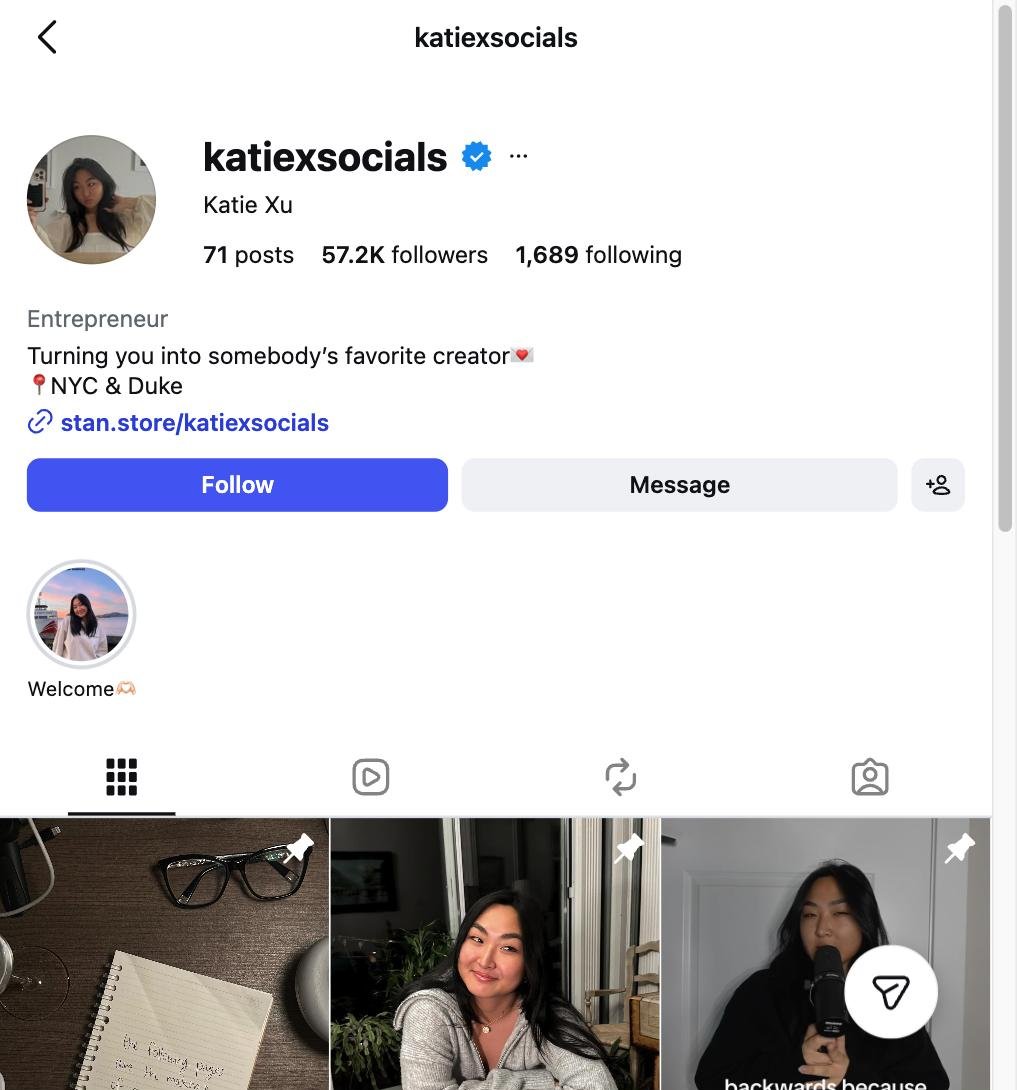
@katiexsocials TikTok, 111.6K · @katiexsocials X · @glosshouseco Instagram, 90
Full background
Katie Xu has made content for about three years, mostly low-effort, unedited yaps. Her first videos to take off came during a gap year from college spent freelancing. She filmed what she was learning with a notebook in frame, and that format alone took her from about 1,000 followers to 30,000. In 2025 she was head of marketing at Cluely, where she built the UGC program to about 750 million views. She’s based in New York (her bio also lists Duke) and has about 57K followers on Instagram and 112K on TikTok. She has guested before: the Cohort 18 Zoom 3 guest, transcribed as “Katie Zoo,” described the same Cluely program and is almost certainly her.
Accounts they pointed at
- CluelyWhere Katie built the UGC program to about 750M views. Handle unconfirmed.
- Alex GarciaCoach; the 3% change and the content funnel.
- Bad HambresColin’s classic story vlog: a couple’s frozen burrito business told through its ups and downs, from an old Taco Bell.
More accounts (5)
- Oren JohnHis Greek Isles vlog with a value twist: why are the Greeks so bad at marketing?
- MirandaCut30 grad’s weekly carousel, “signals I’m paying attention to as a strategist.” Handle unconfirmed.
- “Ricardo” menswearAlex’s top-of-funnel carousel example, “big money vs smart money,” about 25K likes. Name as heard on the call; handle unconfirmed.
- The Collective (Austin)Alex’s former brand as CMO: $5M ARR on organic content only, by his account. Handle unconfirmed.
- Virgil AblohThe designer Alex credits with the 3% rule.
The source
Watch offlineOpen in the Drive app → ⋯ → Make available offline. Streams from johnny’s own Drive copy; if it asks you to sign in, ask him to share it.
Read the full transcript (85 passages, auto-transcribed)
Colin: Good evening, y'all.
Alex: What's up, everybody? Guys, before we – well, people are trickling in, but before we kick this off, you guys are killing it with the content and the formats. It's awesome to see the amount of wins that you guys are having over just the first two weeks. Before even – a lot of times, so many of the wins happen week three in our seven-day challenge that we kind of do at the end, and you guys are absolutely cranking beforehand. So it's amazing to see. Kudos to y'all.
Colin: It is. It is. We got more good homework for you guys this week, too. I don't want to give us too much credit, but I think good homework is helping the cause. I'm excited we got this new stuff in front of you guys to crank. Yeah, I want to drop a link to Katie. Oren's going to be joining us in like six minutes here. He just was meeting with Sam Altman moments ago and had to cut out to get on the call with us. Not actually, I don't think, but he was at a demo day. Our guest tonight, so this is, I guess, our first Zoom of this session with a guest. I think we've mentioned it, but we're going to do some training tonight and then get right into it with Katie, who I just dropped the link to in the chat. She's a fairly legendary strategist as well as a creator herself and always a good chat. And we'll say it again when we get into it, but don't be shy about dropping questions in the chat. with her. It's a not once in a lifetime, but it's a great opportunity to ask questions of, uh, of, of an expert, um, tendril already hitting us with a couple here. Oh, I got you. Good. Yeah. For context, we basically just got super tactical with the homework this time around. Um, we're telling you what videos to make exactly. Um, some of you are doing better better job of following that than others but uh it's leading to a lot more success which is not super surprising so excited for you all to experience that if you haven't already and war of attrition and for anybody that that like hasn't had the win that they want to have yet um a lot of times it comes from taking the the homework and taking the the example that we give you and trying to complicate it like trying to change the like adding an effect in or some transition or the how you position the body of text etc those are the things a lot of times that that can be the differentiator between a video getting a thousand views and ten thousand views and that's actually something we'll talk about briefly in a second but pay attention to exactly what the format is and how it's delivered and i promise you like making you know executing the homework with that same um intention as the the example is will make a big difference so today we are going to people have stopped rolling in so we can get going we are going to cover funnels we're going to look at a couple examples of carousels and vlogs which are our homework this week um and then we're going to get right into things with katie so without further ado alex you got you got a deck for us let's let's
Alex: whoops actually hit yes uh let's jump right into it so
Alex: So two things we're going to be talking about here. First, can you all see my screen or do you see my crazy desktop? Okay, cool. So we're going to be talking about two things, 3% change and funnels. 3% change when we're talking about it relative to content is this idea that you can make an idea completely novel by just shifting 3% of whatever that idea or concept is. This was something that was popularized by a creative director named Virgil Abloh. A lot of the sentiment in this rule was taken really from fashion and we can bring over to anything that's creative. So when we think about videos that show potential and then thinking about how we can change a video that has potential into something that pops, it's really looking at what are these 3% changes that we can make within this content to get it to take off, right? And so a lot of that actually comes down to the data within these videos. you know you hear us talking a lot about like how important a hook is and how important copywriting is and the storytelling frameworks that you guys use to tell your stories all of those actually are like all of the reasons that we we talk about all of those are actually because they map back to specific data that we want you to pay attention to right we want you to pay attention to the script rate we want to pay you to pay attention to the retention graph we want you to pay attention to the average watch time and the share rate and all of these these metrics that Instagram and TikTok give you. And the reason for that is a lot of times you will have a video that has the potential to be a great performing video, but that great performing video is hidden basically in the data showing you like, hey, you just haven't packaged this the best possible way yet.
Alex: This example right here where it shows like three attempts and 3% change is a video early, early when I was making my videos and starting my content that was a perfect example of a concept that as we get into the funnel as well was a bottom of the funnel piece of content that I wasn't packaging it properly for top of funnel presence, top of funnel awareness. And so I'll break down what that means in a second as well. So if you could look at here, you're going to see three basically variations of the same video. You can still scroll deep on my page and find this, But iteration one of this video was me talking about this brand called True Classic. In that video, you can read the title hook. It says the secret to landing pages that convert. When you look at this, if at the time I have a thousand followers, give or take, and I'm trying to talk to the marketing crowd, the content crowd, the growth marketing crowd, the founders, et cetera, me talking about landing pages is extremely niche. It is what we would label as a bottom of the funnel piece of content because the topic is really reserved for a select group of individuals, the people that are CRO experts. And me saying that acronym, there's probably a majority of you that are like, what the hell is a CRO expert? And that's exactly the problem. There's only a specific amount of people that care about conversion rate optimization. So me making a video about the secret to landing pages that convert is a way too specific video for it to have the potential to get 100,000 views, 250,000 views, 500,000 views. The reason for that is there are certain videos that have basically a limited TAM, meaning total addressable market. If you look at like an easy exercise for that, for something like this is like, if you went to LinkedIn today and you, you know, you search via jobs or roles and you put in like conversion rate optimization, and then you compare that to you go into LinkedIn and you search through jobs and you put marketing or content, the number difference is going to be astronomical between those two. Okay. And that is the reasoning for this video, not performing as good as it should have.
Alex: OK, but again, going back to it, iteration number one, the secret to landing pages that convert. The good part of the good part about this video was. No, it didn't reach a shit ton of people, but when I looked at the data, I basically and this is something we talked about, I think, for in week one, it basically had a two to one like to share ratio, meaning for every two likes I was getting about one share. So if this video had, you know, let's call it like 130 likes at the time, it had in that ballpark of like 60 to 80 shares, which is a great metric. So I'm looking at this like, cool, this didn't pop. But obviously, the people that are consuming this video are finding it valuable, like they're extracting information from this, and they're sending it to other people, they're saving it. So looking at that and like the natural, like the, the kind of like marketer in me was like, okay, let's like, let's just iterate again. Let's just try to make it better and see if we can get it to pop. Cause there's obviously value in it.
Alex: So I made a 3% change. My 3% change here was the topic. Really? It was still about true classics, but now I was kind of talking about how true classic turned 3000 into $150 million. But I was talking about their ads. Right. And even in a little bit of like mix of their ads and like their story. Again, when you look at that, and it was a lot about their funnel and stuff. So again, kind of like marketing, two marketing nerd type of content. And so again, I look at the numbers, same thing, roughly 5,000 views. It performed a little bit better. But in the metrics, the backend data still was like two to one. So I'm like, okay, let me take one more stab at this.
Alex: And this is where I was thinking, like, how do I package this where it could talk to multiple audiences that are interested in like one singular thing? But when they when they scan it, they're going to get they're going to get the automatic context to understand what this video is going to be about and what value they're going to extract from that video. Right. So in that second iteration, I took all of the information. Right. Because I could talk about now I could talk about landing pages. I could talk about ads. I could talk about organic content. I could talk about how they upsell their emails. And I just say marketing playbook. That was my 3% change for that third iteration. That third iteration was just me packaging it in a way where the TAM is much larger. Because a creator who's launching his first company could watch this video. He doesn't have to be like really care about marketing, but he cares about his business. So he wants to see how this $150 million brand is building their business. Like what is their marketing playbook? Some founder would be interested in this. Anybody in marketing could be interested in this, right? Anybody in ops could be interested in this. Like anybody within those worlds, like I'm now able to basically place this video in a lot of different categories, a lot of different worlds. And that was the difference in 3,000 views, roughly 5,000 views, roughly 300,000 views. When you watch all of these videos, the information is semi the same. It was just me packaging it and making like these little changes to how the information was packaged and presented. Right. And that's one of the important things that you guys are going to notice with like a lot of the feedback that we give you is, you know, you make it. You may make a video about your product or, you know, within something in your category and you're making it way too niche to the point where you really need to pivot and cast a much wider net with how you talk about these things.
Alex: That's what the content funnel is. And that's what we're about to get into. So the content funnel is understanding that there's really just three buckets of content. There is content to get followers, which is the third iteration of the video that I just showed you. then there's content for your followers which could even be seen as like the second iteration of the video i showed you and then there is content to get your followers to take action it's as simple as like i'm from florida so i'm going to give you guys a fishing analogy here the goal with top of funnel content is content that has the ability to cast the widest net right it's like i i compare it's like commercial fishing like if you're trying to catch as many fish as you can you're not like going and buying a rod and reel you're going to be a commercial fisherman right like you're you're going to try to catch as many fish as humanly possible with the biggest net possible like that is what top of funnel content is and that is the goal of top of top of funnel content and and that's really understanding how like what are the things within your category that have the ability to cast a wide net
Alex: okay middle of funnel content is content for your followers this is the content again if we're going to go i'm going to go deep on this fishing analogy this is fishing with a cast net if you guys know what that is that is a like a 10 8 to 12 foot net you could if you catch like a large pool of fish you could still catch a ton of fish but it's not the same as colin shaking his head at me at these fishing analogies that's because it's an excellent analogy and i still think it's very funny he's just used to fly fishing in portland oregon and catch like a salmon um but that is that is middle of the funnel content and then bottom of funnel content is fishing with a rod and reel right you're trying to catch a specific fish at a specific time you got to use specific bait right like there's so many variables to get somebody to either like get them on your newsletter or get them to buy the product right and so when you understand it through this a lot of the times you could just look at the content and be like, is this content that has the ability to reach a million people? Or is this content that only a thousand people are going to be interested in? Because all I'm talking about is this new feature in my product, right? And that's how versus like this giant problem in the market that you see that's still adjacent to your category. And that's how you're going to start looking at a lot of this content. And this same advice could be applied to every single format that we have you doing, right? Whether it's a one-shot, listicle, essay, comparison, carousels, all of this information stems across that content. And so I'll
Alex: give you another example of, you know, this is a brand example, but all of this can be applied to any of us, which is when I was at the collective, us a CMO there, we grew to 5 million ARR or just via organic content. We never ran a paid ad, but we had a content funnel that we lived by every single week. And it was basically, we had three top of funnel pieces of content going out every single week. We had two middle funnel pieces of content going out every week. And then we had one bottom of the funnel piece of content going out every week.
Alex: Before I dive into the specifics, the thing to understand here and the algorithm wasn't like this back then, but the algorithm's like this now where if somebody, if you publish a piece of content, and this is the importance of top of funnel content and how it actually works in congruency with your middle and bottom of funnel piece of content. If you have a piece of content that goes viral, let's say it gets a million views and naturally shit ton of people engage with that content. Because they engage with that content, you will now show up on their feed even if they don't follow you. meaning you will now show up when they're scrolling through the Reels algo, you'll show up on their explore page, et cetera. That means when you hit a home run, they're now giving you the ability to hit home runs again with people who have already engaged with your content. That is a huge opportunity, right? And so when we think about how all this content is, it works together. It all works like that, where as soon as I get something in front of them and they engage with it, they're going to see more of me. And that's your opportunity, right? Back to the bios and back to what we talked about last week. That's the discovery funnel. This is not a lot of funnels, but this is the content funnel.
Alex: And so again, looking at what we did with collective, we had our three top of funnel pieces. The first one was something that we dropped every single Monday called when the day, you know, we don't talk about archetypes as, as much in cut 30, but we played a lot into like this inspirational aspirational archetype. So all of our top of funnel content was, was inspirational, aspirational with one playing in the entertainment, uh, into an entertainment type archetype. That first one, when the day was what we published on Mondays, which was centered around how somebody, you know, wins the day. It was very motivational. It was very inspirational. Um, it was a series that again was, was made to look at the type of people that would want to be part of the collective um and and you know essentially what would motivate them to to tackle their mondays then the next piece of content which is this this one here in the middle um was called cold hard truth and we would basically take a lot of the members who were creators were influencers were athletes etc and we'd put them in a cold plunge um and we put them in a cold plunge and ask them like rapid fire questions right every single time we and you can kind of look at the metrics on i should have zoomed in like this first one has 10 000 likes uh it had probably two 300 000 views um this one is at the time of screenshot was like at 8 000 something right this this this piece of content as well was getting 200 000 views uh we'd ask them rapid fire questions it was a minute long it was it was made to be funny and this last one was like docu series around a lot of the athletes um and she does have a an arm i don't know why it looks like her arms back like this it doesn't look like she has an arm but um this was like more docuseries around like the builders and the athletes again that we shot with all of these anytime we publish any variation of this content and again this went through rigorous testing anytime we went we published any of this they would get anywhere from 100 to 500 000 views so again we just saw this like we're hyper local You know, we were just trying to grow in Austin. So looking at those numbers, we're like, that is phenomenal for us. That was our top of funnel. We were growing within our area.
Alex: Our middle of funnel content then really focused on education. This content got you into our ecosystem and kind of got you into the door, right? Opening the door to our content. This content was two things. This like podcast that we would do, that was actually more set up for social. It wasn't a fake podcast. was more like a like a little talk show was really around like brand values brand mission like identifying with the type of people that lived here and then this was a lot of like the things that we offered as a facility but positioned in a way where you would understand like if i'm dealing with this excuse me i need to do this right so a lot of specific information and education that was our middle of the funnel right so it was like content to get followers content for our followers hey now the last part is we obviously want you to sign up we're a business like we we got to grow we're going to have this bottom of the funnel piece of content that we that we would always test and like even this like a thousand and eight hundred uh likes on a on a bottom of the funnel piece of content the brand had you know i think at the time 20 30 000 followers this was a phenomenal piece of content we focused on either ambiance amenities offerings uh like vibe, et cetera, but positioning away through the product, which was the facility. That was our funnel, right?
Alex: Now, as you guys go into your content, the mistake we don't want you to make is spending too much time here. And that's a mistake that a lot of you are naturally going to make because a lot of you are going to make content because you want to grow your business, right? Or you want to add people to your newsletter or get people to watch, subscribe to your podcast. So naturally you think you have to just like, you have to push, push, push versus think about pulling, right? You're pulling as like that top of funnel content is meant to pull as many people into your ecosystem, pull as many people into your brand, into your mission and your values and everything that you guys stand for via your content. And once you do that and once you do that to a high level, this shit right here gets so much easier. Like this almost like takes care of itself because so much of like the credibility is built up here. Right. Like me or in calling, like none of us would have the success we have with our content. If we didn't have product versus, you know, or didn't have product versus brand. Colin didn't have his factory breakdowns. I didn't have good content versus bad content. Like those are our top of funnel pieces that we hammered into the oblivion, knowing that was going to do all the pulling for us. So that is understanding the content funnel. That is understanding how to get the most out of the content that you're creating when it's relative to reach, then the people that follow you, and then getting them to take action.
Alex: The other thing I'll add is like majority of you should be looking at this almost as like a 75-25 split. Like 75% of that content, unless you already have like a strong following, should be top of funnel. That other 20% should be middle of funnel. where it's like you do have to make content for the people that follow you. And then that other 5% should be bottom of the funnel where you're testing selling and trying to get people to take some kind of action. I know, Colin, you have something to go over before I dive into carousels. But if you have any questions while Colin goes through that, I can answer any questions relative to the content funnel, relevant to data, relevant to testing, et cetera. Just drop them in the chat and I'll hit them.
Colin: Cool. So we're going to look at a couple examples of each of this week's homeworks being vlog and carousel. This is the week where you do stuff that in many cases you did not think you were going to do at all on your content journey. And Oren's going to cover the exact homework assignments, but we're going to take a look right now at vlogs in particular. We got a bunch of good examples. We've got a couple of questions in the chat about some of these homeworks not applying directly to a niche or what have you. And I think that you will find if you look at this critically, that is almost universally not the case. You have to look beyond what these videos are and look at how they work and what they're storytelling, and then realize that you can drop anything, any story into said thing. So a vlog at its core is typically a bunch of B-roll, occasionally cuts to a speaker, but typically B-roll with voiceover or with textover to tell a story. I'm going to flip through a couple of these really quick to give you guys an idea.
Video: How long does it take to build a brand? The first thing we need to do is craft a brand strategy before we dive into visuals. That's going to back everything we do so that we can express our tone of voice and messaging around our strategy and the product features and benefits in a very specific and dialed way. So with a brand archetype, we have the underlying quadrant. There's four quadrants of exploring spirituality, leaving legacy.
Colin: That is an example of a bunch of talking head cut in with the B-roll. Here is a classic story vlog from our friends at Bad Hombres.
Video: I'm Hank, and eight months ago, I quit my nine-to-five job to start a frozen bean and cheese burrito company with my wife, Sam. After selling 19,000 burritos in our first four months, we felt unstoppable. Then sales dropped fast, but we'd already scaled up. Team, kitchen.
Colin: And this one is an absolute classic, right? It's a bunch of B-roll with a voiceover telling the story, visuals that compliment, but also setting the scene. We'll come back to a note on those kind of story vlogs. And then we've got a bunch of others here as well. Here you've got Oren doing the Greek Isles, but with a value twist.
Video: I'm on a catamaran seeing seven Greek islands in seven days. And today I'm asking, why are the Greeks so bad at marketing? So we've docked in the absolutely insanely beautiful Paros. Like my God fam, this place is excellent. The coffee, the food, the toy store on the hill to bribe my child to go back in the water after his jellyfish stain. And sidebar, look at
Colin: And one other I want to look at before we move on here, and I give you a couple notes, is the listicle, because this one is very non-typical, and I can't get enough of it. This is unorthodox blog footage, but the content is being delivered in the text over the screen, right? Again, this is non-typical, but a really fresh approach at what at the end of the day is just like a text overlay vlog. The things I want to reiterate on, the things I want to really shine light on here are with the story vlog. A lot of folks want to pop in and do a bad ombre style story and just tell this mundane, uninteresting story about like, I quit my job to start a business. We've been there 1000 times, right? If you're going to do these kind of journey stories, which are obviously popular right now, you need to take it up three or four notches. Bad Hombres is really good because they're speaking to an existing community that is burrito people, which apparently, bean and cheese burrito people, which apparently is a thing. And they're always talking about the drama, the ups and downs financially in particular. They're also doing it out of an old Taco Bell, right? There's a lot more here than just like we did a product and now like in here, here's our business, right? There's a lot more layers to these kinds of videos than just the basics. So if you go down that path, make sure to crank it up. The thing I want to call out about Orin's is at the surface level, Orin could have made it like, Hey, I'm in the Greek isles balling out, like check out all these beautiful images, right? That is not the video. Orin flipped it into value to provide some actual value for the viewer and gets a lot more upside out of the video. And that is how you want to approach these things. There are seven different vlogging example homeworks in there for you to work with. Again, you're going to pick one. You don't need to do all seven. You need to do at least one. And then with that, we'll kick it back to Alex to look at a couple of carousels.
Alex: Awesome. I'm going to share my screen. Very similar to what I was talking about a second ago. every carousel could be top of funnel middle funnel or bottom of funnel all about how you position it all about how you package it present it right i'm going to go through a significant amount of examples that were cut 30 grads that they all found their own formats within carousels some examples are not um cut 30 grads but all phenomenal examples of carousels and how to tell a a phenomenal story within essentially a swipe speak on sequence i can't say that word um All right, let me. You guys can see my screen. You can see Miranda. Cool. So let's swipe through this. So this is no different than like we talk about, and we'll talk about this ongoing, a signature series, right? This is a series that Miranda is doing as a creative strategist where she is taking signals I'm paying attention to as a strategist from the brand side. Okay, something as simple as she is doing every single week, and she's basically curating these different signals from conversations. The cool thing that I like about this is it's just a different type of carousel from a design perspective, right? Where the typicals video or a photo and then text overlay, nothing wrong with that. But she basically kind of took this this format that shows, you know, her photo. Sorry, that shows her in like the meetings and then has this clean overlay. So signals I'm paying I'm paying attention to as a strategist. And then it's a little bit more almost like editorial, like when it comes to when it comes to the information in the. So like here's what's interesting about this. This is very like social native, which works because you can look at this first this first line and be like, let me make it as native as possible. So it feels like a piece of content you'd want to scroll through or sorry, swipe through. And then let me clean my act up a little bit. You know what I'm saying? Like, let me present it a little bit different. A great example of this is like all the luxury fashion brands. And they show like an opening clip with a Snapchat filter that's like, what is bro doing? And then all of a sudden it goes to like something beautiful cinema and cinematic. It's like you're kind of doing like this bait and switch a little bit with something very native, very good information that's very polished. But she is just taking all the different signals that she kind of looks at throughout the week as a strategist and curates them here in very relevant information to her audience. Okay.
Alex: So let's go to – is it changing to now big money versus smart money? You all see that? Yep. Okay, beautiful.
Alex: This is one that I found from this brand called, I think, like Ricardo. Some of Ricardo's clothing, home of classy menswear. This is a great example of taking a very, very top of funnel approach as a brand. Right. Big money versus smart money. OK. And actually, I love this. They do this carousel very, very often. And it absolutely rips. This is what I mean by it being top of funnel. This has 25,000 likes. probably in anywhere from like 400 to 600,000 total views on this carousel. But big money versus smart money is just this comparison of like, okay, you can either spend $10,000 on a private jet, or you could spend $1,500 on business class. You can spend $5,000 on their shirt. And this is relative to their product as well. You know what I'm saying? So this is all about packaging and positioning. Or you could spend $60 on their shirt. Richard Milley, I don't know how much, what is it, like $500,000 versus the C-Star that is $900, right? And it's just these clever comparisons where they naturally kind of plug in their product, these Travis Scott Nikes versus their shoes. And they do this with a lot of their, and again, they do a lot of very good carousels. And I'm actually going to break this down real fast. But that one that we just looked at is top of funnel, okay? how to dress as an example old old money date outfits how to dress like a man weekly is more middle of funnel um and then these like sexy but simple outfits is bottom of the funnel because they're selling their product does that make sense of like smart money versus old money smart or old rich money versus smart money or whatever the the it was top of funnel super wide net 25 000 likes middle of funnel i'm now going to educate you on how to dress like a man weekly this is what you're going to wear monday old money date outfits etc all curating um um specific outfits but from an educational pov and then like legit just selling right that's middle top funnel middle funnel bottom funnel great this is brand is doing a great example of or is a great example of like how you can kind of run this this gauntlet via via carousels um
Alex: this is a cut 30 grad world building content references I saved this week, very similar vein as Miranda, just from a different POV from of world building, right? World building references I saved this week, and then just referencing the brand and then a little like a little just blurb of what's educational or clever about that. The other one that I have, or sorry, I have a few more actually, but in my notes, I want to pull up. so that's the same one yo wrap after this one just because we got uh we got katie and it's okay
Alex: another easy one things i learned it while being a creative director and i'm gonna just give an example of like it being top of funnel versus bottom funnel things i learned while being a creative director is is very broad right it allows it to get engagement like this versus if i say how to use lighting to elevate a mood as a creative director that's very niche right and so again just very easy ways of of using uh carousels to tackle top of funnel middle funnel bottom of funnel we have something that's going to show you exactly how to do so but i'll wrap so we can we can hit katie calling if you want to hit the intro for for katie or uncover homework for us real quick
Oren: All right, perfect. So this week we are going to be doing a vlog and a carousel. And we'll talk about a little more from there. We're going to have you do the vlog first. Quick note that in the curriculum, it does say carousel first, but we're actually updating the carousel video. We'll have that up in the next day or so. But we want you to do one of these. So carousel in the styles we have, and they're all broken down there. And vlog, I would crack the vlog first, just because that's usually a little bit harder for people to kind of get the idea, actually go film some content. I would tackle that. If you get through those two, we'd like you to start thinking about upping your volume. We've only been doing obviously like two posts a week here. We want you to start getting into about four this week if you are able to get through those two. If you're still catching up or you have a problem, you're really working hard to get through these two, totally fine. But if you breeze through it, start thinking about, hey, how can I post more? You start doing whatever content you want. You can look at the examples from Colin's video database. And this is prep for what we're going to do next week where we start getting into the seven-day challenge. We end Cut30 with doing seven posts in seven days. And so we'll talk more about that next week, but we want you to start getting that volume up so you can begin thinking through what that looks like. Without further ado, Colin, I'll let you get into Katie.
Colin: All right, guys, I just dropped a link to Katie in the chat. I'm excited to have Katie because, like I said, she is kind of the epitome of a get inspired and let it rip creator and is also the strategist behind, like Katie, correct me if I'm wrong, behind Cluey's video content attack, which is, I think, legendary at this point. and certainly more that we don't know about. Katie, can you give us an intro? And we're excited to have you here.
Katie: Yeah. Hi, everyone. It's great to be back. And great. Love sitting in on these lessons. I always learn so much. Yeah, I've been making content for like probably three years now. My content is very kind of like lower effort, fully like yap style stuff. So I don't go super deep into like editing things. I really am kind of on this, like, like just tapped into like my, my energy of like, what do I want to talk about in this moment? And then like executing on it in that moment and then posting it. And then more professionally last year, I was at Cluey, I was their head of marketing and built their like UGC program up to like 750 million views. And then this year started my own UGC agency. So we run campaigns for like consumer brands and we've generated over 1.5 billion views for our clients.
Colin: Yeah. Yeah. I don't know if we have any of the software bros in this session or on this Zoom, if you are. Lock in, brothers. Talk to us. the first video I saw from you was a classic prop app. I think you were like one of the, maybe we'd say innovators of the prop app with your notebook. Um, talk to us about like the, your, your initial smashes and, and really like how you use that notebook. Uh, I think that shit was art honestly. Um, and obviously it's getting a little dated now, but it's, it's still running rampant. Talk to us.
Katie: Yeah. So, um, yeah, like my very first kind of pieces of content that took off were when I was on a gap year from college, kind of just pursuing entrepreneurship and freelancing and just like making my first like few dollars ever. And like, I was just like documenting that entire journey. And like, every time I would step in a new room and I would get so inspired, I would write down like what I learned from being in that room and share it online. So I would like have my notebook in hand. I would be like, I would show the notebook at the beginning of the frame and be like, here's everything I learned. Then I would just like read off that, those thoughts. And I think like, um, like I do think the like technicalities, like having the notebook in frame and all of that is actually strategic in some ways because it shows you like, it shows the audience. Oh, I've thought this through. There's like a lot of authentic thoughts that I've had. I'm not like reading from a random chat to BT generated script or anything. But beyond that, I think the core of like why those videos did well and why I was able to like take, I think I went from like my first 1000 followers to my first like 30,000 followers through just that like notebook format is because like genuinely the thoughts and like lessons that I was learning came from me and my experiences. I think a lot of the times like we look externally to our For You pages and our explore pages to think like what's going viral right now and how can I say that same thing in my viral way. And I try to kind of take the opposite approach of like not really taking too much input from external sources and like other creators and stuff. And I really just try to like speak from my own experiences and contribute to the conversation in like the way that I am able to through whatever I've noticed or experienced in my life.
Colin: I know that like you, at least we've talked about in the past, how you like take an idea while it's hot specifically and just run with it. Can you talk to us about your, I guess, idea generation process or lack thereof? Yeah. And how you run.
Katie: Yeah. So I don't like to overthink it. And the thing is, I think like everyone has their own strategies. You kind of need to figure out what's, what you are best at. Cause I have a lot of creator friends who do plan out every single video and they're really good at like strategizing and making that video, like a super viral video. But for my personal content, my goal is to really connect with my audience and just build a community of people that are like excited about the same things that I'm excited about. So, um, when I make content, it, it very much relies on me being in a state of like excitement and curiosity. Um, and so like, if I am having a random conversation one day and I learned, I like come to a realization during that conversation, um, I will immediately try to capture that energy and share it and relay it to my audience in a, like a very simple video. So I'll just like go on Tik TOK. I think Tik TOK's the best app for filming these types of videos compared to your camera roll because on TikTok you can like kind of start and stop the video every time you want to say something new or like you need some time to think whereas on your camera roll you have to like film the entire clip all at once um so I'll go on TikTok and I'll just like truly speak as if I'm like on FaceTime with a friend like when I first started making content and like kind of learning how to do it I would literally FaceTime a friend first and like tell them like hey like here's what I kind of want to talk about and I would like practice with them because when there is another person receiving what you want to say you're much better at like articulating it than when it's just a camera until you kind of get used to that.
Colin: I feel like the the energy I don't know there's some trope about how you need to take your energy up two notches because the camera will filter out XYZ and it is oft overlooked. I'm really curious about what's going on with UGC these days and how you're looking at it. I know this becomes a game of like detecting trends and then briefing it and like replicating it. Like, I don't like, what are you doing on the UGC front? What are you briefing clients on what's working?
Katie: Yeah. So like, I guess some context on the type of UGC that I'm operating, like we do very like high volume UGC. So we're hiring, every creator we hire is making a brand new account for the client and product and posting like twice a day on that product, like about that products. And we can do up to like 10,000, 20,000 videos a month. So it's very high volume. And I would say like, to me, when it comes to content, like all things come down to yapping, like, as I've already talked about, like the creators that I look for and the creators that I source and the creators that perform the best, just know how to yap to the camera and know how to relate. Like a lot, we hire a lot of like female creators, a lot of like, just like people that can really, yeah, like amp up their energy and be very relatable and, um, like be very personable. Like they're not talking to a blank wall. They're not reading from a script. They're like genuinely, it's almost like this skill of acting, um, in my opinion of like genuinely being able to like, feel like you're a part of that conversation. Um, I think that's the most effective, like marketing content skill that somebody can have regardless of what the trends and what's working at the moment. But then in terms of like UGC, like I think the best way to do it is to find like viral formats that can be like scaled specifically for like whatever product you have. So a lot of our formats are kind of like skits. I think one very underrated format is like couples skits and having couples make videos together and and like curate the story where like you know one of them gets mad at the other one over some product or whatever like there's so much more you can do when there's two people on on screen too you know
Colin: something I want to call out for I know we got a lot of like agency services and stuff in here your uh I'm fired up is like coming off of a client call or something, right? Like I've always found like you're talking to someone, you're just spitting game, you're giving them your opinion, you're telling them why their idea sucked and they should do this other thing instead. And you hang up the call and like, there it is. Like the passion's there, the idea's there. That's a really good place to harness that.
Katie: Yes, no, I was just to elaborate. Like I think something I'm like genuinely just so passionate about is I feel like everyone has like a place on social media and everyone can build their brand. They just have to figure out like what their strengths are, what their story is, what they are passionate about. And so like anytime I talk to literally anyone in real life who's ever considered content, but they're afraid of it, I get so fired up. And that's when I like translate that energy into my videos. And so when you are thinking about that for yourself, like think about like what you're passionate about, what you like tend to influence your friends to do. Like if your friend comes to you all like, you know, upset or whatever, like what are you telling them to do? What are you passionate about? And like take that energy and put it online.
Colin: It's, it's excellent. It's like even people that are like, like not outgoing, shy, nerdy per se, like, like maybe it's Dungeons and Dragons, but like, it's in there. Like you've got the thing that like you will, will go off the rocker on. And that energy is, is toxic, not toxic. I don't know. You get the idea. Somebody asked, what is the name of your agency? I want to drop that in the chat. Elaine asked.
Katie: The name is Gloss House. I'll type it. We don't have a website or anything.
Colin: Oh, right, right.
Katie: Yeah, we're operating kind of offline. But yeah, we have an Instagram and an X account. I'm going to link that.
Colin: Is this 100,000 followers?
Katie: No, that's a different Gloss House.
Colin: Never mind. All right. We're derailed. um what are so like yapping i don't know i'm curious what is working for you on the app front right now um obviously we saw like i would say the rise of yapping like probably six months ago it was all the rage um it's it's certainly cooled off i think more more than anything like there's got to be a little bit more than just like look it's me talking at the camera like how are you seeing creators like escalate things um these days besides like the notebook etc what are some tactics or trends yeah
Katie: i would say yeah there's definitely been a rise in in yapping um which has been fun to see um I think to me it just comes down to like saying things of substance um and I think something that I've been thinking about lately like I I guess this isn't a trend but this is like just my own take is like, I think from like the way that I approach making content is less about like, what can I make right now that's going to get me the most views? And instead, I think more about like, what can I make that will resonate with the most people or not even necessarily the most amount of people, but resonate like deepest with the right people that I want to resonate with. Because if you were to like, think about like what gets the most views, based on my experience with like the UGC agency and the things that we market, because for those, obviously our goal is to go viral. The things that are going to get the most views are the things that like fundamentally like hit on a core human desire and core human desires are like love sex like I guess food or like health um stuff like that are like core to like belonging um stuff like that those are core human desires and when you make content about those topics like they just tend like that you are now mass appealing to like a wide audience, which can work like if that's your goal. But I think at least for me, my goal is to like have a really strong audience, a really like dedicated audience, like kind of the like 1000 true fans type of thing. And so when I think about like what I want to yap about, it's more about like, what could I say that hasn't been said before, or like isn't as talked about, in which if I were to say it, other people would be like, yeah, I've been thinking the same thing, but like no one's ever saying, like no one's ever put that into words, you know? Yeah. And so my goal, at least with yapping, is to like just resonate and like say things that I feel like aren't being said.
Alex: So much of UGC as well is looking at, like almost like developing the formats that are going to be relevant in culture, right? Like you guys always have to be ahead of the curve and almost like setting the curve. What are some of the formats that you guys are looking at now? starting to test with creators um what's what's kind of popping that hasn't popped in culture yet
Coach: the partner the relationship the two the sorry go ahead
Katie: yeah no that i i actually do think like that um is kind of like people haven't caught on to that quite yet but that is something that gets us so many like we have some couples like skits and videos that um can get upwards of like 20 million views so it's insane I think that's like a very untapped um format and like what the format is is basically if you were to look at like like look up any couples accounts like just any normal couples accounts on TikTok like there are a lot of couples that do like it's like couples videos but like they're kind of you can tell they're kind of like um planned like they're not fully organic videos and um those formats do so well because it's a core human desire right to like like have love and relationships and stuff like that um and you can easily like remake those videos with a real couple or actors or whatever and like place products within it um and like kind of see them in or like have them like arguing about it or whatever so yeah that's like very untapped
Colin: sorry to put you on the spot do you mind showing us one and like walking through kind of like the anatomy of how you guys make it brief it and it gets shot
Katie: yeah um i can here let me find an example
Coach: and guys while well katie does that drop any questions that you guys want us to to run through um aiden earlier was asking about how to adapt like some of the homework to like learning a language and uh aiden i don't have the idea exactly for you but like using a relationship dynamics to play with like language learning language do you understand did you miss the did you miss the memo entirely right like um uh like all of these core emotions um like really adapt across anything if you if you kind of like look at it with the right eye i wish i had a good example there but i think there's a ton there relationships and language and communication whole world questions here yes i'm starting to pop in okay did you have any thoughts on ai you you see this is a question from jeff i would love to get your take on
Katie: yeah i mean i think it's definitely getting there um i i think like it i think it's still like kind of obvious i think actually i've heard i feel like i've heard some people using it like for like i don't know this is kind of like sad to me but um i think like older generations maybe don't know the difference as well but obviously i think if you're more native to tiktok and instagram you can still tell to a degree usually um i've seen it work for like a few different apps and i think it certainly can in the future i don't think that the cost of like a real creator is so insanely like high that um it's not worth like trying right now
Coach: real yeah yeah yeah okay cheating or just
Katie: Okay, I can here I can share my screen and just like show you guys. One of these videos.
Colin: Is it going to let you?
Katie: This one is like one of the 20 million viewed ones. The integration is not like super intense. I think you can get a lot more intense with the integration for products. And when you do, the views tend to be a little bit lower. But this is literally it just like feels like any other.
Colin: Is it going to let you share? um and now you can just drop the link in the in the chat and one of us can share it
Katie: yeah yeah let me try that um
Alex: as we collectively do you want to hit it calm or you want me to
Colin: all right if i got it i'll pull it up
Alex: you got it all right all right you got it yeah geez prolific stats sitting on this thing go ahead all right
Colin: all right i'm gonna play this and then katie you just tell me you want to pause if you want to break something down right
Video: Liking another girl's Instagram story? Disrespectful. But like you're liking it. Yeah. Like you like what you see. Oh, that's not something I'm like, I'm just liking it's funny. It's a stupid story. I'm just liking it's funny. Buying another girl her like Aritzia shopping cart. That's cheating. Disrespectful. Oh, just disrespectful. Yeah. I mean, buy my Alixia shopping cart though. Yeah, 'cause I can just buy you stuff off Duke. Right. What is that? It's way cheaper. I don't want to spend my money on your Alixia cart. But you would buy it at other places. Why don't you just get the other places? That's a hypothetical question. Right, okay. Just buyyourstuffoffdupe.com What is that? I'll just show you later. Giving a girl a ride home. That's disrespectful, I guess. I do. I don't really know how. I don't really, yeah, I don't think that was either. Hey, you want me to show you the truth thing? Yeah. So I'm looking at some leggings from Aritzia, and it's literally way too expensive. So all I have to do is just hold down that image and then press copy. And then I just go to duped.com, and I just paste the link from the image. And press enter. And now that I've searched it, I can see all of these leggings that are very similar and way cheaper. Okay, cheating or disrespected?
Colin: That was legendary.
Alex: That was so good, yeah. Tell us about it.
Katie: yeah yeah honestly i think like the format to me it speaks for itself like um it's very visual you kind of know exactly what's going on you can find so many couples formats like this that are like them playing random games um and like there's there's obviously a lot of like rage bait like a lot of the guy making the girl mad and the comments will obviously be about you know how the guy sucks or how disrespectful he was being or maybe someone's on his side like it's very polarizing um and the integration is very subtle very like just very like at the end kind of thing But I think, yeah, this is just like a way to, I think of the strategy more as like a billboard strategy. Like it's not super specific to the product, but to get 20 million impressions on a website like that is still very useful.
Colin: It's ridiculous.
Alex: I also think it's so key. Sorry, it's so key. Like at first, like the product, the integration was like so natural, right? like, you know, like what is do, you know, and you, it's like a quick explanation. And then the product breakdown isn't even really until the end, end of the video after somebody is like fully committed to, to watching it versus like so many of us will make the mistake of trying to put it in like the first eight seconds of the video versus making it like you have to watch this video. It's such a good format. And then at the end, I will get you to, to see the product immigration. Is that how you guys kind of think about it?
Katie: I think it's a trade-off. So it goes both ways. Like definitely not everyone stays till the end of the video. So it's like, but at the same time, like if it was any earlier, like it wouldn't have gotten 20 million views. So it's kind of a decision of like, like would you rather have 3 million people of the 20 million see the demo or would you rather have 100,000 see the video itself? So it kind of depends on what you want. And sometimes the lower viewed videos are the ones that convert better. So it's not like always like the more viral, the better.
Colin: I also just want to call out like the use of just like such a basic prop of like the glasses and then they're filling them. And there's something weird with your brain where it's like it's going up and is it going to get all the way up, right? Like it's just like so basic and rudimentary. but that video doesn't do however many views it was without like the glasses in play. And then that being a part of the, of what's going on there.
Coach: We had a couple of questions here. I want to hit before we're done. Sean asked, what data do you look at before repurposing a piece of content into new formats? We were talking a lot in here earlier about shares. Curious your take.
Katie: Yeah, I would say it differs from like a UGC business perspective versus a personal perspective. From the personal perspective, I care a lot about comment sections and like what people are saying in the comments. If they like really resonate, really relate. Because for somebody to comment on your video, like that's like think about how often you comment. At least personally, I very rarely comment on a video. So if you're getting a lot of comments and a lot of people resonating with you, I think that's like really strong indication that if you talk about it again, you will attract more people that also relate and that there are people out there that do relate. I think that's like, to me, what matters the most for like personal branding.
Katie: And then for UGC, it's so interesting, like to see it is such a like power law curve of what formats go viral every single time it is tried. Like there are some formats we will try it a hundred times and it never does well. There are some formats when you try it 10 times, all 10 times it hits at least 100,000 views. And so I wouldn't like, there's not like a specific metric or like likes, comments or shares that tell you that information. It's really like, it just has to, the whole format just has to make sense. And like the one that I just showed you guys, like that format you will see like has been recreated so many times by that account by other creators and it hits every time and it's just all of the components of the video have to make sense there's suspense there's visuals there's a lot of controversy that can be talked about in the comment sections I think that's like actually one perspective that I really like when it comes to content both for personal and for business UGC is like can your video incite any sort of discussion like if your video is just talking about like one random thing that like no one really cares about no one's going to talk about it no one's going to comment if your video can incite just any type of discussion whether it's should you break up with this guy or is he low-key in the right like any kind of discussion like that or if you're like more professional if you're if you're like in the like golfing like niche or something like what discussions are happening in golf right now and what kind of discussion can you insight or like start what kind of conversation can you have with the other golf enthusiasts to get them to like comment and be a part of your community
Coach: and i would share to that that applies to like basically basically anything and people were always like oh how does this apply to me it's like okay interior designs what are couples choosing in their house what do they argue about that's in there if you are doing um if you're in business it's like what are people making decisions on inside those meetings or like what are competitors doing uh so like it definitely applies to everything. Don't hear those kinds of things and like block it out. Like, I don't make that kind of content. It works across all these niches. It really comes down to what you mentioned. What are those common questions? What are those arguments? What do people talk about every day inside your niche? Yeah, we got a tactical one that I want to hit really quick here. Sorry, Katie, but Oseel asked, why did you go from adding titles with nice font to your thumbnails to more raw and without it more recently?
Katie: Yeah, I wouldn't say I have a good answer. I think the raw videos are videos I film directly on TikTok and the ones with fancy aesthetic titles are the ones that I film on my camera and post directly to Instagram. So they're kind of a different style. I would say like if I were optimizing for growth, I would on Instagram, I specifically, I would probably go back to adding titles and being a bit fancier. I'm just not really in that phase right now. And I think like for me, a lot of my creative process starts on TikTok and It starts kind of how I discussed it earlier, where I just like wait for the energy a little bit, wait for the ideas to come. And so I kind of have to do the raw version first. And if the idea is good, if I see it resonating, then I might make a fancier title version. And right now I'm just kind of in the like raw, raw idea phase. So, yeah.
Coach: I think classically an example of like, it's easy to overthink this stuff. You need to just make the video. I want one last thing for you because there's like three questions around this. With your agency, with UGC, can you just clarify for folks? You did say 10,000 videos. That did not mean Katie recording 10,000 videos. That means Katie's agency's creators. Can you just give people a little rundown on that if they're not familiar?
Katie: Yes. We hire like we have over probably 200 creators posting like every day for different brands, making different accounts for different brands and stuff. So yeah, it is a huge, I don't know, contraption, but it is not me making the videos. I don't make the UGC. I just run it. And we have strategists and coaches that review every video and stuff like that.
Colin: All right, guys. I just dropped a link to Katie's Instagram in the chat. If you need some help with UGC, hit her up. Katie, thank you so much for joining us. A pleasure as always. You got anything else to plug before we call tonight?
Katie: Not really. Thanks so much for having me.
Colin: Awesome. All right, y'all. Homework is carousel and vlog, and we will see you in Slack. Thanks again, Katie.
Coach: Thanks, Katie.
Katie: See you guys.