Cohort 24, week 4. Guest session recorded 26 August 2026.
How Briar Cochran builds a creator’s format: archetype first, then seven formats for four weeks
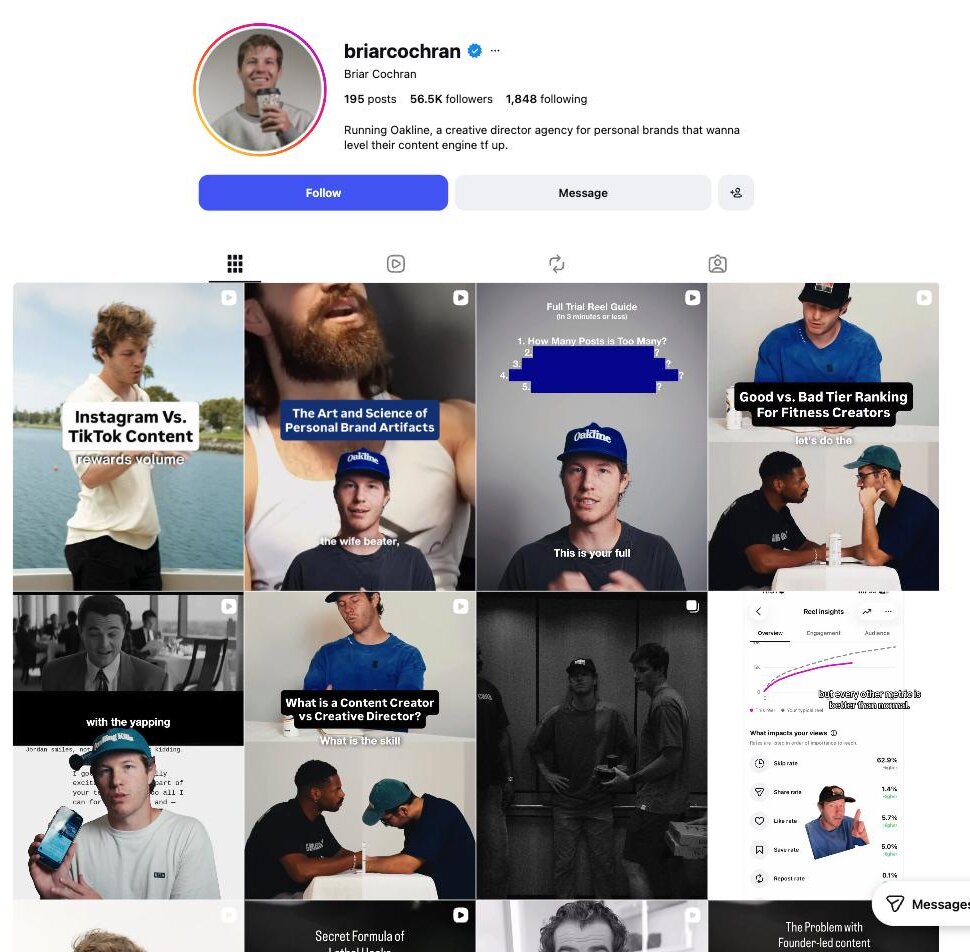 Briar Cochran of Oakline, in conversation with the Cut30 coaches
The one idea
What kind of account is this?
More context
A founder-led personal brand, an influencer, a creator with a business behind it, a business that wants to start talking, or a podcast/newsletter funnel each has a different north star, and the metric, the format test, and the review cadence all fall out of that answer. We tend to pitch formats to clients. Briar pitches an archetype, then a bounded test with dates on it. That is also how he gets a slow, committee-run client to say yes to testing. Briar Cochran is a strategist who talks like an operator: sort the creator into an archetype, reverse-engineer the goal, then test seven formats a week for four weeks and double down on the two or three that win. He is blunt about the failure modes he sees in clients (one-format accounts that collapse when copied, niche swaps that kill non-follower reach, viral-broad content that never converts) and about getting committee-run businesses to test at all: a 90-day window, named KPIs, fixed review dates. Around him the coaches close Cohort 24 with ‘finding your format’, series in seasons, and the calendar they hold back until the last week. Below: his method, who he points to, and what we could run with it on our own clients.
I think your first 50K comes from a good counter position. It’s just being unique. Once I started to get a little bit of money, I was like, I literally can’t get a nice car because it will ruin the brand. Keep the world building dialed.
What this means for our clients
Read against the current client list. Check the dates before acting on one.
Write the 90-day test into the unsent SOW
- Founder-led archetype: name the north star (authority and inbound for Vos, not follower count) before the Sept videos go up
- Run a 7×4-lite: three formats rotating across the 3×/week cadence for the first month, cut from the biweekly directed sessions, then double down
- Put a monthly pillar review and a day-90 read in the SOW so approvals stop being per-video
Q-012 is drafted with a 3-month initial term and unsent; the ‘bad days’ video Dom and Robyn both called authentic is Briar’s meeting-voice principle already working.
Add non-follower reach to the report before Allie’s persona shift
- @thisdermsays is layering a fashion/travel persona onto a derm account: track non-follower % per video and hold the 70–90 line
- Four faces (Ellen, Allie, Ally, Jennifer) is the Darkroom model on a clinic; name it as a strategy, not a scheduling accident
- Marmur’s realistic-filter, luxe-stock edit standard is a visual counter-position against green-screen med-aesthetics; say so in the 90-day review
A live $7.5K/mo retainer with a monthly report pattern and a talent who asked for coaching: the gauge and the framing slot straight in.
Turn the monthly report into a pillar-vs-pillar review
- August closed at 65.7K organic; add Briar’s comparison layer: each pillar against the others and against last month
- ‘Let’s Simplify’ and stitches are formats under test; hold judgment until each has run four to six times
- Blanket collab consent (+1–2 KOL collabs a week) is how @thevoscollection gets many faces on a brand page without key-man risk
The report distro is now SOP and a new series just started; a 90-day read is the natural next line in it.
Answer Tat’s editing-outsourcing ask as a 90-day test
- Propose four pillars, saves/shares/views reviewed monthly, and a day-90 plan instead of an hourly editor rate
- Weekly one-liner update (done / in your court / blocked / next) as the deliverable rhythm Alex describes
- The Oct 2/3 Gustavo shoot banks the footage for the first format grid
Tat asked what it would cost to spare an editor for ‘social all the time’ with 85% of TSO content made in-house; a symphony decides by committee, and this is the structure Briar uses to get one to test.
Non-follower reach is a pivot gauge, not a health score
Briar’s 70–90% line is a growth creator’s number. A clinic or an orchestra may run a deliberately follower-heavy account (patients, subscribers) where 50% non-follower reach is fine. Use the metric to watch a persona or niche change; don’t import the thresholds as pass/fail.
‘I won’t work with them if they don’t test’ is a solo strategist’s bargaining chip
JI’s institutional clients (TSO, Metcalf, CMPA, a regulated clinic network) operate by committee for legal and brand reasons, and green screen with an on-screen citation is a legitimate vehicle in medical content even if Briar would drop it in brand marketing. Take the structure (90 days, KPIs, review dates), skip the ultimatum.
The tactics
Sort the account into an archetype before anything else
Founder-led brand, influencer, creator-operator, operator-creator, or podcaster: each has a different north star, and the strategy is reverse-engineered from it.
His five buckets: founder-led personal brands (the goal is authority and business, not raw growth); influencers who just want to grow and get brand deals; creator-operators, who are creators first with a business behind them (most of the room); operator-creators like a dentist or a local HVAC company, business first, now making content; and the podcaster/newsletter type moving people between platforms. Same person, different bucket, different plan. Following an influencer playbook while trying to sell an info product is his example of the mismatch.
· · ·
Coach: no just two just just personal brand creator and brand business
Briar: but exactly falls in line right yeah right and yeah there's like subcategories of that because like on personal brand some of you are just going straight for growth and some of you would want to go for monetization and more revenue and so you've got to start with the north star in mind and then reverse engineer the strategy from there because like if you're following like an influencer strategy you're an idiot if you're trying to like launch an info product like that's just like a pretty rough combination there so that's where i start in my pain
Colin: yo uh you just mentioned i can't remember what you just said but or and i were talking the other day about how in a lot of ways like brand, brand accounts are dead, um, because they've become so personality driven. That's probably an overstatement. Right. But I'm just curious what you're like, what you're seeing on the brand side as it is becoming personal, like it's face driven, um, on brands and businesses now. And it sounds like that's, that aligns with what you are just saying, where, where it's like about the creator, uh, even if their primary gig is being the operator, so on and so forth.
· · ·
His yap voice is his client-meeting voice
The notebook format had zero thought behind it; what worked was that he already talked that way in meetings.
Briar was tired of memorizing scripts, so he put a pen and pad in front of him and recorded. The read on why it hit and why copycats couldn’t replicate it comes from Alex, not Briar: in Alex’s words, the jokes, the ‘did that land? no? moving on’ are exactly how Briar runs a client call — he brought over something he was already doing. By accident Briar also ran TikTok like a YouTube channel (first 20 videos averaged eight to nine minutes) in a feed full of fast, cringe content, and the contrast did the rest.
· · ·
Briar: no thought i was like i'm tired of trying to memorize a script i'm just gonna fucking like put it right here in front of me and just record this video and then it looks kind of like i have authority or something because i have like a pen and paper but there's no no zero thought
Alex: and i want to stress that this is like the way briar would talk in his yaps is how he would talk with meetings with clients where he'd be like ah and then like talk and like that's how his yap was and that's why it works so well like people would try to replicate it's like well you don't understand like that's just how briar is you know what i mean like he like he says those jokes in his in his in the meetings and then he'll like like did that land no it didn't okay moving on like that's just how bryer is like legitimately in real life situations and it works so well because he literally just brought something over that he was already doing
Briar: and just what's also what's also interesting about this is my first 20 videos on tiktok which is what really like blew up i think they averaged eight to nine minutes long so you know we talked about finding a format that's unique to you i was basically treating TikTok on accident as like a YouTube channel and people resonating because everybody was used to like basically like cringe content that was like super fast over on, on TikTok and just kind of flipped it. But yeah, to prove you guys point.
· · ·
Seven formats, four weeks, then compound the winners
Test seven formats Monday to Sunday, repeat the grid for four weeks, and come out with two or three formats to rip.
Week one is seven formats; weeks two to four repeat them, so every Monday is the same format four times. One idea travels across formats (five great dog foods as a carousel, then a one-shot, then green screen, weeks apart) so you are testing the format, not just the topic. After a month you have winners; then a 70/30 rule: 70% of posting hits the proven formats, 30% keeps testing. When something wins, untangle whether it was the format or the topic by running them separately the next week. The coaches back this with their own floor: four to six attempts before you judge a format or series at all.
· · ·
Oren: yeah and then just quick note on that too like that's just like how do you prove expertise when when the people that uh are like the people that run the company work on linkedin they talk on linkedin all the time they don't want to talk on the main account they don't want to be about them it's like okay how well who best represents us as a creator first agency creators and let's get them to talk about their expertise and then get people to ask questions. And what's funny is like, we don't even, there's no call to actions. There's no any of that, but the website lead form just absolutely bangs. And like Alex knows that too, right? You just, you make the content about it and you give people the opportunity and they will. And so I'm curious, so you, you were doing, working with that client, they kind of, you know, you brought up that idea. What, what, what are some first pieces of content that, you know, you're diving into with them or, or you recommend for people to get started with, with talking in particular?
Briar: Yeah, so we take a seven by four format strategy. So for right off the rip, we're going to try to test seven formats Monday through Sunday. And then we're going to repeat them week two, repeat them week three, repeat them week four. And it's going to be Monday, Monday, Monday, Monday, Tuesday, Tuesday, Tuesday, Tuesday. And basically how this call started, we are trying to find two to three winning formats that we can start ripping. Right now, there's key topics, right? There's ideas or unique value propositions that are inside of these brain. And we do this for personal brands too, right? So if I have work with a person, it's going to be the exact same thing most of the time. Trying to find that format. And then we just combine formats with idea, okay? Intellectual property with social native format. Test, test, test, test, test, test, test. You have winners a month later, compound on the winners. Make sure you have a 70-20 rule where you're still, or 70-30 rule where you're still hitting the winners. Keep testing for the 30. And that's like just the simplest way to just run a blueprint up to the moon. But that's the first thing is we try to, We have like a kind of a format swipe file. You guys have a format swipe file, I think. Hoax swipe file. Is there a format swipe file on this thing?
Coach: Yeah. Sure. Something.
· · ·
Alex’s answer: get a committee to test with a timeline, KPIs and review dates
Asked how to break through businesses that run by committee, Briar’s own answer was one blunt line; Alex followed with the structure that actually gets a yes.
Oren relayed a question about businesses that run on an old marketing model and decide by committee. Briar’s answer was one sentence: he tells them he won’t work with them if they won’t test. It’s Alex who lays out the structure that gets a yes: 90 days, a pillar system of four content types, metrics named up front (saves, shares, views), a monthly comparison of pillars against each other and against last month, and a day-90 look-back that writes the next plan. It removes the open-ended argument about every single post. Alex adds the rhythm in between: a weekly note (done, in your court, blocked, next) and the same analytics every month until they stop opening the email.
· · ·
Coach: yeah you yell yeah yeah
Alex: we deal with this all the time right like a it's that it's like if you you have to test this or you're gonna keep not hitting your goals that's like number one you want to keep failing or do want to win. And if you want to win, then you need to suggest a timeline, a set of KPIs. So we will basically do the same thing we did in Cut30. Okay, you have 90 days. We have a pillar system. These are your four types of content that we're going to test. We're going to review these metrics, saves, shares, views, et cetera, every month. We're going to compare the pillars against each other. We're going to compare the pillars over month over month and the account overall month over month. At the end of 90 days that you're going to give us, we're going to look back over that 90 and be like, what worked and didn't? Are we reaching the goals that we thought? And then we're going to create a plan for the next one. But you have to get, you know, as soon as you start being like, these are the metrics we measure. This is how long we have to test to do this. And here's when our review dates are. So you're not have a bunch of open-ended questions about every piece of content and every week. And what's our strategy be like, no, we're going to talk about it at the end of this 90. Once we execute, then you give yourself some room to actually operate. And what most people realize is they want to do it. They just don't trust that someone knows how to measure it. They don't know what they don't know. So you have to show them that, you know, it.
Oren: boom and then a ton of click this is more like agency mindset stuff here but like then ton of clarity and communicating what you're doing in between
· · ·
Non-follower reach is the gauge for a niche swap
Pivot the account and watch non-follower reach; 70 to 90% per video means it is alive, below 50% means you changed too much.
Aaron, a former TV host, asked how to add business content without turning off the audience that came for the personality. Briar’s answer: every niche swap has a dip coming; either start a new account or track non-follower reach while you make the turn. If videos keep pulling 70 to 90% non-follower reach, the account is moving past the old audience and still growing. If it slides to 50, 40, 30, the change was too big. He borrows Paddy Galloway’s YouTube rule: two videos should not share a page unless about 80% of the audience overlaps.
· · ·
Coach: yeah yeah i think we may need a more specific question too
Briar: well yeah yeah i have a principle here i have a principle here like it might not be possible aaron like anytime you niche swap you have to accept that you have a value of shadow of death coming before you and you have two choices start a new account or track the non-follower reach while you start talking about this new thing and making sure that your non follower reach is still pushing 80 to 90 per video maybe 70 per video that is whenever you know that you can still move past your old followers who want you for a tv who followed you for tv host and you can tell that your account's not that and you're still moving in a trajectory that has an alive account once the follower reach or excuse me the non-follower reach drops below 50 40 30 that account is fucked and you probably tried to make too big of a change patty galloway on youtube says this and i think it's true on instagram from video to video but basically it's like you should a video should not be on the same page if it does not have 80 of the same audience right and if it is then expect just mentally prepare for just worst expectations you can't have your cake and eat it too you know what i mean so going from tv host and trying to please those people will also it's like you're asking like hey you know i used to play baseball and i was really good at throwing a baseball now i want to go play lacrosse how do i just like be really good at baseball and with my lacrosse skills that made no sense but you get the point
Oren: uh bryor what they want to ask you is you know when you're doing that seven by four you're looking at content in week one and changing it or iterating on week two what are you looking at what are you changing and what are you testing
· · ·
A one-format account is a table with one leg
Diversity of formats and topics costs you growth speed and buys you stability; run one format into the ground and copycats take it.
His friend Sky Tan gained 100K followers on a pause-react format, then went from millions of views to a thousand when everyone copied it, and says he regrets not having format diversity. Briar’s own notebook yaps got ripped by the TikTok Shop kids, the mindset kids, the productivity kids, and his views slid. He deliberately rotates now: single-diagram green screens, split screens with a whiteboard, car yaps, skits, so no one comes to him for a single thing. Even the basement and the topic of counter-positioning started to pigeonhole him and he stepped away from both. The trade is explicit: slower growth, sturdier account, and an audience that stays for more than the one thing that attracted them.
· · ·
Oren: all right what um what are you testing right now yourself i like because I never know what I'm going to see. I know you're just throwing stuff out there. What does that look like for you? What do you use as a testing ground for?
Briar: Yeah, I mean, the balance of what you started this call with is if you find a format and it works for you and you run that mother effort into the ground and all of a sudden a bunch of people start copying you, you lose your alpha, right? This happened with Sky Tan, who's one of my boys. like he had this like pause react play pause react to like a video and he ripped it gained a hundred thousand followers the instant he's not doing it he literally went from like millions of views to like 1 000 views and it was a huge follow-up because everyone just started flooding and accompanying every like i literally could not scroll without a pause say something really fast reaction to the video and then i asked him i was like hey do you regret going all in on this format he's like yeah i wish would have had some format diversity to it right so like my whole thought here is if you can build the foundation with multiple legs it's more sturdy and it's going to fall apart way less easy where if i'm building a freaking unicycle or a table with one leg aka just one format and someone comes in or i lose alpha or i i can't stay the leader of the pack then i'm going to fall really hard so my page is all about like how do i make this thing as diverse as possible so nobody is coming to me for a single thing i don't want someone to come for me for like even this basement this basement right here what you guys are seeing right now started to pigeonhole me just a little bit and i had to break out of them it was counter position everyone wanted me to talk about counter positioning i had to quit talking about counter positioning because i was like getting too much and like so for me it's all about like how do i have a level of diversity which actually equals stability and slower growth so orange your point i just throw like shit at the wall so that it nothing gets like too much weight in the pie
Oren: will you tell us tactically exactly so you were doing the notebook yaps and you wrote that pretty hard but there was definitely you had that moment where it's like it's time to make another kind of video like tell us about those very first like tell us about that turn because i remember i remember like you were doing those long notebook yaps and then it was like okay there's there's new stuff happening here
· · ·
The hook is a gate, and perfectionism closes it
Open a loop, name the audience you want inside, raise pain or desire, then let personality run. Think about the views while recording and it is over.
Two influences: a short stint inside Shelby Sapp’s content engine, where the videos that hit came from her energy that day more than her words, and Ogilvy’s line that a marketer’s sin is to be boring. So his hook checklist is three things and then chaos: open a loop, target the TAM (creators, creatives, or business owners building media teams; the hook decides who gets through), increase pain or desire. He warns the broad language that goes viral is usually not the sophisticated content that sells, so pick which gate you are running before you chase views. And on set: the moment you start thinking about the thousands of views on the other side of posting, people can smell it. Colin: seeing one of Briar’s weird, uncaring videos was what made him want to make content again this year.
· · ·
Alex: One thing I think is super interesting that you do that I wouldn't say a lot of people do is you inject like personality into your hooks. Yeah. More than more than others. And an example of this is as bear with my my recreation of what Breyer did here. But he was like he had a video where he was like, how do you make a hook where you just like I want to eat it up? And he like made this like weird noises and shit. He's like acting. He's like saying odd things like but you do that often with a lot of your hooks. Like they're not the traditional hook where, you know, a lot of times with my hook, I'm like, this is how you do X. You know, and that's my hook. It's worked well for me. I continue doing it because it works. Yeah, it just works well with what I do. But then with your on your side, you're kind of putting in like these little personality pieces into your hooks and making that the hook. How do you think?
Briar: So there's two layers here. Number one, I worked with Shelby Sapp for a little bit. very short-lived. I got fired, but it is what it is. I'm not trying to take any credit for that. That's not a flex, but I got to see the inside of her content engine. And it was very clearly like when she was in flow state and got views, it was significantly less about what she was saying. It was more about her energy that day. And I was like, there is something about personality and like just aura on camera that holds a weight in like a hyper scripted world the second thing is david ogilvy says like the number one sin of a good marketer of a marketer is to be boring to be a bore and so it's like i've always just had that in the back of my mind it's like i never want to be boring i never want to be boring i never want to be boring and so my thought my my swing thought there you go con my swing thought my hook thought is how do i open a loop how do i target my tam my total addressable market am i speaking specifically to content creators am i speaking specifically to creatives am i speaking specifically to business owners building media teams i want to target the audience that i want to hear the video in the hook it's a gate for me how many people am i going to let inside the gate and then i want to increase pain or increase desire and then i just say fuck it let's roll with these three things open hook tam pain and desire and then just let my personality just do some crazy shit and then just whatever happens happens
Colin: i want to i want to just say that like i took a break from making content this year and the first time that i was actually fired up to make content was when i saw that crazy fucking video you made i don't even i'm gonna try and drop it in the chat later but i text i texted briar i was like i literally like i haven't wanted to make a video in months and uh and it was it was just you like being kind of weird and crazy and not caring and there's there's like absolute superpower in that. Um, we got a bunch of questions.
· · ·
Counter-position on three layers, then keep the world consistent
Visual, intellectual property, association: your first 50K comes from being different on at least one. Then protect the association you built.
Start by knowing the niche cold (Oren: go to the video database, find the 10 or 20 popular videos that look the same). Then pick a layer. Visual: if everyone green-screens, don’t, or make yours graphic-designed in your own palette the way Fake Plastic Brands did. IP: strong beliefs and stances the rest of the category doesn’t hold. Association: how people perceive you, the Midwest farmer of the niche, or Shelby Sapp as a woman in a male niche. Briar’s own association (broke Midwest kid in a basement) was an accident, so he protects it on purpose: he bought a vintage car instead of a nice one because a nice one would break the brand. Evolving is fine; showing up inconsistent is not. Most people, he says, find their counter-position by posting and reading the signal.
· · ·
Oren: Go in a video database. If you're like, Hey, I'm in golf, I'm in real estate. What is everyone doing? Go in there and go look at all the popular videos and be like, what are they sharing common? A bunch of them will be outliers, but a bunch of them, if like 10 or 20 look the same, you're like, Oh, everyone's doing that. And then you can get into what he's about to talk about.
Briar: Yeah, exactly. And so I think there's three categories. There's the visual, which is the format. If everyone's doing green screen, like guys, just, I'm going to be brutally honest if you are in brand marketing don't fucking do a green screen probably i don't know you got orin and alex in here that are going to run circles around you guys on green screens all day long maybe you have to be unique right so uh my boy fake plastic brands who did it has a different visual look he had a super strong visual brand and so it positions him against a casual green screener because it has a design element it's like right like back to the format how do you do the same thing but apply your own unique look to it you see when i do green screens now i have they're all graphic designed in a way other people can't with my own color schemes. And that's like helps me be like, I do this by doing an elevated way. Yep. So you have visual number two, you have intellectual property. Where do I have strong beliefs and stances? If I'm an educational creator, that's abnormal than the rest. And then number three is association. How do people perceive me? Am I the, the Midwest farmer of the niche or am I the, you know, Shelby Sapp was just a female in a male niche like that's a counter position in itself that's an association difference so um i think it's huge i think i've said this before i think your first 50k comes from a good counter position it's just being unique
Oren: i think that's huge you know to back even when everyone talking about the tv host position it's like okay all those people i think people relate a lot to aaron's content which does really well because it's like okay you have this outsized personality but it's not like it's some corporate Hollywood thing. It's like a relatable, it's like a new generation of it. Like you kind of see a lot of people that succeed coming out of this have natural counter positions.
· · ·
Who this is
Briar Cochran
Creator and personal-brand strategist out of Omaha. Runs Oakline, a ‘creative director agency for personal brands’ that works with founders and creators (a group program plus a done-for-you agency tier). His own format: long, unedited notebook yaps shot in a Nebraska basement with a blanket over the window.
Small-town Iowa wrestler (a D1 wrestler per Alex’s intro; Moravia’s first state champion in 2016 and walk-on at Iowa State are per public bios, not stated on the call), then campus ministry: the Salt Company in Ames and college pastor at Citylight Church Omaha (also per public bios/LinkedIn). Took Cut30 himself around Aug/Sept 2024, got turned down by Alex Garcia once, then joined House of Distribution that December as Alex’s number two — a five-month run-up, in Briar’s own words — before posting his own first video in May 2025. His first 20 TikToks averaged eight to nine minutes, roughly 100 notebook yaps in a row; TikTok blew up first. Now runs Oakline full time, says he has nearly 100x’d his income in 24 months, and became a father of two days before this session.
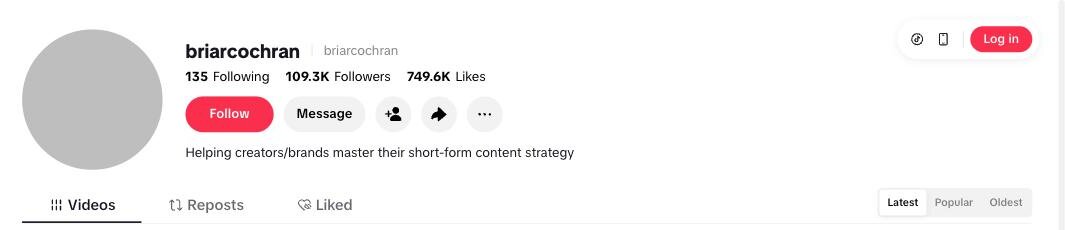
Briar Cochran runs Oakline, an Omaha-based content-strategy agency for founders and creators. Before content he was a D1 wrestler (per Alex’s intro; Moravia, Iowa’s first state champion in 2016 and walk-on at Iowa State are per public bios) and then in campus ministry with the Salt Company in Ames and as college pastor at Citylight Church Omaha (also per public bios/LinkedIn), which is the ‘youth pastor turned creator’ in Alex’s intro. He is a Cut30 grad (around Aug/Sept 2024), was turned down by Alex once, then joined House of Distribution that December as Alex’s number two, working brand strategy while quietly blowing up on TikTok with eight-to-nine-minute notebook yaps — a five-month run-up, in Briar’s own words, before he posted his own first video in May 2025. He now has about 56K on Instagram and about 109K on TikTok, plus a Substack of content principles. Alex’s lore: 140 pounds soaking wet, he pinned every ex-football player on the team in ten seconds each at a company offsite. He is 15 months into posting, a father of two as of days before this call, and by his own account has nearly 100x’d his income in 24 months off 90-second videos.
Accounts they pointed at
- Briar CochranThe guest — Oakline founder, notebook-yap originator, this whole talk is his method.
- Oakline Content AgencyBriar’s company: a group program plus a done-for-you agency tier for founders and creators.
- Alex Garcia / House of DistributionThe Cut30 co-founder Briar started working under in a five-month run-up to his first post; ran the intro and the lore.
- Tim NakiColin’s OG journey series: day X of playing blackjack betting 10 cents per follower; ~1M followers in ~120 days.
- Country Club HitchhikerColin’s newest journey example: hitchhiking onto every private golf course in Utah, broke-boy contrast built in.
- Jason SweatColin’s branded resource series: ‘tools for lazy creatives’, a five-tools list with a hook that makes it his.
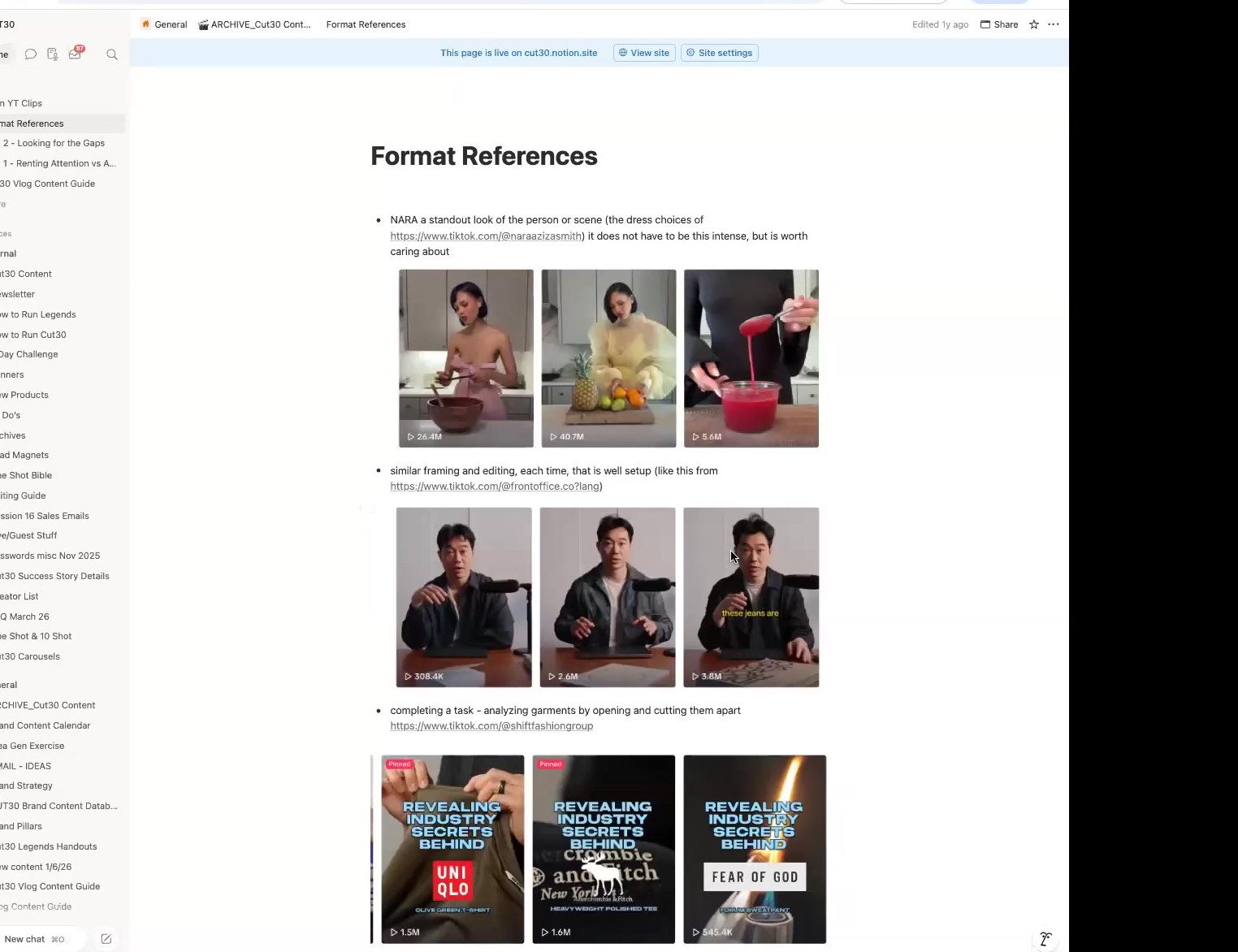
- Nara SmithOren’s format example: from-scratch cooking, couture, same kitchen every time.
- Ken SakataOren’s desk-and-book fashion breakdowns; the style Oren built his own set on.
- Shift Fashion GroupOren’s example of an action that opens every video: they cut a garment open to show how it’s made.
- Shelby SappBriar worked briefly inside her content engine; his lesson was that her energy on the day outweighed the script.
- Fake Plastic BrandsBriar’s example of visual counter-position: graphic-designed green screens with their own look, not a casual green screener.
- Paddy GallowayThe YouTube strategist behind Briar’s 80%-audience-overlap rule for what belongs on one page.
- SubwayTakesThe aside that broke Alex: the ‘subway’ is a shared set in New York.
- DarkroomBriar’s pick for the best brand-first page online: many faces, no key-man risk, no CTAs, and the lead form still bangs. Handle unconfirmed.
- Sky TanBriar’s friend who gained 100K on a pause-react format, then lost it when everyone copied him. Handle unconfirmed.
- Anushka ChhikaraLast week’s guest (S24 Zoom 3, ~228K on Instagram); Oren cites her Friday ‘stuff I saw on the internet’ series as a low-weight vehicle.
- MirandaRepeat Cut30 student whose curation carousel, ‘signals I’m paying attention to as a strategist’, went 12K on the first and keeps re-running. Handle unconfirmed.
- HansCut30 grad Oren uses as a format example: darkened CapCut look, consistent titles, specific green-screen styles. Handle unconfirmed.
- JessOren’s friend who copied the Nara Smith format for tech (trad outfit, vibe-coding apps); 3.8M on her first video. Handle unconfirmed.
- Alex HormoziBriar’s reference for longevity: seven years of posting and not even a decade in yet. Handle unconfirmed this session.
The vocabulary
- Archetype
- Founder-led brand / influencer / creator-operator / operator-creator / podcaster; the goal sets the plan
- 7 × 4 test
- Seven formats Mon–Sun, repeated four weeks; leave with two or three winners
- 70 / 30 rule
- 70% of posts on proven formats, 30% still testing
- Untangle the variables
- Was it the format or the topic? Run them apart next week
- 90-day frame
- Pillars, named KPIs, monthly comparison, day-90 look-back: how a committee says yes
- Non-follower reach
- 70–90% per video means a pivot is alive; below 50% you changed too much
- One-leg table
- A single format grows fast and collapses when copied; diversity is stability
- Hook as gate
- Open a loop, pick the TAM you let in, raise pain or desire, then personality
- Three counter-positions
- Visual, IP, association: be different on at least one to get the first 50K
- World-building
- Protect the association people assign you; evolve, don’t show up inconsistent
- Seasons
- Oren’s series play: rest a proven hook, then rip 10–12 in a row when the calendar is right
On screen in the session
The source
Streams from johnny’s own Drive copy, about an hour. If it asks you to sign in, ask him to share the folder.
Read the full transcript (107 passages, auto-transcribed)
Oren: the last week of this round of Cut30. So we were going to go through some logistics of what happens when this ends next week. We're going to talk through this idea of finding your format. Alex is going to hop on and talk about a bit about kind of calendar. Colin's going to talk a bit about turning some of your best content into series. And then we're going to get into it with Briar, who's an awesome guest and awesome strategist I'm excited for you all to workshop with. So first to kick off, this is the last of these Zooms. But during the seven day challenge, we do a number of office hours. So starting tomorrow, we are going to be in a seven-day posting challenge. We have a bit of an honor system. If you are partaking in the challenge, you are welcome to come to, I think we're going to do six office hours over the next like seven days. We don't do Sunday, but we do Thursday, Friday, Saturday, Monday, Tuesday, five office hours, I believe. Is that right, Colin? Or yeah, five office hours. Every day, but Sunday. However that land. Every day, but Sunday of Thursday, Friday, Saturday, Monday, Tuesday. These are a little more ad hoc. There's no calendar invites. We're going to do them roughly around that 8 a.m. PT time. We'll drop it in Slack, but we may be like five minutes or ten minutes, one there or the other. But you'll note I am tomorrow morning. I will be there at 8 sharp for office hours, and we will be workshopping with anyone that wants to do the seven-day challenge. They're just posting every day for seven days to kind of get you in the habit of posting daily. You can post whatever you want. There's no kind of assignments or anything this week in particular. We just highly encourage you to, as part of it, Colin's going to talk about series, and we're going to talk about basically remaking some of your best content you've already done better with your new toolkit is something we'd like you to look at. So then logistics-wise, you have access to Kajabi forever. You can log into it even after this is done. So you don't have to worry about if you haven't read whatever in the coursework. But Slack will close next Wednesday. So if you want to look at any messages or feedback or get anything, get it in there. We will feedback everything up until that Tuesday night, but then copy or grab anything out there, We will close the Slack channels. Other logistics. If you want to rerun this at any time, at the end of this in Slack, we are going to put a code. You'll see, you'll notice a lot of people are here for their second or third or fourth time. We have a code that makes it, I believe it's $350 anytime you repeat it. So make it easy for you to repeat whenever you want. So there's a repeat code that will be in there. You can get used to any future session. Doesn't have to be next one or whatever. And we do not change it super frequently. And if we do, you can feel free to just, you know, to email us or whatever. We will hook that up. I believe that's all on logistics. But we want you to kind of come out swinging over these next seven days and really get into daily.
Colin: Yeah. Before you jump into formats, I want to stress the seven day challenge. All of all of our biggest success stories, like all the legends that come out of this, the Hanses of the world all started with the seven day sprint and basically never looked back daily. Right. As you grow and mature, maybe you don't need to end up posting every single day. Everyone who wins out of cut 30 started with every day in the seven day challenge and then continued that for months and months and months to build the muscle, to get momentum, all of those things. So if you are serious about this, it starts tomorrow, like for real. And we'll talk more about that at the end, but it starts tomorrow.
Oren: All right. That's a much better motivational speech than I was given. It was all logistics. I appreciate that. All right. I'm going to run through this idea of finding a format. So why we call this out is over the last few weeks, you've developed a toolkit. Now you've done your carousels, you've done vlogs, you've done graphic apps, whatever. And you're starting to find the things that you like. Now we want to talk a bit more about branding yourself and finding the things that kind of tie your account together. So I'm going to run through some examples. And then we have a big Notion doc of this or link inside the, I forget if it's an actual linked notion or if it's just inside the actual Kajabi, but there's a bunch of examples here that you can look at. So for reference, when I talk about finding a format, you'll notice that a lot of big creators do really similar things for not all of, but most of their videos. So for instance, if you go to my account, you'll notice that a lot of my content, probably 75% of it, I'm sitting at roughly the same desk, doing roughly the same titles and captions with a very similar editing style. And even if I'm in a different location, it's all a little bit the same, right? And that is kind of my core format is content that looks like that. Same thing for really popular creators. So Nara Smith, that many of you know, she makes kind of, she makes things from scratch. She's always wearing couture. She's always in her kitchen. She becomes known for it. Does she do other content? Yes, but it's her core. Same thing with our friend Ken Sakata used to always do these videos where he was sitting down at a desk with a book in front of him, breaking down a good chunk of what like different fashion things. A lot of the style I developed is based a little bit on his style, just I talk about different topics. Same thing with this. This is a group that they cut open clothing to discuss how it's made. Every single time you will see they will cut open a shirt or a hoodie or whatever. As they start, that became core format. Faceless account, very similar too. They have the same title. They would always put a picture of the celebrity and they would always kind of have their same look and feel. Same thing with carousels. A stylist's no bullshit list or no bullshit pics or ratings became the trademark for this account. This person using their apartment. Our friend Eugene using his particular title style and his particular look of green screen. Same thing with Hans, one of our grads. His titles look the same. He darkens his videos in cap cuts. He looks a little bit more moody, specific styles of green screens. There's a lot of different ways. We have a ton of examples of those that are in there, but we want you to start thinking about what are your trademark things? What are those environments that you could be sitting at? Could you be having a certain type of wardrobe choice? Could you be having your captions in a certain slight color, a certain, begin to look at your titles here? Can you have an action to start a lot of your content? Start it's worked so far and take from some of these, right? So my friend Jess just started a new account and she's crushing. She's got, she had, I think millions of views on, yeah, 3.8 on her first video, 233 on the second. She is copying that Nara Smith format for tech. She basically is wearing a trad kind of outfit. She uses the Nara Smith voice, but then she is talking about, I believe it's called spike coding, where she's making apps like with a very particular theme. She's taking a lot from this particular style, but she made her own, right? It's a different niche. She's borrowing some of the core things to make the content good, but she's kind of finding her way with it. That's what we'd encourage you to look at here and be like, all right, we really love how they cut those open. I have a metal shop. I'm going to start every video with me hitting a hunk of metal, whatever it is. We just want you to brainstorm and start to get creative on that. That's part of your homework this week. If you want to workshop your ideas for it, you can workshop it in idea workshopping. But we want you to start thinking about what that could look like for you. In a similar vein, Colin, you want to hit series?
Colin: Yes, sir.
Alex: let me hit something there real quick where yeah um this is also why we tell y'all like to find something interesting to add to your content in stale in categories that are either oversaturated and or stale like a lot of and a lot of times our feedback is this for anybody that's talking about ai right if you're if you are talking about ai you have to figure out some kind of format that's more interesting and a lot of times it's looking at categories like like this like fashion um like interior design and figuring out, okay, what are they doing that's working for them? And how can I bring this into AI? If everybody in AI is just doing like talking head in front of their desk, you know, in a dark, dark room, right? You have to figure out something that you can do that's a completely different. And that's why finding your format is so key. It helps you stand out so, so much in categories, but go ahead, Colm.
Colin: Everything always comes back to doing something that only you can do and having an interesting, unique format is like a great first step forward in doing that. Let's talk about series for a second. So series are important tools for a couple of reasons, right? The first is as you embark on making content every day, if you can get a series or two to fill out your week, you've got two of your seven every single week kind of figured out, not scripted maybe, but figured out. And that's really, really helpful when you sit down to do this daily grind, right? The second is, of course, to give your audience something that they can come back to, something they can follow along with, so on and so forth. Some common vehicles for this, right, are social shows. You'll see this, especially with brands. They can be as simple as a repeatable or brandable hook. They can be a recurring concept or a way that you cover a topic in a specific way. And then, like we said, they can also be a format or a topic layered into a format. So I do this talking head style and I always talk about what's happening in this niche when I do it, right? Examples of that. I've added a couple of new ones here, but I've kept some of the OGs because I think that they are so good. Journey, right? The day X of doing Y, the doing X every day until Y. We always present this one with a caveat. This is where everybody goes when they start thinking series and it will not work unless you take it up a notch, unless you add tension, add some layers to it, so on and so forth, right? Day one of quitting my job and starting a business, we have seen that 1 million times. It is not going to cut it, right? A couple examples that will cut it, we've got at the bottom here, we got the legend Tim Naki who did like a million followers in like 120 days. He did day one of playing blackjack and betting 10 cents for every follower. He was like one of the OGs of layering this stuff, right? That adds a money element and an escalation built in. As he grows, things get crazier by default. It's an amazing, amazing setup there. Another favorite, this guy, daily reps guy, just hit 365 days. This guy didn't do how can I get jacked day one of getting jacked. He did day one of trying to get jacked in 20 minutes or less, right? Again, like huge constraint, filter it down, make it more interesting. And then the most recent one that's ripping in my space and the golf space right now is this guy, country club hitchhiking. So this guy is seeing how many country clubs he can play. Boring on its own, right? When he adds this layer of hitchhiking and trying to get in, like kind of from a broke boy stance, right? Of like trying to get in for free on an expensive country club. The contrast that we have there works extremely well. It's layers. I kind of went on, went in on that one because I know how popular and how much we like doing journeys. You got to take it up a notch. Another, another play here is just doing resource videos with, with a branded hook. Great example of this is Jason Sweat's tools for lazy creatives at its core. This is like five software tools I like, right? But he opens it. He hooks it with tools for lazy creatives, which qualifies it. It makes me know it's his video and not just some other one and speaks directly to him. And then another one here, the OG product versus brand, which I feel like at this point maybe has been retired. Orin, I don't know if you can speak
Oren: We're coming back for the fall. I'll do it in seasons now. That's how you think about it, right? You come up with a good series. I'll do the video like that every month or two. And then in the fall where I know people are trying to buy stuff in holidays, I'll go rip like 10 or 12 in a row. It's a way to think about if you have some IP, it starts to not work. It's not the end of the world just kind of like start to test the waters and then begin to find where you want it and like build it into your toolkit the more you begin to be a creator the more you can kind of think in terms of like longer term stuff like that
Colin: a series like that guys is basically just niche commentary but again with a repeatable hook that has proven itself and i know that hook like took several videos to come together it kind of evolved but he's like that thing works and so he can bring it back and just turn it into a recurring thing
Oren: and some quick context like you meant on the hook to see you kind of see the evolution there. Like that started as like status blank. It'd be like status watches. Didn't really feel right. Then it was like red flag or green flag, right? Only talk about bad or good. That didn't feel right. But then the idea of comparing the two was good. And then we kind of started with some weird categories with like energy drinks or whatever before we settled on consumer products. And so it like it evolves. And to the point of like what we want you to do this week in the seven day challenge, take one or two of your performing existing content pieces and either just redo that video just with like a better hook, better execution, make it more of a series or do the next one. like all right cool that kind of had traction what if i do a really similar video what if i begin to treat it like a series that's going to go well for you
Alex: a lot of times that just comes into how you package a working idea right like if whether it's orin colin or myself like for me when i started comparing content what was a good piece versus a bad piece it then was in that was one of my first uh banger pieces of content it wasn't packaged into my format yet or it wasn't packaged into my series yet and it was just like okay like how do i name this once it was once i could name it then i was like okay make endless episodes about this right and i could go into all sorts of different different categories different products different brands um and it makes it a lot easier versus there's like there's there's some of you in in office hours we were talking about this where they're like oh i think it's going to be like a a boring concept if i do it again but it's completely different if you think about it through the lens of this is a series that people loved it and they're going to want more of it. And when you start thinking about that
Oren: They watch 400 videos every day. So you can get away with quite a bit.
Alex: Yes.
Colin: You know, Alex, while you're pulling up calendar stuff, we got a couple of questions I want to hit on. And actually one from Anushka here, who we talked to last week, something I wanted to call out as a serious thing is Anushka mentioned, I can't remember the name of the series, but she mentioned she had a video she does every Friday or something. That's something like stuff I saw on the internet this week. Again, coming back to like use this as a vehicle to like talk about stuff you want to. Right. Like that is a series that is designed to just as a place for her to put stuff she thinks is interesting, which which takes a lot of weight off of coming up with video concepts. I also wanted to call out Aaron when we were talking about formats earlier when Oren was. Aaron mentioned that she started wearing a bandana again. That's like a format doesn't need to be insane. Right. like bring out the red bandana every time it like in the teardrop tattoo. And like, that's your stick. Just kidding. That was a joke. Um, but like, like these little things can become part of your format. Um,
Oren: absolutely. And look, and curation is a great one. Like, uh, like Miranda, she's done cut 30 a few times. She, um, did this carousel signals. I'm paying attention to as a strategist. First one to 12,000. She's repeated it. These haven't done 12,000, but they've all done like a couple thousand likes on each one. She's running it back a bunch. And again, it's just her curating. And so I can't in your niche to the point of a news, because things I saw on the internet, if people like your perspective, and it's like brands I'm paying attention to as a Google ads strategist, you know, the cases that are on my mind as an attorney, whatever, you can do a lot of simple stuff like that. And she's a good example, because these are not, they're like pretty simply designed. I'll share an example in here. And like, you don't have to overthink it. Jimmy asked, can you give examples of how you guys found your unique format in that journey
Colin: first of all i think it is like it's an ongoing one like the this format that you've seen become like basically signature for oran like i don't think existed eight to ten months ago right and like that that's kind of the nature of the beast um it's an annoying answer but like by iterating
Oren: and yeah it's just iterating like even that one we did i did two in december that weren't right and then like one in january that wasn't right and then like another and i just kept being like what's the right set for it when you bring the graphics in and i think the biggest thing is sticking to it so the thing we want to call out for all of y'all is that four to six attempts is the kind of minimum to see if a series lands or a concept lands right i didn't have that video tape that style take off until video six and uh and so it's like you have to give it if i'd given up on video two or three i wouldn't have one of my better styles now and so i i would just say you have to test things that many times and to the point you said earlier no one notices no one cares until your videos are doing hundreds of thousands of views each time, no one's going to be bothered by you making relatively repetitive stuff as you figure it out, especially if it's valuable.
Alex: For me, I could give my whole good content versus bad content was based off conversations with potential clients where a client would be like, why don't we get this to hit? But they do. And I'm like, ah, good content versus bad content. You know, like it's so easy to be able to, if you actually look at your kind of day-to-day and you see the common denominators and things that get asked, you know if you work in the in services or anything client facing or like in anything consumer uh product led etc you could kind of figure out how to package certain scenarios into a series that only you can do right and and i think a good one that that colin brings up um is the guys that that bought that land and kind of turned like this golf course or old area into a golf course that's just like they packaged their essentially they packaged their journey their blog into this reoccurring series that again nobody else could replicate versus if they're like hey we're starting a golf course you know this is day one of starting a golf course it's not unique but the second that they go like hey we bought this old abandoned golf course and now we're abandoned just turn it into exactly abandoned golf course and we're turning it into x that already presents a story that is one of one versus building a golf course or whatever you know whatever the the case may be in that situation. And so a lot of times, you know, I was stressing this on office hours. Everything's about packaging and positioning, right? Like when we're talking about series or we're talking about ideas and packaging it into a series or how you take a series and you position it properly so that it's unique.
Oren: All right. Let's get into calendars and let's talk to the haunted golf course.
Colin: Yeah. This abandoned haunted golf course. We're turning it into a perfect.
Alex: Cool. Y'all can see my screen right here?
Coach: Yep.
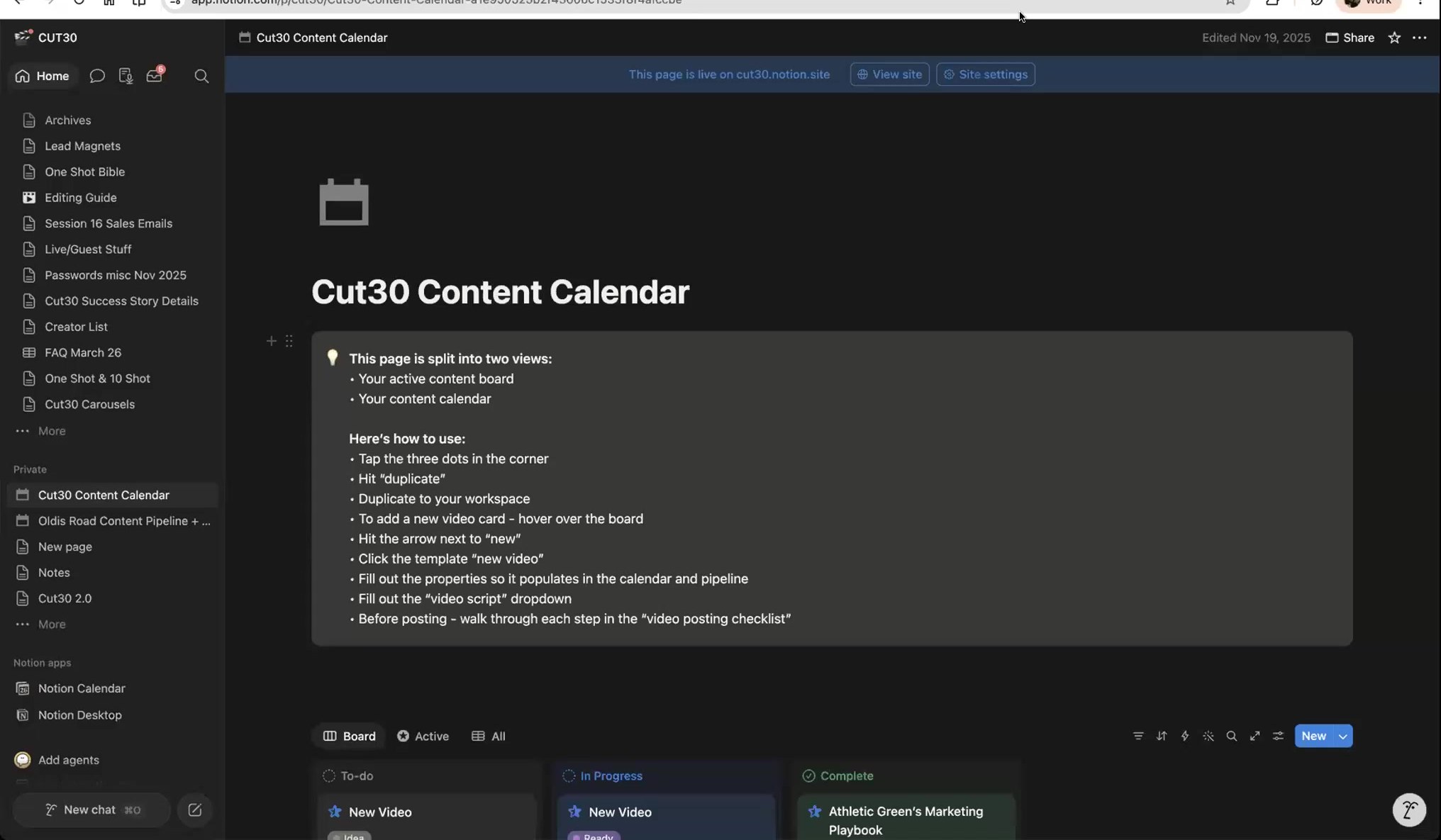
Alex: Cool, cool, cool. All right. So I'll start with this. We didn't want to give you this in week one, week two, week three. We want to give you the last week for a specific reason, which is, and I think, Orin, you made a video similar to this, right? Like about the, what is it like your acquisition? And like how a lot of times you get something like a content calendar. And this is almost like the gear acquisition syndrome for for people that want to make content. It's like you have to have the perfect content calendar and the perfect pipeline and like all the perfect properties in Notion before you make a piece of content. Meanwhile, your hook is still terrible. Meanwhile, your script is still terrible. And so we don't give this to you in week one because we want you to produce content. We want you to divide. It is a literal skill to press publish. It is a literal skill to then make very good hooks and tell very good stories. And so we don't give you this so that you focus on that. You don't focus on this because this part right here is not going to make a video better. It's not going to turn a good idea into a great video. And so that's what we're now giving it to you as you hopefully get ahead of your content and you start maybe building out some process. You start having some winners. You start wanting to take a Miranda where, hey, I want to take this winning carousel. I want to make it a one shot. I want to make it a yap. I want to make it a series, et cetera. Like this is where those ideas could start living. That's where that pipeline could now exist. So we built this for you. It's extremely easy to use. You're just going to hit these three dots in the corner. You're going to hit duplicate. You're going to be able to bring this into your Notion workspace. Again, if you don't like Notion, no problem. The best process is the one that fits your workflow and helps you really get out content as fast as possible. But let's say you duplicate it. You bring it into your workspace. You're now going to have this board view. Personally, for me, the board view is my favorite view. you have to do in progress complete very simple but at the end of the day like you can also complicate this and you can add a bunch of different steps in here you know if you have a team and you want to add like getting edited scripted etc you can you can start doing that but what you're going to be able to do is you're going to hit new you're going to hit this drop down right here you're going to hit new video you could edit this template as well it has these different properties. One thing I will stress is do not overcomplicate this and add, you know, 20 different properties that you got to fill out for every video. It will not get done. You'll ignore it by the fourth or fifth video that you do. But you can look at this. It's nice to have things like pillars and formats in here so that later if you're looking at the data, you can understand what pillars and what formats are really cranking. We added in these templated little like little kind of rules you could follow where it's like hook, bullet point value, CTA if needed and wanted. Reality is 95% of you should have this deleted. It should just be like hook, bullet point, value payoff. The last part, video posting checklist. Promise you it still happens to myself, Colin, Orin. I know for a fact, Briar, where you forget to turn on your mic. You forget to maybe turn on your light, you forget to even hit record. All of those things will happen to you. It's nice to just skim this and be like, okay, light on. Yep. Mic plugged in. Yep. Enough power. Yep. Like, right. It just run through this real fast. Do you even need to checklist it? No, but it's nice having it in this format so that you can understand, Hey, these are the things that I need to do so that I don't record eight videos. And then all of a sudden it's like my mic was not turned on the, the entire time. But the key prop, the key portions here is like, if I, if I want to put, you know, Cut30 video, have a specific date on it. So if we're looking at here, it's in, let's say the in progress phase, etc. Everything will get updated, right? So this is the video I just created. It then pre-populates on this calendar view. It'll pre-populate on the in progress calendar. So you'll have like a master calendar, in progress calendar if you have things scheduled super easy to use again you could add steps to it but don't over complicate it the whole goal is just for you to sometimes you know you have a great idea put put the idea in here you know put it in to do make this uh make this your home um but don't obsess over the calendar at the end of the day like what me calling and all in or and say is like banger videos solve all you could have the either best or worst kind of operating system for your content the banger videos the thing that's going to work you know it's going to solve all problems whether uh whether you like it or not so don't don't obsess over this um but yeah let's get into to briar because it is going to be 35 minutes of heat
Oren: i'm trying i'm trying to intro briar look when when i'm at bro alex pulled briar out of the cornfields you know i'm saying i placed him into the world where briar's coming is that he's the contest driver of the bible belt he is a absolute legend in the game this man is doing every i mean but how would you describe it you're doing what like with the right wing podcast circuit strategy
Coach: oh bro yo briar's a new dad i heard like days ago he's hours ago he has two kids now he has two kids
Alex: let me i'll get briar intro i'll get briar intro
Coach: he didn't he didn't have the kid his wife
Alex: sorry for a hot second okay so briar is a youth pastor turned creator this is if you didn't know He also was a D1 wrestler. Briar worked with me probably a year and a half ago. I'll give you some lore about Briar. Briar is 140 pounds soaking wet. Everybody on my team is like, we all played college football or, you know, something equivalent of college football. Okay. We were doing a company offsite. I don't know what everybody drank that morning, but it was like, are y'all trying to wrestle in the backyard? and everybody was like yes and so everyone just was like no we can take briar like there's there's no chance briar could beat us and briar just stood there and was like every time again like i'm talking like there's strong dudes on the team we're like briar was like put a timer for 10 seconds i'll get each one of them in 10 seconds and just because of the fact that i was the boss i'm like i'm not gonna do this you know like i'm not about to just get suplexed by briar but briar legitimately took everyone out in in 10 seconds and like the i'll spare the details but like he was like watch this i'm about to make this dude's head touch his ass cheek and like literally did a move and like held it there and he was like you see this and it was it was one of the the coolest things but briar uh got to work with a ton of of amazing brands and like helped lead strategy for a bunch brands and then went on to build his agency really focusing in the creator space and working with founders and ceos and developing their content strategy um another funny part was like one of my downfalls is i don't post on tiktok even though it's so simple but like as bryor was working with this he was just like blowing up on on tiktok and i didn't know for like the longest time and then briar went on and did his thing and now you all know briar is an absolute uh killer and he is a a father of two um he makes irresponsible money decisions as well he bought a uh briar i hope you can give us a better intro than we than we've been able to i'm giving you all the lore
Coach: i love it that was perfect i love i love briar to death i love briar to death but go ahead
Briar: but Alex found me on the side of the street. I was addicted to meth for like seven years and he brought me into his house like a baby bird and fed me and, and gave me a milk bottle and trained me up to be a marketer. And now here I am.
Oren: So what was the arc? When did you start making content for yourself? And then how'd that go?
Briar: Dude, I think I was probably in cut 32 years to this session. It would have been August or September cold. The end Alex in September, he denied me the first time. And then I didn't post my first piece of content until the following May, but I started to work with Alex in that December. So I had like a five-year or a five-month run-up before I posted my own piece, which would have been like a year and a half ago. Almost. Yeah, a little over a year ago, which is crazy. I've only been in the game for like 15, 16 months, actual posting. But, yeah.
Oren: Yo, I just want to call out, talking about formats. I know like you came in hot with like the notebook yaps.
Briar: yeah it was literally this right here just a little little pen and pad right at this table this was literally my format like this is the format guys right
Oren: what was the thought behind that because it was effective and you did it well how did you know
Briar: no thought i was like i'm tired of trying to memorize a script i'm just gonna fucking like put it right here in front of me and just record this video and then it looks kind of like i have authority or something because i have like a pen and paper but there's no no zero thought
Alex: and i want to stress that this is like the way briar would talk in his yaps is how he would talk with meetings with clients where he'd be like ah and then like talk and like that's how his yap was and that's why it works so well like people would try to replicate it's like well you don't understand like that's just how briar is you know what i mean like he like he says those jokes in his in his in the meetings and then he'll like like did that land no it didn't okay moving on like that's just how bryer is like legitimately in real life situations and it works so well because he literally just brought something over that he was already doing
Briar: and just what's also what's also interesting about this is my first 20 videos on tiktok which is what really like blew up i think they averaged eight to nine minutes long so you know we talked about finding a format that's unique to you i was basically treating TikTok on accident as like a YouTube channel and people resonating because everybody was used to like basically like cringe content that was like super fast over on, on TikTok and just kind of flipped it. But yeah, to prove you guys point.
Oren: And so now you are doing this for a wide variety of people, right? Like we joked about it, but you do it for famous people. You've done it for up and comers. You know, where do you start when you're going to work with an existing person? Like what are those questions you ask? How do you begin to dive in with them?
Briar: Yeah. So I think first you have to separate the creator into an architect. type based on the goal because that's going to inform the strategy right so you have founder led personal brands this is greg lav dama ikavon ross mckay almost alex now and is on the stage those people have a different goal than like you know what i would then call an influencer okay this is the alex earls the catchy bts of the world they just want to grow a pissed ton and get brand deals then you have creator operators which this is in my opinion what most of us are we are creators first and then we have businesses on the back end. But if you're going to hold a gun to our head and make us pick our business or our platform, you're going to, most of us are going to pick platform. Then you have operator, creator. This is like a dentist office or a local HVAC company. Operator or business first that wants to start making content. They have different goals. And then the last one would be somebody who's like, this is like a miscellaneous, we call them a podcaster format, but it could be somebody who has like a big newsletter and they want to just move people from short form to a newsletter or short form to podcast or maybe long form to support their short form it's kind of this like multi-platform strategy so the first time is you have to understand and reverse engineer the goal in my opinion and you guys all have different goals that's why the you guys still have three tracks in here right brand creator
Coach: no just two just just personal brand creator and brand business
Briar: but exactly falls in line right yeah right and yeah there's like subcategories of that because like on personal brand some of you are just going straight for growth and some of you would want to go for monetization and more revenue and so you've got to start with the north star in mind and then reverse engineer the strategy from there because like if you're following like an influencer strategy you're an idiot if you're trying to like launch an info product like that's just like a pretty rough combination there so that's where i start in my pain
Colin: yo uh you just mentioned i can't remember what you just said but or and i were talking the other day about how in a lot of ways like brand, brand accounts are dead, um, because they've become so personality driven. That's probably an overstatement. Right. But I'm just curious what you're like, what you're seeing on the brand side as it is becoming personal, like it's face driven, um, on brands and businesses now. And it sounds like that's, that aligns with what you are just saying, where, where it's like about the creator, uh, even if their primary gig is being the operator, so on and so forth.
Briar: Yeah, I would say that I am significantly underqualified to talk about like business brand pages. My thought is like, this is probably, is that kind of what you're asking? Like if like, uh,
Colin: yeah. And I guess, I guess it's more so, but like in, in this lines up with Dan's question, he just threw in the chat. Like it's kind of like operator creator is more like that's the clearest model for a business to win now. Right.
Briar: Yeah. Oh, dude, for sure. Like if you can, it's the classic, like creators need to be better at business. Businesses need to be better at content and being better creators. Right. Like I see like every other bio I see is helping businesses be more like a creator, helping creators be more like a business. It's like, okay. I don't know what that means. But yeah, if you can, like 95% of businesses don't even have talking content. It's like carousels and product shoots. That's it. Like that's literally all they have. We just consulted for a company last week and I'm looking at it and I'm like, these are just AI generated. product shots just literally for 45 days in a row. That's going to do nothing. It's not going to educate people. It's really like this UGC strategy or some form of, I think what darkroom agency or in like what you guys are doing over there is like one of the sickest brand first, like business brand first pages, like on the internet, right? They're collabing with a lot of people in the space to become the face of the page, but there's not just one face, there's multiple faces. So you don't get key man risk and there's a bunch of value going in that's just establishing themselves in this like native platform like do a deep audit on darkroom agency in my opinion on on that side of things
Oren: yeah and then just quick note on that too like that's just like how do you prove expertise when when the people that uh are like the people that run the company work on linkedin they talk on linkedin all the time they don't want to talk on the main account they don't want to be about them it's like okay how well who best represents us as a creator first agency creators and let's get them to talk about their expertise and then get people to ask questions. And what's funny is like, we don't even, there's no call to actions. There's no any of that, but the website lead form just absolutely bangs. And like Alex knows that too, right? You just, you make the content about it and you give people the opportunity and they will. And so I'm curious, so you, you were doing, working with that client, they kind of, you know, you brought up that idea. What, what, what are some first pieces of content that, you know, you're diving into with them or, or you recommend for people to get started with, with talking in particular?
Briar: Yeah, so we take a seven by four format strategy. So for right off the rip, we're going to try to test seven formats Monday through Sunday. And then we're going to repeat them week two, repeat them week three, repeat them week four. And it's going to be Monday, Monday, Monday, Monday, Tuesday, Tuesday, Tuesday, Tuesday. And basically how this call started, we are trying to find two to three winning formats that we can start ripping. Right now, there's key topics, right? There's ideas or unique value propositions that are inside of these brain. And we do this for personal brands too, right? So if I have work with a person, it's going to be the exact same thing most of the time. Trying to find that format. And then we just combine formats with idea, okay? Intellectual property with social native format. Test, test, test, test, test, test, test. You have winners a month later, compound on the winners. Make sure you have a 70-20 rule where you're still, or 70-30 rule where you're still hitting the winners. Keep testing for the 30. And that's like just the simplest way to just run a blueprint up to the moon. But that's the first thing is we try to, We have like a kind of a format swipe file. You guys have a format swipe file, I think. Hoax swipe file. Is there a format swipe file on this thing?
Coach: Yeah. Sure. Something.
Briar: It would be just like that. Like just sifting through trying to figure out, okay, it doesn't really make sense for this company to do this or this creator to do this. It's a little too playful for them. They don't need to be doing AI carousels, you know, whatever, stuff like that.
Oren: Yeah. So I just want to clarify for everybody here. What are you saying? And Briar, correct me if I'm wrong, is like if the video is, or the piece of content is like five, five great dog foods. You can buy a target. He's saying five great dog foods as a carousel, five great dog foods as a, yeah, five great dog foods as a one shot, right. Where it's just text over later, whatever. And then in doing that across every day for four weeks, seeing what is rising to the top to kind of like nail down some, some pillars to keep coming back to is that.
Briar: Yeah. Yeah. We would have definitely like plenty of like idea like topic or ideation diversity it wouldn't just be like ripping five dog five you know whatever dog food things just every single video it might be like you know one time this week and then we're gonna go test it on green screen next week and then we're gonna move that idea over to carousel the week after that so there's also a ratio of of wanting to making sure that like we're not just overly hitting the exact same topic just over and over but yes exactly the list school format
Oren: so mario asked uh uh how do you break through businesses that run in an old marketing model and operate by committee uh versus like testing like this how do you get people to test
Briar: uh i just tell them i'm not gonna work with them if they don't
Coach: yeah you yell yeah yeah
Alex: we deal with this all the time right like a it's that it's like if you you have to test this or you're gonna keep not hitting your goals that's like number one you want to keep failing or do want to win. And if you want to win, then you need to suggest a timeline, a set of KPIs. So we will basically do the same thing we did in Cut30. Okay, you have 90 days. We have a pillar system. These are your four types of content that we're going to test. We're going to review these metrics, saves, shares, views, et cetera, every month. We're going to compare the pillars against each other. We're going to compare the pillars over month over month and the account overall month over month. At the end of 90 days that you're going to give us, we're going to look back over that 90 and be like, what worked and didn't? Are we reaching the goals that we thought? And then we're going to create a plan for the next one. But you have to get, you know, as soon as you start being like, these are the metrics we measure. This is how long we have to test to do this. And here's when our review dates are. So you're not have a bunch of open-ended questions about every piece of content and every week. And what's our strategy be like, no, we're going to talk about it at the end of this 90. Once we execute, then you give yourself some room to actually operate. And what most people realize is they want to do it. They just don't trust that someone knows how to measure it. They don't know what they don't know. So you have to show them that, you know, it.
Oren: boom and then a ton of click this is more like agency mindset stuff here but like then ton of clarity and communicating what you're doing in between
Alex: yeah exactly like weekly update right like every any if you're doing social media for a client right or you're writing scripts for whoever every single week being like here's the scripts we completed here's what's in your court to review here's where i'm blocked here's what's coming next week and then every month being like here's the analytics and you're gonna see the same analytics every month eventually they just stop opening the emails they're just like go cook yeah even if it's not doing well they just want to see base level of competency you know
Oren: uh aaron's got one if you started as a personality in your work tv host but do more than that business and entertainment what's the best way to implement more of the business mind without turning audience off that came from your personality yeah so aaron aaron was like a tv aaron's an interesting case read read that one if i didn't say it clearly it might be easier to read with the parentheses
Coach: yeah yeah i think we may need a more specific question too
Briar: well yeah yeah i have a principle here i have a principle here like it might not be possible aaron like anytime you niche swap you have to accept that you have a value of shadow of death coming before you and you have two choices start a new account or track the non-follower reach while you start talking about this new thing and making sure that your non follower reach is still pushing 80 to 90 per video maybe 70 per video that is whenever you know that you can still move past your old followers who want you for a tv who followed you for tv host and you can tell that your account's not that and you're still moving in a trajectory that has an alive account once the follower reach or excuse me the non-follower reach drops below 50 40 30 that account is fucked and you probably tried to make too big of a change patty galloway on youtube says this and i think it's true on instagram from video to video but basically it's like you should a video should not be on the same page if it does not have 80 of the same audience right and if it is then expect just mentally prepare for just worst expectations you can't have your cake and eat it too you know what i mean so going from tv host and trying to please those people will also it's like you're asking like hey you know i used to play baseball and i was really good at throwing a baseball now i want to go play lacrosse how do i just like be really good at baseball and with my lacrosse skills that made no sense but you get the point
Oren: uh bryor what they want to ask you is you know when you're doing that seven by four you're looking at content in week one and changing it or iterating on week two what are you looking at what are you changing and what are you testing
Briar: yeah it varies varies by goal so if we go back to the archetype if this is like an influencer they just want growth then we're just like literally looking at like follower acquisition what were the formats and topics that were had high follower acquisition but then what you have to do is you have to extrapolate the variables which basically just means untangle the data was it the format or was it the topic right because there was two two things at play there let's separate them now run them both next week and see which one wins there and maybe they both went again okay great well maybe the format and the topic were both the thing that ripped last time so now if it's we're going for for monetization then it might be like you know did we get an influx of dms inbound leads this week or whatever the person's like a loser that might just be views that we're chasing or something like that but yeah
Oren: all right what um what are you testing right now yourself i like because I never know what I'm going to see. I know you're just throwing stuff out there. What does that look like for you? What do you use as a testing ground for?
Briar: Yeah, I mean, the balance of what you started this call with is if you find a format and it works for you and you run that mother effort into the ground and all of a sudden a bunch of people start copying you, you lose your alpha, right? This happened with Sky Tan, who's one of my boys. like he had this like pause react play pause react to like a video and he ripped it gained a hundred thousand followers the instant he's not doing it he literally went from like millions of views to like 1 000 views and it was a huge follow-up because everyone just started flooding and accompanying every like i literally could not scroll without a pause say something really fast reaction to the video and then i asked him i was like hey do you regret going all in on this format he's like yeah i wish would have had some format diversity to it right so like my whole thought here is if you can build the foundation with multiple legs it's more sturdy and it's going to fall apart way less easy where if i'm building a freaking unicycle or a table with one leg aka just one format and someone comes in or i lose alpha or i i can't stay the leader of the pack then i'm going to fall really hard so my page is all about like how do i make this thing as diverse as possible so nobody is coming to me for a single thing i don't want someone to come for me for like even this basement this basement right here what you guys are seeing right now started to pigeonhole me just a little bit and i had to break out of them it was counter position everyone wanted me to talk about counter positioning i had to quit talking about counter positioning because i was like getting too much and like so for me it's all about like how do i have a level of diversity which actually equals stability and slower growth so orange your point i just throw like shit at the wall so that it nothing gets like too much weight in the pie
Oren: will you tell us tactically exactly so you were doing the notebook yaps and you wrote that pretty hard but there was definitely you had that moment where it's like it's time to make another kind of video like tell us about those very first like tell us about that turn because i remember i remember like you were doing those long notebook yaps and then it was like okay there's there's new stuff happening here
Briar: yeah it's probably 100 videos over on tiktok just every day ponding the stone right here no idea what i was going to talk about showing up to the notebook ideating ripping no edits posting changed my life it was literally the like the best thing ever um and then what i realized is everyone started ripping me like dude there was i could just scroll like the tiktok shop kids were ripping me the mindset kids were ripping me the productivity kids were with me i was like fuck and i just saw my views just go so slow like i could i literally could have posted a video of me just screaming and gotten 100 000 views it was just right and it would have printed and then at the beginning and then just slowly went down and so i like tested some green screens some single diagram green screens did well um ripped that for a little bit did some split screens where i'm at the top and a whiteboard was behind me did that a little bit and then got in my car and yapped a little bit let's change the background so it's not just pen and paper but like more just like this guy's just can be in the wild and i just see his face now not the basement right i didn't want people to recognize the basement this right here is like literally a brand pillar for me this fucking blanket over my window yeah it's literally you're like nebraska dude i like we're getting new office i'm like i think i need to have them build this room in the office so i can still rip content in this like setting but
Oren: you know that'd be fire and then it zooms out and it's just like that would be sick
Briar: that would be sick um but i'll just find everything when you find out subway takes isn't filmed on a subway and you're like what do you mean and you're like oh it's a fucking set
Oren: wait wait wait
Briar: yeah subway subway takes is a fake subway it's a it's a set that a bunch of people use in in new york
Oren: he's not real i can't i can't handle that right now yeah i can't handle that right now that's too much that's too much that's crazy
Briar: okay but yeah yeah i tried everything green screen green screen's a layup right like especially like being in cut 30 it's like all these guys are green screeners so i was like oh that's logically what i must do next you know um split screen and And then just everything, I started, like, having some fun, doing some fun, like, some random skits where I'm trying to, like, my snapping my aunt's neck and stuff like that. So, whatever.
Coach: Right. Talk about how you even think about a little bit, you know, relevant to set design and how that kind of cements you as, hey, this is – when you see this set, you're going to see this type of content.
Briar: Yeah.
Coach: That's something you've done very well.
Briar: Yeah. I mean, like, you've got to think about world building and, like, how – what do people associate with you? right so like people started on accident this wasn't intentional this is literally my basement and so like people started to associate me as like this poor midwest white kid you know i don't know it just is what it is and so i was like you know once i started to get a little bit money i was like i literally can't get a nice car because it will ruin the brand and i was like okay i'll go get a vintage car. And it's like just that little mind frame right there, that little mind switch or mind frame, whatever, that's not a real word. That little frame of mind switching to just stay, keep the world building dialed, keep the world building dialed, keep the world building dialed is huge. Whenever you start to really form like your association, especially in your niche, once you get into like the top 10, 15, 20 people in your niche, and they start to assign beliefs and like characteristics to you, you want to like stay consistent, right? So it's almost like set for me is less visual i don't think a ton about visual hooks as much as i do association and world building and like this is a representation of how i want people to think about me but i will say this probably matters significantly less at like the first hundred videos but also like fuck it just do it in the first hundred videos too that's kind of cool too i don't care right
Alex: One thing I think is super interesting that you do that I wouldn't say a lot of people do is you inject like personality into your hooks. Yeah. More than more than others. And an example of this is as bear with my my recreation of what Breyer did here. But he was like he had a video where he was like, how do you make a hook where you just like I want to eat it up? And he like made this like weird noises and shit. He's like acting. He's like saying odd things like but you do that often with a lot of your hooks. Like they're not the traditional hook where, you know, a lot of times with my hook, I'm like, this is how you do X. You know, and that's my hook. It's worked well for me. I continue doing it because it works. Yeah, it just works well with what I do. But then with your on your side, you're kind of putting in like these little personality pieces into your hooks and making that the hook. How do you think?
Briar: So there's two layers here. Number one, I worked with Shelby Sapp for a little bit. very short-lived. I got fired, but it is what it is. I'm not trying to take any credit for that. That's not a flex, but I got to see the inside of her content engine. And it was very clearly like when she was in flow state and got views, it was significantly less about what she was saying. It was more about her energy that day. And I was like, there is something about personality and like just aura on camera that holds a weight in like a hyper scripted world the second thing is david ogilvy says like the number one sin of a good marketer of a marketer is to be boring to be a bore and so it's like i've always just had that in the back of my mind it's like i never want to be boring i never want to be boring i never want to be boring and so my thought my my swing thought there you go con my swing thought my hook thought is how do i open a loop how do i target my tam my total addressable market am i speaking specifically to content creators am i speaking specifically to creatives am i speaking specifically to business owners building media teams i want to target the audience that i want to hear the video in the hook it's a gate for me how many people am i going to let inside the gate and then i want to increase pain or increase desire and then i just say fuck it let's roll with these three things open hook tam pain and desire and then just let my personality just do some crazy shit and then just whatever happens happens
Colin: i want to i want to just say that like i took a break from making content this year and the first time that i was actually fired up to make content was when i saw that crazy fucking video you made i don't even i'm gonna try and drop it in the chat later but i text i texted briar i was like i literally like i haven't wanted to make a video in months and uh and it was it was just you like being kind of weird and crazy and not caring and there's there's like absolute superpower in that. Um, we got a bunch of questions.
Briar: To what you just said, the instant, dude, this is so huge. The instant perfectionism slips into your recording session is game over. The instant you start thinking about the thousands of views that are on the other side of posting, you are brutally fucked. You have to, it has to just be you and you in there and you have to like detach your identity and your self-worth and the fact that your dad probably hit you whenever you were younger and he doesn't want to proud of you. So therefore you got to earn worth through like more views and more follows. Now, like you got to get that shit out and like, just let it sing because that people can smell and like, feel it. You can just feel it. You're like scrolling and you're like, it's like your friend starts making content for the first time. And you're like, Oh, like that was a hard watch. Yeah. It's because they're like thinking while they're recording about like all the people that might see it.
Colin: So dude, sometimes like I get like George he followed me in my next video was me. Just, this was it. I flipped it on and I just went, and i just turned it off because i was getting in my head i was like how to get it had to get it
Briar: dude he literally texted me like venting like i don't know what to do i didn't post it was like two or three days and then he was like wait he literally texted me he goes wait george heaton followed me for me i should keep posting you know
Colin: it's true it's true i just you get you cannot get in your head anyways little side tangent there
Oren: beautiful beautiful um we got a couple questions here in the chat let's uh dan said don't you want dan said don't you want the world to evolve though so this is coming back to the the world building and the uh the old car thing um uh don't you want the world to evolve though or if you're doing a format does it need to be exactly the same every single time speak to that
Briar: yeah you want the world to evolve but you still want to there's a difference between evolving and just like showing up inconsistent. Like, is there progress to the story? Right. Like that is, there's a big difference. I did not say anything about not wanting to progress. You know, I left my basement, right. I left my basement, moved into plenty of other things. You know, part of this is like, I am in the age range of like Miami guru McLarens and shit. And I have like a wife and kids in my twenties, early twenties, you know, Like that's part of the world building. That's evolution more than just me in my basement. Right. So I'm going to show that.
Oren: Yeah. I know counter-positioning got done to death in a while back, but we don't talk about it much here, but so I'm going to ask you out in a second, but for people that don't know, there's this idea that if a lot of people in your niche are doing one thing, right, you'll see everyone's doing highly produced videos. And if you do something lo-fi, then you're basically counter-positioning against them. What Breyer's talking about here is a perfect example. A lot of content strategists, people that will help you with your brand or whatever are in Miami being like, I just bought this Lambo off of content creation. I'm in a group job with a bunch of those dudes with Briar in it. Right. And, but him being like, I'm in Nebraska. I just got his content started with, I just got successful. These are my first few months being successful. I'm showing you a real look at this journey. This is my family. This is my whatever. That's a very, uh, it's very relatable in a different way. And so that's something to think about in your content. If you see a lot of stuff, you don't have to feel like you have to match the niche. How do you counter position? Um, Briar, be curious on your like thoughts. Like how do you put a strategy like that together?
Briar: Yeah. It's number one, you have have a deep understanding of the actual niche. You have to know like, what is the position you are countering against? I guess you could say.
Oren: Go in a video database. If you're like, Hey, I'm in golf, I'm in real estate. What is everyone doing? Go in there and go look at all the popular videos and be like, what are they sharing common? A bunch of them will be outliers, but a bunch of them, if like 10 or 20 look the same, you're like, Oh, everyone's doing that. And then you can get into what he's about to talk about.
Briar: Yeah, exactly. And so I think there's three categories. There's the visual, which is the format. If everyone's doing green screen, like guys, just, I'm going to be brutally honest if you are in brand marketing don't fucking do a green screen probably i don't know you got orin and alex in here that are going to run circles around you guys on green screens all day long maybe you have to be unique right so uh my boy fake plastic brands who did it has a different visual look he had a super strong visual brand and so it positions him against a casual green screener because it has a design element it's like right like back to the format how do you do the same thing but apply your own unique look to it you see when i do green screens now i have they're all graphic designed in a way other people can't with my own color schemes. And that's like helps me be like, I do this by doing an elevated way. Yep. So you have visual number two, you have intellectual property. Where do I have strong beliefs and stances? If I'm an educational creator, that's abnormal than the rest. And then number three is association. How do people perceive me? Am I the, the Midwest farmer of the niche or am I the, you know, Shelby Sapp was just a female in a male niche like that's a counter position in itself that's an association difference so um i think it's huge i think i've said this before i think your first 50k comes from a good counter position it's just being unique
Oren: i think that's huge you know to back even when everyone talking about the tv host position it's like okay all those people i think people relate a lot to aaron's content which does really well because it's like okay you have this outsized personality but it's not like it's some corporate Hollywood thing. It's like a relatable, it's like a new generation of it. Like you kind of see a lot of people that succeed coming out of this have natural counter positions.
Briar: Yeah, exactly. Most of the time you find it on accident, you can actually find your counter position through the signal of taking action. Like the views and the comments will just start revealing it to you. The views tell all.
Oren: We've got three minutes here. I just wanted to tee you up. Like if you are giving kind of the, the, the game to a bunch of new creators, like what are we doing? What are we not doing? Like what did it give us, give these people.
Briar: I've never, I've never seen, um, a lot recently I've seen a lot of people progressing into their content journey and regretting something like someone didn't tell them about this. and now they're like, ah, shit, this sucks. Do I have to restart and all this stuff? I want to give you guys some morning, some cautionary tales is what I'll call it. How about that? The first one is what you attract the audience on is what they will expect moving forward. The more diverse, potentially, that you can have on the attraction, the more they will stay for more things. That's kind of what I talked the format same with topics i just i really really really think that like if you're gonna do one thing even those challenge like those guys doing challenges you know 365 days of doing whatever what happens the day that you're tired of it are you still as relevant what would have happened if maybe you would have done week one and then six videos of of more diversity and then week two and then six videos of more diversity like would you grow on as fast no right but would people be following you for a little bit more um of a kaleidoscope is what i'll say okay number two is tam tam is this concept of like you can go viral and what is normally in contrast with virality normally not always is monetization usually in order to go viral you have to speak in a more simple, broad type of content, type of language, type of topic. And usually people, not always, but usually people buy a more after a more sophisticated educational content. Okay. Again, not always, this is more so for educational creators. And so you might be loving the views, you might be chasing the views, you might be able to run it up. And then you're going to sit there one day at 50,000 followers, like, man, just put a story out for one-on-one coaching. And I got two leads because nobody has ever been nurtured by your expertise on this journey. You can easily run up to followers. That's almost the easy part. But can you run up to followers with a level of sophistication and education if your goal is this monetization goal? Now, that's not always the goal, right? Sometimes it is just growth and you just keep on growing and monetization will find you eventually. Right. That's another one. The third one is if you take a long break, content is so momentum based. My biggest regret on TikTok is I did not post all of last December. Business got hectic, quit posting, and I lost so much momentum. Like you have to be hard to kill in content. Your goal is to not miss. Your goal is to not miss. I'm curious to see. Colin, have you started posting again
Colin: uh yes sir
Briar: how's it look is it is it back to baseline
Colin: uh it's fine honestly i think you're you're totally right and i think it's also good to remember that like nothing matters and like if you do end up taking a break it's fine
Briar: exactly back up exactly it's like you can't but you have to have like realistic expectations about it right and it's not going to be you can't
Colin: yeah yeah boom yeah
Briar: so it's all about you know trade-offs uh but what but it's just crucial to know that you want to be making content for 10 years not for 6 to 12 months like that's where that's where the greatness comes in that's where you change your life that's where you can have the world at your fingertips is whenever you're in this game for a decade like hermosi's been posting content for seven years the dude's not even in the game for a decade like imagine like what you can do over your life for seven years i think i think instagram reels came out in like 2020 something like that is that right i like that yeah so i don't know those are my three things that i'm pretty passionate about is i have a lot of creators that come to me that force burnout or take long breaks and they struggle with momentum they went too high high tam and they struggling to monetize or they went too narrowed on a topic or a single series or one format and then they get burnt out they want to express themselves and uh and it's they're not you're just not gonna be able to sustain that same level of um of growth and that's fine just have the expectation that there's trade-offs to all of it right and uh the last thing i would say which a lot of people disagree with is nobody really cares about your lifestyle for like the first whatever hundred thousand followers and you probably most of you are probably not cool enough to do like vlogs and day in the life. So I'm really sorry about that. I'm really sorry.
Oren: There's a reason we don't put that in there, but I will say that if you have a bunch of other content going well, and this happens a lot, we'll get people to come out of here 30 days later. You're going to be like, my videos are starting to do well. I'm not getting any followers. And you go, okay, what can you do about that? It's like, how do you reintroducing your story? So in the back half, so you had some content blow up about news or something happening. It's like, okay, how are you adding your expertise or your anecdote or bringing in the fact that you're a mother or a father or that you were immigrated from wherever or that story that makes people go you know what i like i'm interested in what they have to say as a person all it takes is one line in a video to begin building that up
Coach: yo speaking of which briar like i would love to give you some homework of an origin story carousel because based on tonight it sounds like it might be amazing
Briar: dude i was just on a podcast and like it's crazy you said that he said at the end he's like all man i fully expect we got in some weird therapy session where he's like why don't you talk about your life and all this shit and i was like i don't know he's like all right i fully expect to see you talk about your life a little bit an origin story so i think i might be might be due for one
Oren: beautiful yo guys i'm dropping the link to briar's instagram right here in the chat uh this has been excellent you got anything else before we sign off
Briar: no man just uh keep on pumping there's literally not a better thing on there's not a better time to be alive you can literally make a 90 second video and get 100,000 people to see you and change your life I have almost 100x my income in the last 24 months because of 90 second videos on Instagram and TikTok
Colin: Amen Thank you so much for joining us, this has been excellent Guys, go follow him on Instagram For everybody else we're doing formats this week, as a reminder seven-day challenge tomorrow is the first day of the rest of your life truly follow listen to briar's advice grab some momentum starting tomorrow and just don't look back for six or 12 months or or more um oren i miss anything
Oren: go we'll see i will see you all for office hours tomorrow morning all right see you guys thanks again briar let's go
Coach: Oh.
Cohort 24, week 4. Guest session recorded 26 August 2026. Open the owned video