Cohort 23, week 4. Guest session recorded 16 July 2026.
How Sam sold $1M of Bad Hambres burritos with zero ad spend
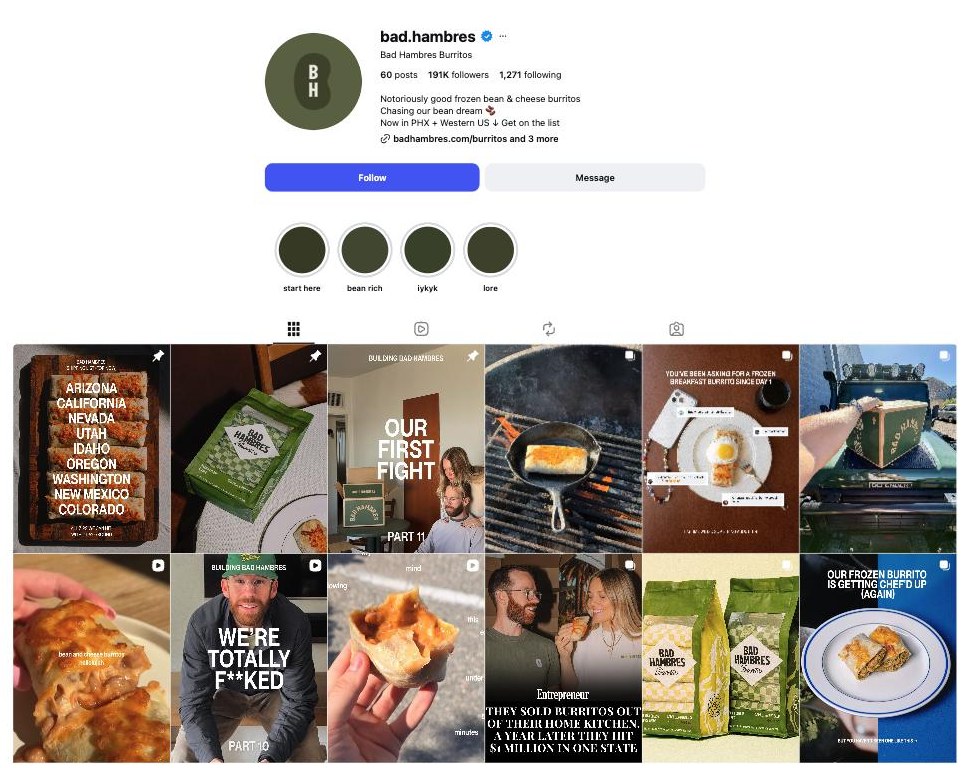 Sam of Bad Hambres, in conversation with the Cut30 coaches
The one idea
The product decision is the first content decision.
More context
A frozen bean & cheese burrito sells into a small, fanatical crowd, so every hook she writes already has better odds. Pick the client (or the client’s niche) whose audience is rabid, and the content gets easier for good. Sam and her husband Hank built Bad Hambres to $1M in first-year sales, in Arizona alone, with no paid ads and no influencers. It ran on one organic series. Her method treats a reel as applied psychology: open a curiosity loop and never let it close, put real money on the line, and make the viewer feel something before you ask for anything. Below is what she does, who she studies, and what we could try with it on our own clients.
When you take a bite and a little bit of bean and cheese squirts out, that shit pings. I’m not going to not build a million-dollar burrito company because it’s cringe. So embrace the cringe a little bit.
What this means for our clients
Read against the current client list. Check the dates before acting on one.
Give each talent one compounding signature hook
- @thisdermsays: ‘the derm who says what your derm won’t’
- Ally’s treatment room: stack visual + spoken + caption loops
- Bill hook-stack QA as a coaching add-on inside the retainer
Three on-camera talents plus a signed retainer make a ready-made hook lab.
Reframe the doc around escalating real stakes
- Greg’s number: what one paddle costs him vs what it sells for
- An honest $106K-style stake beats vague craftsmanship reverence
- Cut a five-hook GoFundMe trailer, emotional peak before the ask
Founder-quit-to-make-paddles is the Bad Hambres story. It drives the crowdfunding.
Steal hooks from outside medical-aesthetics
- The Comments Show is weekly already; swipe interior-design and food hooks in
- Build one shared swipe-folder JI runs across every MSP clinic
- Sell trial-reel testing as a monthly optimization line
An existing weekly series plus a multi-clinic footprint means the swipe system scales.
Pattern-interrupt a symphony’s stuffy feed
- Embrace the cringe: a musician’s bite or gesture as the scroll-stopper
- Realistic stakes: one player’s story, not ‘150-year institution’
- Bank hooks at the Oct 2/3 shoot; don’t just shoot pretty B-roll
Classical brands over-index on prestige; a human interrupt wins reach.
Seed the swipe folder as a real JI asset
Sam’s 300+ saved-hook folder is a system, not a takeaway. Stand up one shared JI hook-swipe board, give it an owner, and have every client feed it.
Translate the stakes; don’t transplant them
‘$1M not $1B’ is a burrito founder’s realism. A clinic’s believable stake is a maxed schedule or a botched-then-fixed result; a wealth firm’s is a $340K misstep. Same principle, different currency.
The tactics
Stack five hooks, not one
Visual, title, spoken, caption, and a pre-hook — five bets in the first two seconds.
The five aren’t sequential, they’re stacked into the same opening. A pre-hook fires before the recognizable series line, then the series hook does its job. Every one of them should open a loop or reinforce the main one. Most creators sweat a single opening line; she treats the first two seconds as five separate jobs.
· · ·
Coach: yeah whether accounts or just like actual things you're thinking about like biting a burrito or opening a door or any of the things that have been on your mind
Sam: yeah so i mean there's like i'm sure you guys talked about this there's the different of hooks. There's the visual hook, there's a title hook, there's the what you say, and then there's the caption hook. And so I'm really thinking about all five of those things. And I really want all five of them to open a loop of some kind and or reinforce the loop that's that I'm presenting in the beginning.
Coach: But for those that have never heard that before, because I think some people may not know the term open loop would love to get a quick description
· · ·
Let the signature hook compound
Bolt a new qualifier onto the same line every time; each one grabs a different viewer.
Video one was just ‘I quit my job to start a burrito company.’ Since then she keeps adding qualifiers to the same line: the wife, the Taco Bell. Each aims at a different person. She’ll make a real business decision partly because it sharpens the story; she half-jokes the five-year lease was for the hook.
· · ·
Coach: So the first place I want to take with you is I was just running through some serious stuff and how important it is, obviously, to escalate and take it up a notch. like you you took this so far beyond like we're a husband and wife and we quit our jobs to do a company right uh i guess walk us through like what that hook is and i guess like all the extra layers you've added to the story because at the end of the day like as a starting point it is like hey we quit our jobs to start a company it's like how a lot of people would start that video and that's very far from like how a bad ombre's video starts
Sam: well so like video number one so there's been 11 parts at this point. Video number one basically was that. And we just keep adding kind of like these qualifiers on the end of this hook that, so it's, hi, I'm Hank. I quit my nine to five job to start a frozen bean and cheese burrito company with my wife, Sam out of an old Taco Bell. And like all of those things hit someone, you know, somebody wanting to quit their nine to five, somebody wanting to start a business with their wife, it's men and women. Taco Bell, it's like a recognizable brand. And it just, it really does hook people. But that being said, we've kind of moved to a point where we have what I call like a pre-hook or like the real hook. And then that's like the more recognizable series hook. And so I will say like, I would say that there's content fatigue with that particular hook, but it is what is signature to the series. And once people stop the scroll, I think it really does hook them. And like, I mean, we, mom, this is what, this is one of my other quirks. I'm only as good as my last video. And so I feel like a total fraud talking to you guys. It's had an absolute flop. The one before that got, you know, over a million views. And it's literally like the same hook. And, but yeah, it's like, it's always evolving, I would say.
Coach: I feel like it's worth pointing out to everyone that Sam, who's a legend at this, also feels like she sucks at it from time to time, I'm sure.
· · ·
Steal hooks from a different niche
She mines interior-design creators for food content; borrowed devices read as fresh.
She keeps more than 300 saved folders on Instagram, sorted by hook type: visual, caption, title. When she needs one, she scrolls the folder. The freshness comes from lifting a device out of a category her own audience doesn’t watch.
· · ·
Coach: You know, the, the bite of the burrito thing, did you, were you like looking, looking for hooks and saw somebody else biting into a burger and we're like, let's try this. or is that like
Sam: yeah like and then you just a hundred percent and then on all of our other I mean I gotta be honest like on basically all of our storytelling I do storytelling for different for collabs and different kinds of things as well and all of the hooks that I use I take from somebody else in like a completely different niche like I feel like interior design those people are pumping out so much content they have like a finger on the pulse of what hooks are hooky um
Coach: what are a few of those that uh that you like or like things that that you've written down or kind of hooks that people here might feel like get some inspiration from
· · ·
Put real, believable money on the line
$106K more than the cash in the bank locks people in. $1B breaks the spell.
The number has to be real and believable. ‘$106,000 more than the cash in the bank’ is a true stake; a billion-dollar claim reads as fantasy. A maxed $3,000 card is just as true a stake as $100K. The point is honesty, not scale.
· · ·
Coach: yeah what was the angle that uh you ended up taking for that
Sam: so basically all of our these style of reels are um you know problem solution problem solution or like uh tension release tension release there's a big problem in the beginning so the big problem was we built this business with diy stickers baggies and paper wrappers but it wasn't going to work at scale. And then in that moment, it popped up with a soggy paper wrapper picture. And so it was like, okay, that's the big problem. And all in, we knew the first order was going to cost $106,000 more than the cash in our bank account. So that number $106,000 is a ton of money. And it literally was more than the cash in our bank account. And so that adds stakes. So an example I often use is like, if somebody is shooting half court shots, nobody gives a shit. But if somebody is shooting half court shots for a million dollars, like the entire stadium is locked in, right? And so anywhere where you can add stakes or like amp up what's on the line. And for our business, bootstrapping, it's just inherent in what we're doing. Like literally everything is life or death. Like all of our money is in this thing. Right. And we just started paying ourselves the tiniest little paycheck. And like we have credit cards maxed out, like the stakes are real. And so yeah, that was basically the angles, like it's going to cost this much and we're panicking. We got to get it done by the deadline. Packaging was late. Packaging showed up. Things weren't quite right. And at the end of the day, it all worked out, of course. And everything was sick. And so I always like to have a callback too. Like I always like for at the very end before I do a cliffhanger and a call to action, I like for there to be like an emotional peak. And so when people tell me like, oh, my gosh, I teared up watching this. That is the best compliment I could have. I am going for that every time. Like the entertainment that I think I'm providing is to make people feel something. like whether that's part of our journey or inspired to do their own thing. But in this case, it was like seeing the burritos in the final packaging for the first time actually made me emotional. It was like, damn, this bean dream might really work. And it like showed what the packaging was and what it is now. And like both of us kind of being emotional. And that's another that's another big thing. If you want people, we have like mirror neurons, right? As humans. And so when people see you experiencing an emotion, they also feel that emotion. And so a big thing that I have for our content is that we never act like we never like, okay, act as if this just happened. I just shoot everything on my iPhone. And the reason I do that is because whenever we're experiencing some kind of emotion, I just whip out my phone and capture what's actually happening. And I think that's been a big part of why it's been successful as well.
Coach: I think something you do is like you're talking us through how you add drama and pull people through the story and all these details. I think there's something to be said for the fact that like it's all real like none of it is made up and I think it'd be easy I know there are people here who are doing content around the business building it's like you have a packaging error and it would be easy to to to write that off as like god damn it carry carry on like you instead grab that and go okay how can we make that this like huge centerpiece of this really compelling video and I think it's easy you don't have to sign a five-year lease on a former Taco Bell, right? That works. That's pretty helpful too. But like there's little things throughout like that, like, or just like having a really meaningful amount of money on the line. Or I can't remember if it's one of your videos or another I'm thinking of, but it's like, you know, maxing out my credit card is subjective. Like I could spend $3,000 on a small credit card and I just maxed out my credit card. It doesn't have to be a hundred grand in order for for me to make that video about my business and have it be true and and then like inherently more compelling than like making up a billion dollar number or something like that but I don't know that uh I just want to call that out for everybody you do that in a masterful way um and like I gotta what does it mean to you like why why
· · ·
Use the cringe if it works
The burrito bite pings every time. It’s cringe and she uses it anyway.
The bite is a pattern interrupt: a physical jolt that re-grabs attention. When a story starts to drag or turns a corner, she drops another visual hook in to carry people over the hump. Cringe is not a reason to leave a working device on the table.
· · ·
Coach: Can you kind of break down your thought process when it comes to both verbal hooks, visual hooks? Because you're meticulous about one testing before the real life of change. But like you're very meticulous about about all of both your visual hooks, your verbal hooks, and then how you introduce like net new hooks in the video. Can you break that process down for us?
Sam: So there's the biting into the burrito hook, which is just the cringiest possible thing. But it fucking works, you guys. I don't know what to say. I tested so many hooks and trial reels when you could really like rip trial reels hard. And when you take a bite in and a little bit of bean and cheese squirts out, that shit pings. And like, what am I going to do? I'm going to not use that, even though it's cringe. Like I'm not going to build a million dollar burrito company because it's cringe. So I would just say like embrace the cringe a little bit, like to a, to a degree, like we have some standards. I'm not going to like pull a full like Mr. Beast situation, but yeah. So there's that hook, which is really critical to the series. And then throughout, I'm constantly like feeling when is this starting to feel slow? Or when is the, when are the words or when is the story starting to feel slow? I'll always put another visual hook in at that point. But I'm also thinking about the words too. How can I add more open loops throughout the story to keep people engaged? So there's like this internal voice that you have, or like you can hand your phone to someone and like have them watch the video. And when their eyes like pick up from the screen, you know, you lost them, but you have that internal voice inside you too of like, okay, I'm kind of bored now. Like I've lost interest. And those are the points where you kind of have to tweak and add that interest through yeah, visual hooks or open loops throughout.
Coach: You know, the, the bite of the burrito thing, did you, were you like looking, looking for hooks and saw somebody else biting into a burger and we're like, let's try this. or is that like
· · ·
Pace it to the caption
As fast as someone can read, no faster. She slowed one video and it hit 300K.
She watches everything muted first. If she’s talking faster than the captions can be read, that’s the ceiling. One video did nothing until she slowed it down, then it hit 300K with nothing else changed. Then she varies it: quick on transition words to loop people back, slow on the parts carrying the information.
· · ·
Coach: And then we can send it to everybody. That would, that'd be great.
Sam: But even, yeah, I'm just like skimming through some of these videos and without even sound on. And I'm like fighting to X out. Like I don't want to. Oh, that's another tip. Always watch without the sound on. And make sure you can read the captions. And like, if you're speaking faster than that, that's the pace. So the pace of the video is important. The pace that I found that's perfect is as fast as someone can read, but no faster. Like, but go that fast. I think it's different for different types of content. But that's what's worked for us.
Coach: But it's so true. Like, I remember you and I were texting about that. and you were like uh you said something along the lines of like i always like watching your videos but they're hard they're you go too fast and like in the next video i intentionally tried to slow down and i think that video then got like 300 000 views yeah like nothing of the structure was different of the video you know what i mean like it was just i slowed it down and i talked
· · ·
Hit an emotional peak before the ask
Mirror neurons do the work; shoot real-time on iPhone, never ‘act as if.’
She never re-stages a moment. Shooting real-time on iPhone keeps the emotion genuine, and mirror neurons do the rest — when a viewer watches you feel something, they feel it. Each reel runs tension then release, with a callback and an emotional beat right before the cliffhanger and the ask.
· · ·
Coach: yeah what was the angle that uh you ended up taking for that
Sam: so basically all of our these style of reels are um you know problem solution problem solution or like uh tension release tension release there's a big problem in the beginning so the big problem was we built this business with diy stickers baggies and paper wrappers but it wasn't going to work at scale. And then in that moment, it popped up with a soggy paper wrapper picture. And so it was like, okay, that's the big problem. And all in, we knew the first order was going to cost $106,000 more than the cash in our bank account. So that number $106,000 is a ton of money. And it literally was more than the cash in our bank account. And so that adds stakes. So an example I often use is like, if somebody is shooting half court shots, nobody gives a shit. But if somebody is shooting half court shots for a million dollars, like the entire stadium is locked in, right? And so anywhere where you can add stakes or like amp up what's on the line. And for our business, bootstrapping, it's just inherent in what we're doing. Like literally everything is life or death. Like all of our money is in this thing. Right. And we just started paying ourselves the tiniest little paycheck. And like we have credit cards maxed out, like the stakes are real. And so yeah, that was basically the angles, like it's going to cost this much and we're panicking. We got to get it done by the deadline. Packaging was late. Packaging showed up. Things weren't quite right. And at the end of the day, it all worked out, of course. And everything was sick. And so I always like to have a callback too. Like I always like for at the very end before I do a cliffhanger and a call to action, I like for there to be like an emotional peak. And so when people tell me like, oh, my gosh, I teared up watching this. That is the best compliment I could have. I am going for that every time. Like the entertainment that I think I'm providing is to make people feel something. like whether that's part of our journey or inspired to do their own thing. But in this case, it was like seeing the burritos in the final packaging for the first time actually made me emotional. It was like, damn, this bean dream might really work. And it like showed what the packaging was and what it is now. And like both of us kind of being emotional. And that's another that's another big thing. If you want people, we have like mirror neurons, right? As humans. And so when people see you experiencing an emotion, they also feel that emotion. And so a big thing that I have for our content is that we never act like we never like, okay, act as if this just happened. I just shoot everything on my iPhone. And the reason I do that is because whenever we're experiencing some kind of emotion, I just whip out my phone and capture what's actually happening. And I think that's been a big part of why it's been successful as well.
Coach: I think something you do is like you're talking us through how you add drama and pull people through the story and all these details. I think there's something to be said for the fact that like it's all real like none of it is made up and I think it'd be easy I know there are people here who are doing content around the business building it's like you have a packaging error and it would be easy to to to write that off as like god damn it carry carry on like you instead grab that and go okay how can we make that this like huge centerpiece of this really compelling video and I think it's easy you don't have to sign a five-year lease on a former Taco Bell, right? That works. That's pretty helpful too. But like there's little things throughout like that, like, or just like having a really meaningful amount of money on the line. Or I can't remember if it's one of your videos or another I'm thinking of, but it's like, you know, maxing out my credit card is subjective. Like I could spend $3,000 on a small credit card and I just maxed out my credit card. It doesn't have to be a hundred grand in order for for me to make that video about my business and have it be true and and then like inherently more compelling than like making up a billion dollar number or something like that but I don't know that uh I just want to call that out for everybody you do that in a masterful way um and like I gotta what does it mean to you like why why
· · ·
Who this is
Bad Hambres
Premium frozen bean & cheese burritos, sold direct online. From-scratch beans, Monterey Jack, house-made salsa, locally sourced tortillas. ‘Hambres’ is Spanish for hunger.
Hank Murphy cooked beans for 10 years, then in April 2024 made 120 burritos in his kitchen and sold them to friends while working a corporate job. Month two he sold out 300, then 600, then 1,000 in a day. He quit his job. His wife Sam, a designer, runs the content. Year one hit $1M in sales, Arizona only, with no paid ads.
Sam co-founded Bad Hambres with her husband Hank. She is the designer and content lead; he is the burrito obsessive who quit his corporate job. Year one: $1M in sales, Arizona only, fully organic. Now around 200K followers on Instagram and another 200K on TikTok, expanding across the US. She is meticulous to a fault, spending up to two weeks on one video, roughly 100 shots each, scripting over four days. She is a recurring Cut30 guest (also S19, S21, S22); this is her newest appearance.
More from this guest — Cohort 21 Zoom 4
Accounts they pointed at
- Bad HambresSam’s own brand — the ‘Building Bad Hambres’ series this whole talk is about.
- Nara SmithOren’s example of setting as the format: she makes recipes from scratch in couture, in her kitchen, every time.
- Ken SakataOren’s example of consistent framing: same desk, same jacket, same caption style — recognizable at a glance.
- Shift Fashion GroupOren’s example of a signature visual hook: they cut open a garment every video and explain how it’s made.
- Jenna PhippsAn interior-design creator Sam mines for hooks — a niche she says has ‘a finger on the pulse of what’s hooky.’
- The Avant GardeAnother interior-design account Sam pulls hooks from (her cross-niche stealing move).
- WacomoSam studies him for shot variety and telling ‘stories out of nothing’ — a lot of her shot inspiration.
- Tim NakiColin’s example of the journey series done right: a daily bet-per-follower on blackjack, stakes escalating each day.
- Jason SweatColin’s example of the resource series: ‘tools for lazy creatives’ — branded and aimed at a specific audience.
- Jessi JeanSam’s example of tying content to a deeper why — she anchors hers to supporting her son; ~$1.2M yap-challenge drop.
- Busy Beat MarketingColin’s example that a series can be a simple one-shot: practical business stories over a walk. Handle unconfirmed.
The vocabulary
- Hook stack
- Visual, title, spoken, caption, pre-hook: five jobs in two seconds
- Open loop
- A curiosity gap that keeps ‘what happens next’ alive
- Pattern interrupt
- A physical jolt (the bite) to re-grab attention
- Real stakes
- Genuine, believable numbers and deadlines, not invented billions
- Tension / release
- Problem then solution; a callback and emotional beat before the CTA
- Shot variation
- ~100 shots; never two wides in a row; selfie, tripod, walking
- Trial reels
- Test hooks in trial reels; re-edit and re-post flops with a new hook
- Readable pace
- As fast as captions read; vary speed on transitions vs knowledge
- Brandable series
- Two weekly series means only five fresh videos to invent a week
- Swipe system
- 300+ saved folders by hook type; shoot on iPhone in real time
On screen in the session
The source
Streams from johnny’s own Drive copy, about an hour. If it asks you to sign in, ask him to share the folder.
Read the full transcript (92 passages, auto-transcribed)
Coach: I don't know if people on this chat are old enough to remember when the PT Cruiser was just a default rental car everywhere. And it was just terrible. Although it carries quite a bit, not going to lie. Deceptively utilitarian, that's for sure.
Coach: The guy texted me. He was like, he made it in. Barely low. Drop your favorite model of Ford Taurus in the chat. One for 90 to 95. No, I'm just joking.
Coach: All right. Week four, middle of summer. We're getting a little loopy. Not going to lie. So we'll try to keep it lighthearted today.
Coach: That's because you've been on a yacht.
Coach: Yeah, I'm lighthearted for a number of reasons. I'm jet lagged.
Coach: All right. So today we are going to hit week four. So this is our final week. We're going to touch on some of the logistics of what happens as this ends. We are going to go through the seven-day challenge, which is how we end this. We have our guest, which is Sam from Bad Hombres, who is an awesome brand builder and one of our favorite guests. We've had her back a bunch. She's used to talking to the squad here. And then we're going to go through some things around planning and analytics and finding your format and some of these more important conceptual things. So I think we can start with the logistics. This is the last of these Zooms. We are going to do several office hours. We usually end with almost every day, not quite every day coming up here, but you should see one of us Thursday, Friday, Monday. It's just not Sunday.
Coach: Yeah, it's not every day, but Sunday from here.
Coach: Got it. Yeah. You will see us on Thursday, Friday, Saturday, Monday. And then we are going to Tuesday is the final day that we are in Slack. Slack, we will basically keep up for a few days after that, but the team will stop answering questions in there of day Tuesday. We will cover anything that is posted in any of the channels until then. And then the Slack does go away. So if you have anything you want to capture from that, we would recommend grabbing it or screenshotting it. Your Kajabi does not go away though. So you have access to that login all the time. We do some, we used to do minor updates regularly. Now we do big updates less frequently. So for those who haven't been in there in a while, things like the graphic yap and stuff like that did not exist a couple months ago. So you can always come back and check. There is a lot in there for probably more than you've dealt with here. Instagram stories, planning, hooks, brand deals. So use that as an ongoing resource. But we will be, yeah, just trying to get everyone locked in on finishing up these couple days here strong. So the quick note on that seven-day challenge and on what we're going to talk about here, what we really want you to do this last week is like find your unique voice, right? So a lot of you have found that, hey, my carousel is my best performing post. or hey, I got this one video that did a lot better than some of the other stuff. Usually by now, everyone's found that, hey, I got at least one thing that did better than I expected. So what we want you to do this week is not just make a bunch of videos to make videos. We want you to double down on that stuff that you've seen work to start to take this whole toolkit you have. Okay, I got carousels and yaps and green screens and 10 shots and actually think about what your strategy is. So we'll talk a bit about that in the format section. But I just want to keep that in mind, that your goal this week should be to repeat some of the things you've won at and start to find your original voice. Alex, you want to hit calendar and planning?
Alex: Yep. I'm going to hit two. All right. Y'all can see this okay?
Coach: Yes, sir.
Alex: Okay, cool. That's awesome. All right, guys. So I'll start with this where most of you probably would have wanted to have a content calendar on week one. The reason we don't give you a content calendar is week one because it's so easy to get wrapped up in the content strategy, having the perfect system, perfect process, the pipeline that you love to look at, but has a bunch of information and content that never gets shipped, right? Like that was the last thing that we wanted to happen. So in week four, the last week, now that you're doing seven day challenge, now that you're going to be on your own and hopefully making content until until your last day. This is when we give you the content calendar, because the goal is now for you to have some kind of system, even if it's if it's quite simple to be able to start organizing everything that you're doing. And so we built out this content calendar for you. It's very easy to use. You can easily customize it. You can change all sorts of different variables and properties within it. But I'll show you how to use it. So first thing, if you use Notion, you can easily bring this into your workspace. So you're just going to hit the three dots in the corner. That's going to allow you to hit duplicate. And then as soon as you duplicate it, you can put it into your workspace and bring it right over. The next thing is there's this pipeline view. So this pipeline view is very simple. So right now there's to do in progress complete. You can add different properties. You could add different steps within this. We already built out some templates that you can use. So if you hit new video, you can change all these properties. You could have the platforms that it's going to go on. You could have the pillars. You could have the formats. You could have basically add any of the properties you need. The reality too is probably the less amount of properties that you have, the better. A lot of people like to get crazy with this. And then in reality, only fill out two or three every single time. A lot of it is overkill. So just put in what you need to have. The next part is we have a little template for you that's just like the video script where you can put the different hook, you can brainstorm your different hooks, the bullet point value as in like, hey, like these are the things I want to make sure that somebody is walking away or watching this video is walking away with this guy from. And then if you have a CTA, if it's needed or wanted, most of you will not be putting CTAs in your videos. And then the other key part about this is this video posting checklist. The reality is this is going to be a two to three minute thing that you should run through every single time you make a piece of content until nearly everything is muscle memory, right? The reality is there's still so many times that I'll record a video and I don't turn the light on or I don't have my mic plugged in or I don't turn on my mic. I speak very fast when I record my videos. Like all of these little things that it kind of reminds you and it reminds you about here you want to look at. You want to run through it. You kind of want to remind yourself of these things so that you don't record four videos. You think you're getting ahead and then, you know, you didn't have your mic on and there's no audio and you're just not talking to anybody. Right. Like we don't we don't want that to happen. So good, good habit to just run through this. Even if it's very brief, just look at these things. You don't have to check them off, but they're here if you want to make it a habit. Now, the next part is down here. There is a calendar view that you can have. This calendar view is based off the different tagging, like the tagging system within here. So like if I take this cut 30, the final video and I do, you know, 20th and then I change the different properties within here. So in progress, then it will it would pop up within within here. And so with that, you can switch and you could kind of change all of the different things that you want to have within this within this calendar. So if you want to, again, like have it to be just everything that's in progress, everything that's getting edited, everything that's getting scripted, whatever the case may be, you can have and or build that out so that you have that view. This is just the master calendar. This will show everything and anything that's getting worked on. But overall, it's a very simple pipeline. Everything could be edited as soon as you put this into your workspace. You can make it however you want to have it. And the reality is the best kind of operations and process is the thing that's going to help you ship the most videos and the best videos as often, as fast as possible. If this doesn't work for you, don't do it. Don't try to force it. If you operate better with the notes app or just your crazy system of getting ideas and shipping ideas, then run with that. And then the last thing on mine is like, don't think that you need, you have to have this to start posting every single day. You know, like, you know, this is going to wrap up next Tuesday and you're going to have this system. You don't need to make this perfect system. You know, me, Colin and Lauren, we built, or we all had videos get millions and millions of views that were just like ideas in our notes app. And then eventually, you know, as we started building out teams, et cetera, it was like, okay, we have to have some kind of process and system that everybody could, could live by. And so that's when, you know, this truly made sense. But you don't need it to be successful. You don't need to have the perfect process and ops and system to ship videos. You just have to make – banger videos will always win. That is our motto at InCut.
Oren: Amen. Always win. You know, as with everything, the best system is the one that works that you will use, right? And that probably can't be said enough. And it is critical to not let having a great system or perfect strategy get in the way of just making, like Alex said, the next video. So it's worth saying 10 times. Or in formats. We are going to talk about this idea of a format. So what do we mean by that? So you will notice that in the, what we have shared so far and in all the homework you've had, we have basically wanted you to do very specific things. We want you to use the same titles. We want you to use the same captions. We correct you pretty frequently on this. And what you'll notice is if you paid attention to that, things improve. Hook rates improve, the amount of time people are watching. People are used to seeing specific things. We want you used to the vernacular of what happens on the internet. Now, once you've kind of gotten the basic understanding of that, which most people have by the end of Cut30, we want you to start thinking about what can make you unique as a creator. And this comes from a few things. I'm going to go through some examples here in a second about it. The first is the setting. Where are you filming yourself and how do you make it interesting? And so an example of this would be this creator, Nara Smith, who's here in the middle, who basically, Let's see if I can blow this up. She is in her kitchen for most of her videos, making something from scratch, wearing couture each time. She is basically taking this idea that I'm going to make a recipe and elevated it with her setting and what she's wearing. Same thing with my friend Ken Sakata. He is basically sitting at his desk most of the time. He's changed this up now. Sometimes he's standing. We'll notice the framing is almost always the same. When he started out, he would always have a book in the foreground and it would change. He would be wearing a similar jacket. He would be using the same caption style we recommend, but he chose yellow with the black outline and began to feel a little more like him. So all people also choose to do a specific thing. You may have noticed that some of your videos have done better than others if you did a specific style of breakdown, etc. So one of these creators, Shift Fashion Group, every time they do, they have basically a marquee series where they cut open a piece of clothing. The same visual hook where they cut it and they walk through and explain all the things and how something like that is made. They use the same title with the logo and the thing on all the videos and it becomes a signature. There's a bunch of these examples that you will find inside Kajabi where we actually have gone through a number of these. Same applies for carousel styles, how you use your house. If you use a green screen, making your own kind of version of a title that looks a little bit more unique. Hans, who came from here, he darkens his content a little bit on there as well. Some people play around with the actual layouts they've designed, like this creator here. And some people are just doing actions with their content. We've talked about yapping. This guy yaps while cutting wood, right? So what we want you to think about is what can you do to make your content unique? Pick one to two things of like, okay, the setting I'm sitting at, how can I really dial in my setup to make it interesting? Or how do I add an activity? Can I be, if I'm talking about a brand, can I be cutting open their clothing? If I'm yapping, can I always be whatever your equivalent of chopping wood is? And then begin to think about, okay, my titles, do I want to have a slightly more unique look? Does that look visually interesting? Workshop that stuff with us here in Idea Workshopping in this last week. Any of those ideas you have or things you want to do to make it unique for your own creating, this is your opportunity to start getting a little more creative here and thinking about what that future looks like. And again, we have tons of those references in Kajabi for you. colin do you want to hit the series
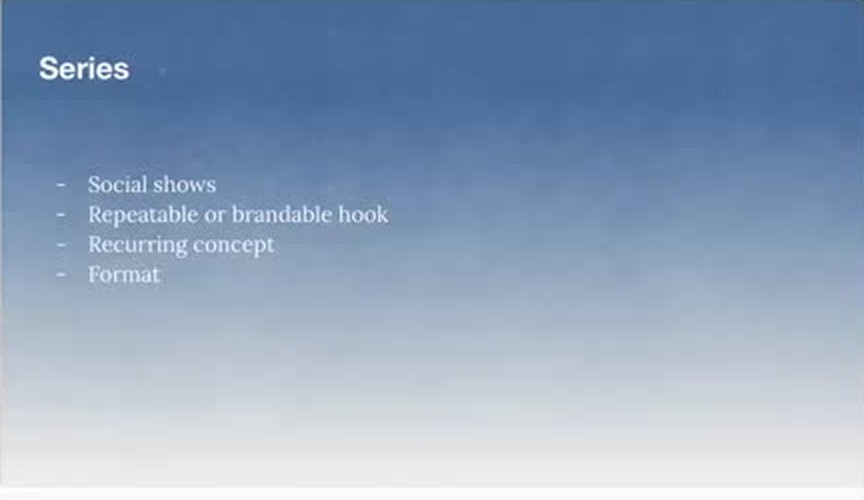
Colin: yes sir here we go so i think something we've breezed over a little bit here today is that the next seven days are our famous seven day challenge seven day sprint to close this thing out and critically all of our biggest success stories the biggest success stories out of this group are going to come from people who hit the next seven days with a video every single day and then basically don't stop that for the foreseeable future right whether it's 60 or 90 or 120 days all of our biggest success stories um hit that cadence at least for a few months it does incredible things it's obviously very productive for your algo you will you will be so much better at this three or four months from now um and and critically you'll have 100 plus shots on goal so that begins tomorrow and then the office hours that oren mentioned are in support of that, right? So we're going to be doing a quick stand-up, 15, 20 minutes every day with everybody that's doing the seven-day sprint to talk about what ideas you have, what you need help with as you're embarking on the first seven days of that daily journey. And with that, there is no better time to talk a little bit about series. There we go. Because as we set out to make a video every single day, If you can lock down a series or two, that's going to make your life a lot easier to fill in, right? If we can do two weekly series, now we only have to come up with five videos a week, right? So series, we've all seen them, right? These are social shows. They can be as simple as a video with a repeatable and hopefully brandable hook that you do over and over again. Maybe it's a recurring concept, or as Orin just mentioned, it's your format and a specific topic within that format that you do on Fridays or something similar to that. Some of our favorite examples here, I was just thinking about how these haven't updated in a while, and I'm okay with that because these are all like apex predators here. So some common series are, first of all, the journey, right? This is the classic day X of doing Y, doing X every day until Y, so on and so forth. As we've told you by now, if you're going to do this, you need to take it up like seven or eight notches, all right? The example here is Tim Nackie, which is one of the best examples of this of all time, who did, I am betting like a dollar for every follower I get, which had this money element. It had this growth element. And every single day, there was more and more dollars on the line. And it was ridiculous. This can be really, really overdone. Again, you need to be doing something novel. You need to have a good spin on it. There needs to be several layers to it. We're going to talk more about this in a few minutes with Sam. But do not do a basic version of this or of anything, I guess. But you get the idea. The other is the resource. So again, branded. So here's a thing, part 73. Jason, noted Cut30 alum with his tools for lazy creatives, right? At the core, this is like, here's software that I use, part seven, part eight, part nine, right? But he branded it. He made it his own while also speaking more to the audience that that's for. It's not just for creatives. It's for lazy creatives. And that was born out of a really good video that he turned into a recurring series. And then there's, of course, the commentary. Oren's famous product versus brand, which was an evolution of a successful hook and concept that he kept iterating on and landed here. And then we've seen this. I don't know how much of a part of his content is these days, but certainly in the past, it's been a weekly. Now it's probably every few weeks when he feels inspired. But again, same hook, different concept. And there's more here than just the hook when you dive into the structure of these videos. But it is something he can come back to over and over again into the future as he wants to. These are all helpful mechanisms, but I don't want to just breathe over this without calling out that a series can be a one-shot, right? Busy Beat Marketing is a Cut30 alum whose series is just like kind of practical business stories over one shot of her walking down the street, right? They do not have to be ultra produced. A series could be a carousel, so on and so forth. At any rate, locking these in will give your followers something to expect from you. It checks the box on brainstorming a video every week or every couple of weeks or whatever the case may be. And will be very productive overall. Tons of examples of those in Kajabi and beyond. And there's literally no better guest to talk about series with than Sam. who I think is here. But I guess real quick before Sam, to restate, your only homework this week is to make seven videos over the next seven days. That is your only homework. Let the games begin. And let's get ready to take it up a notch.
Coach: Now, without any further ado, I think I saw Sam earlier, is she? Yep. The legend. There we go. Alex, you want to do the intro?
Alex: Yep, yep. I'll hit. So long story short, Sam is the GOAT. that quite frankly can be the intro. But if you guys haven't seen Bad Ombedness on social, Sam is the mastermind behind everything that they do on the content side. She is the wife of Hank. They're both building Bad Ombedness day-to-day and have built not only like an amazing product that, I forget the crazy number it is, but like sold some 100,000 or something crazy just in Arizona before expanding. But they've also built nearly 200,000 followers just on IG. probably another 200,000 followers on TikTok at the beginning just off one series. And then this year they really expanded their content players in the different formats that they're doing. But Sam is also like, and this is one of the first things I want to get into is like meticulous about everything she does with every single video. And we'll sometimes spend like two weeks on one video. And it's dope to hear her thought process behind it. But Sam, if you want to give an intro and then we can dive into questions.
Sam: Hi, guys. I'm Sam. Like I said, I started Bad Hombres with my husband, Hank. We sell premium frozen bean and cheese burritos on the internet, which is a good hook in itself. And in our first year, we bootstrapped to a million in sales, just selling burritos in Arizona, just with organic marketing. And the reason I mentioned that is not like a humble brag. It's just to show you the power of organic content. It really, if you can find a concept that works, you can really grow a business on the back of that. And so we're in our second year now and we expanded to the Western US and we have just recently started layering more marketing channels in. We're starting to grow the team. The business is getting legit. Things are feeling good. But at the core of everything, I think for us, organic content and collabs will be the two big marketing engines in our strategy going forward.
Coach: I just want to restate that a million dollars only in Arizona of burritos just off an Instagram account. It's crazy.
Sam: It's crazy. Zero paid. Zero influencers. Zero anything.
Coach: So Boyd says if you expand it to all 50 states, you'd be doing 50 million first year. That's easy. It's easy math, guys. Easy as that.
Sam: We can't know. We've been really happy with the growth that we've had. And in two weeks, actually, we're launching East Coast. And yeah, it's kind of, it's been a wild ride for sure. But anyway, we grew our account pretty much on this Building Bad Ombre series. And I love talking about this stuff. Our strategy has been quality over quantity, which is not something I would necessarily recommend. It's more part of my quirks and personality than I would say a strategy you should follow. But I am an open book and happy to answer any questions.
Coach: So the first place I want to take with you is I was just running through some serious stuff and how important it is, obviously, to escalate and take it up a notch. like you you took this so far beyond like we're a husband and wife and we quit our jobs to do a company right uh i guess walk us through like what that hook is and i guess like all the extra layers you've added to the story because at the end of the day like as a starting point it is like hey we quit our jobs to start a company it's like how a lot of people would start that video and that's very far from like how a bad ombre's video starts
Sam: well so like video number one so there's been 11 parts at this point. Video number one basically was that. And we just keep adding kind of like these qualifiers on the end of this hook that, so it's, hi, I'm Hank. I quit my nine to five job to start a frozen bean and cheese burrito company with my wife, Sam out of an old Taco Bell. And like all of those things hit someone, you know, somebody wanting to quit their nine to five, somebody wanting to start a business with their wife, it's men and women. Taco Bell, it's like a recognizable brand. And it just, it really does hook people. But that being said, we've kind of moved to a point where we have what I call like a pre-hook or like the real hook. And then that's like the more recognizable series hook. And so I will say like, I would say that there's content fatigue with that particular hook, but it is what is signature to the series. And once people stop the scroll, I think it really does hook them. And like, I mean, we, mom, this is what, this is one of my other quirks. I'm only as good as my last video. And so I feel like a total fraud talking to you guys. It's had an absolute flop. The one before that got, you know, over a million views. And it's literally like the same hook. And, but yeah, it's like, it's always evolving, I would say.
Coach: I feel like it's worth pointing out to everyone that Sam, who's a legend at this, also feels like she sucks at it from time to time, I'm sure.
Sam: Literally every day.
Coach: Yeah, you're not alone. Yo, you added the Taco Bell thing. Like, obviously, you didn't have a Taco Bell building on day one of doing this. Right. That, like, kind of came into the mix later, right?
Sam: Yeah. And I knew it would be such a good story. Like, it was part of the reason that we went after this building so hard is I knew it would be a good hook, honestly.
Coach: The five-year lease for the hook.
Sam: Yeah, I'm constantly thinking about that. Like we're doing this, a new collab dropping in October and there are like these challenges with it. I'm like, honestly, let's do that. It makes a good story. I'm constantly thinking through things through the lens of what would make it a good story and kind of making choices based on that.
Coach: Can you kind of break down your thought process when it comes to both verbal hooks, visual hooks? Because you're meticulous about one testing before the real life of change. But like you're very meticulous about about all of both your visual hooks, your verbal hooks, and then how you introduce like net new hooks in the video. Can you break that process down for us?
Sam: So there's the biting into the burrito hook, which is just the cringiest possible thing. But it fucking works, you guys. I don't know what to say. I tested so many hooks and trial reels when you could really like rip trial reels hard. And when you take a bite in and a little bit of bean and cheese squirts out, that shit pings. And like, what am I going to do? I'm going to not use that, even though it's cringe. Like I'm not going to build a million dollar burrito company because it's cringe. So I would just say like embrace the cringe a little bit, like to a, to a degree, like we have some standards. I'm not going to like pull a full like Mr. Beast situation, but yeah. So there's that hook, which is really critical to the series. And then throughout, I'm constantly like feeling when is this starting to feel slow? Or when is the, when are the words or when is the story starting to feel slow? I'll always put another visual hook in at that point. But I'm also thinking about the words too. How can I add more open loops throughout the story to keep people engaged? So there's like this internal voice that you have, or like you can hand your phone to someone and like have them watch the video. And when their eyes like pick up from the screen, you know, you lost them, but you have that internal voice inside you too of like, okay, I'm kind of bored now. Like I've lost interest. And those are the points where you kind of have to tweak and add that interest through yeah, visual hooks or open loops throughout.
Coach: You know, the, the bite of the burrito thing, did you, were you like looking, looking for hooks and saw somebody else biting into a burger and we're like, let's try this. or is that like
Sam: yeah like and then you just a hundred percent and then on all of our other I mean I gotta be honest like on basically all of our storytelling I do storytelling for different for collabs and different kinds of things as well and all of the hooks that I use I take from somebody else in like a completely different niche like I feel like interior design those people are pumping out so much content they have like a finger on the pulse of what hooks are hooky um
Coach: what are a few of those that uh that you like or like things that that you've written down or kind of hooks that people here might feel like get some inspiration from
Sam: yeah uh like specific accounts
Coach: yeah whether accounts or just like actual things you're thinking about like biting a burrito or opening a door or any of the things that have been on your mind
Sam: yeah so i mean there's like i'm sure you guys talked about this there's the different of hooks. There's the visual hook, there's a title hook, there's the what you say, and then there's the caption hook. And so I'm really thinking about all five of those things. And I really want all five of them to open a loop of some kind and or reinforce the loop that's that I'm presenting in the beginning.
Coach: But for those that have never heard that before, because I think some people may not know the term open loop would love to get a quick description
Sam: so it basically is like a curiosity gap which is also lingo um so it just like opens a question in your mind like what's going to happen next ultimately it's just what's going to happen next um so uh i i always try to have that and then the i feel like the biting the burrito is a pattern interrupt and so it's like when you can do and particularly the beans like kind of squirting out of the burrito like I don't know trigger something in the human brain I don't know I can't explain it um but uh so when I'm looking at other accounts I'm looking at like I feel like you know that we talk about the pope in the pool where you're like doing something with your hands like the chopping wood guy while he's talking um like to be able to find that thing that adds more it's kind of like more stimulation honestly like we are ultimately this is a game of psychology and we are hacking the attention of the viewer and I think like to think I'm using that power for good um but at the end of the day It's like, what's going to stop the scroll? And I actually, the number one thing where I get inspiration from is when I stop my scroll and I watch to the end, I have a full just like saved folder of those. And like, I have 300 folders of saved posts in Instagram. And it's like, I'll have one for hooks. I'll have one for, and then it'll be even more niche. I'll have one for visual hooks. I'll have one for caption hooks. I'll have one for title hooks. And whenever I like need to pull something for a video, I just scroll through and really good inspiration that way.
Coach: You said something earlier that was, that was interesting where you said like, if you feel like something's getting boring and within the video, you'll like insert another visual hook. Have you found like a timestamp or like a second mark that that usually happens where you're like, hey, you know, anytime around the eight second mark or the 12 second mark, I have to put in another visual hook or what?
Sam: Not really. It's more so when I feel like just like internally, the story is dragging or like when a story pivots, it's like I want them to go on to the next part of the story. I have found that that helps getting them over that that hump.
Coach: and then for everyone here can you give um an example of what you meant in one of your videos like when you introduce like a an open loop in the video
Sam: uh yes um so for example
Coach: yours are so good because they're so clear cut like you lay you just you lay it out so clearly in your videos they're not hard to pick up on once you're looking for them. I don't know if that's a good thing or a bad thing, but I think that's what makes it universally watchable.
Sam: Yeah,
Coach: even if you're not into burritos in Arizona.
Sam: Yeah, exactly. Yeah. Let me just pull up a script. um for example okay so a curiosity loop this is part 10 this one like did over a million views it starts we're totally fucked sleeped out and anytime you can bleep in the uh hook i feel like i don't know it works are fun yeah it's good um and then uh i it goes on to like the series hook said before i'm hank and 19 months ago i quit my 95 job blah blah blah and then so this that's like the the open loop is we're totally fucked how are they totally fucked i gotta know how they're fucked and then um the uh like series hook is like they really just quit their jobs and start to do this crazy thing how is that working out for them that's another open loop and then i always other open loop right after that. And for this one was, we somehow grew this thing to a million dollar business last year. And we did it with DIY stickers, baggies and paper wrappers, which got the job done, but it wasn't going to work at scale. So it's like presenting a problem, like the million dollar business, like anytime you can have like numbers or big numbers, that's also hooky. Just like people know it's, I don't know, something about numbers and psychology as well in general.
Coach: But I would like to call out realistic numbers on that because we've had some people that have like hopped on that and been like a billion dollar. And like what I like about a million is it's realistic to a business that people say, hey, I could do that versus something that's like some insanely big one. So just a quick note for people out there, realistic numbers are great.
Sam: Oh, yeah. And I said we grew this thing to a million dollar business last year. I never say like, I want to be the next billion dollar frozen bean and cheese burrito company. I don't. Even though I kind of do, but yeah, maybe that could work. I don't know. But yeah, it's more that that's another that's a good point, actually, because when we started this series, it was like Hank and I doing everything. And that was super relatable. And now we're like behind the computer 99.9% of the time. And we have a team doing, you know, stirring the beans and rolling the burritos. And so like the visuals, we've had to get more creative, I would say. In this script that I'm talking about right now, um it's a story about just designing new packaging and I was like this is going to be a tough one how can I make like designing new packaging interesting whatsoever but I wasn't expecting it to perform as well as it performed to be honest
Coach: yeah what was the angle that uh you ended up taking for that
Sam: so basically all of our these style of reels are um you know problem solution problem solution or like uh tension release tension release there's a big problem in the beginning so the big problem was we built this business with diy stickers baggies and paper wrappers but it wasn't going to work at scale. And then in that moment, it popped up with a soggy paper wrapper picture. And so it was like, okay, that's the big problem. And all in, we knew the first order was going to cost $106,000 more than the cash in our bank account. So that number $106,000 is a ton of money. And it literally was more than the cash in our bank account. And so that adds stakes. So an example I often use is like, if somebody is shooting half court shots, nobody gives a shit. But if somebody is shooting half court shots for a million dollars, like the entire stadium is locked in, right? And so anywhere where you can add stakes or like amp up what's on the line. And for our business, bootstrapping, it's just inherent in what we're doing. Like literally everything is life or death. Like all of our money is in this thing. Right. And we just started paying ourselves the tiniest little paycheck. And like we have credit cards maxed out, like the stakes are real. And so yeah, that was basically the angles, like it's going to cost this much and we're panicking. We got to get it done by the deadline. Packaging was late. Packaging showed up. Things weren't quite right. And at the end of the day, it all worked out, of course. And everything was sick. And so I always like to have a callback too. Like I always like for at the very end before I do a cliffhanger and a call to action, I like for there to be like an emotional peak. And so when people tell me like, oh, my gosh, I teared up watching this. That is the best compliment I could have. I am going for that every time. Like the entertainment that I think I'm providing is to make people feel something. like whether that's part of our journey or inspired to do their own thing. But in this case, it was like seeing the burritos in the final packaging for the first time actually made me emotional. It was like, damn, this bean dream might really work. And it like showed what the packaging was and what it is now. And like both of us kind of being emotional. And that's another that's another big thing. If you want people, we have like mirror neurons, right? As humans. And so when people see you experiencing an emotion, they also feel that emotion. And so a big thing that I have for our content is that we never act like we never like, okay, act as if this just happened. I just shoot everything on my iPhone. And the reason I do that is because whenever we're experiencing some kind of emotion, I just whip out my phone and capture what's actually happening. And I think that's been a big part of why it's been successful as well.
Coach: I think something you do is like you're talking us through how you add drama and pull people through the story and all these details. I think there's something to be said for the fact that like it's all real like none of it is made up and I think it'd be easy I know there are people here who are doing content around the business building it's like you have a packaging error and it would be easy to to to write that off as like god damn it carry carry on like you instead grab that and go okay how can we make that this like huge centerpiece of this really compelling video and I think it's easy you don't have to sign a five-year lease on a former Taco Bell, right? That works. That's pretty helpful too. But like there's little things throughout like that, like, or just like having a really meaningful amount of money on the line. Or I can't remember if it's one of your videos or another I'm thinking of, but it's like, you know, maxing out my credit card is subjective. Like I could spend $3,000 on a small credit card and I just maxed out my credit card. It doesn't have to be a hundred grand in order for for me to make that video about my business and have it be true and and then like inherently more compelling than like making up a billion dollar number or something like that but I don't know that uh I just want to call that out for everybody you do that in a masterful way um and like I gotta what does it mean to you like why why
Sam: you know like everything that we are posting about is like directly tied to our lives and our livelihood in some way and like is it like uh jesse gene have you guys she like had that million dollar uh drop like she ties everything back to like supporting her son and um so it's like there's always some deeper like what's your why that you can tie to the stakes yeah
Coach: um what was i just gonna ask you i'll make a note while you're thinking about that too that if you are if you don't have a business like sam or you are telling other stories i think you can still take away quite a lot from this and that if you are trying to tell a story about i know we had someone in here who's doing stuff on like how to get a fashion degree or get into a fashion school it's like you can tell the story of someone who like applied and failed and reapplied again and what what did they do and what did that situation look like for them and like think of any of the stories you tell around business and your niche with some of these same techniques and then you're sharing learnings from it is equally as as powerful so i would say like if you are an expert looking at this too i'd be thinking about how do you use some of these same techniques in the examples that you're providing for whatever you're making content about
Coach: amen um where i was going to take this sam was you're you're a bean and cheese burrito person right and this is like a thing i didn't know this before meeting you that bean and cheese burritos are a thing oh it's like a large group of people's favorite food right so i think it's worth calling out i'm thinking about this because like i wrote a whole newsletter about about your guys content and and this is a big part of it is like this doesn't work with like a coffee shop because like that's been done a million times and like coffee's not special the bean and cheese burrito like and to the to the same end like doing the like billion dollar frozen food company is like not compelling like just because it's so wide for you it's like this hook every hook you do has better odds because you are speaking so directly to such a specific person and an existing community that you're going into and that kind of comes back to like that's the first business decision you made was a product decision and it was to do a product to sell into a rabid community right and like that as a starting point is going to make like every piece of content you make is much easier
Sam: that was and it's so it's just so almost absurd a frozen bean and cheese burrito company it's just so specific um like that was not part of the reason that we chose like the literal reason we started this business is because my husband has been obsessed with making them for 10 years but i think like the stars just kind of aligned for us with that one
Coach: it's very true it's there's a there's a good question here Sam it says how much time do you put into each step of making a video filming scripting editing reviewing etc
Sam: I uh just like always have my phone out and so I'm just always capturing everything so uh there's never any like set filming times it's just capturing what we're doing and then um scripting. I, I spread it out over maybe like this. I'm like embarrassed to admit this, how long it takes me, but I spread it out over maybe like four days and I maybe like an hour each day. Just because like having time between each time looking at it, it just gets so much better. in my mind, will think of ideas between just like back burner. Like you just have to give your brain space to come up with these things. And then right now, honestly, the thing that takes the longest, which is such a freaking pain in the ass is finding the right video to go with the words. Like as, and this is like part of the reason that it's like impossible for me to delegate to someone as I'm writing the script, I'm thinking in my mind what clips I have. And there's like a thousand clips to choose from. I mean, more than that. Like now, if I go like all the way back, but between parts, I will have taken like a thousand video clips. Like it's so dumb and insane. And I have to like literally go through all of them on my phone. There's gotta be a better way. I've seen some people like build some things with cloud code to, uh, I don't know, help you go through those. I, but anyway, that, that takes like a full day. I'm not going to lie. And, um, now I have actually an editor who takes the first pass at it and, um, it's never in its final state, even then going back and forth it's never perfect so I have them send me the premiere file and then I go back through maybe spend like a half a day making sure it's it's perfect and like again I'm not sure if I would advise what I'm doing but that is the truth
Coach: how do you think about collecting shots like I know you said you just whip out your phone all there you thinking about like wide shots close shots yeah you think about all that
Sam: definitely I mean I like to try to never have two wide shots right after each other I try to like go between wide medium close up I don't even know the names for these things to be honest um so in any kind of like circumstance where I have my phone out I try to get one of those at least and then like vary the types of shots like sometimes it's selfie sometimes it's on a tripod sometimes it's in my hand sometimes we're walking sometimes we're stills it's I think the more you can vary the shots between each shot the better
Coach: have you counted how many should typically go in one of your videos what have you counted how many shots goes like go typically into one of your videos
Sam: um like a hundred which is it's you guys i wouldn't necessarily advise it okay
Coach: but you made it work it works
Sam: uh but i've said this before it's a big bet it's really time intensive and it sometimes they flop at the end of the day um but i will say uh when they do flop i do typically get them to do well in trial reels so like this is another thing that i do that i actually think this is a good idea after i post i learned so much i learned the people's reaction to it like just the comments I feel like tell me so much and like even before I post you know I can see kind of like fall off and trial reels but after I really post to our audience I just like learn a lot and so I'll take another pass at it and edit it one more time and put it in trial reels and this last time I had a different version of tech talk than I had in Instagram and I changed the hook. The hook, it all comes down to the hook. That's what's so frustrating. Like I can spend freaking like two weeks on one of these videos. And if the hook doesn't hook, it's all for nothing essentially.
Coach: We got a bunch of, a handful of questions to rip through here with our next nine minutes. When you write scripts before hook ideation or anything, Do you have a general idea of how to land the plane for the whole video? Do you ideate what the whole video is or even series will be? Yeah, talk to us.
Sam: Yes, I know how the video is going to end. I know how the video is going to start. And then my first pass at it is basically, how would I tell this story to a friend in a way that would be interesting? But yeah. And then what was another question?
Coach: I like that. Next one. I'd love to know Sam's favorite accounts that she gets inspiration from.
Sam: Yeah. Oh, you specifically mentioned interior design. Let's see. I'm going down to interior design to Algo right now. I mean, these people are pumping. Jenna Phipps. She's a big one. Oh, my gosh. What's this chick's name? The Avant Garde. yeah um she i'm putting links to these in the chat you guys if you want them really rips um let's see what are some other ones that i look at the avant-garde like the the the no this is not i feel like i follow that account where i'm not finding it I think this is the right one. It's like, I really like pulling from non-CPG, non-food accounts because it feels fresh in food accounts. This guy at Wacomo, W-A-C-O-M-O, he's so good at storytelling.
Coach: um how do you spell that one
Sam: w-a-c-o-m-o oh yeah this guy's i just put in the chat he's so good at like the different shots i get a lot of shot inspiration from him um the people who really inspire me are people who tell stories out of nothing there's like there's not even really a story there but they found a way to make it a story and make it super engaging. I can send more in the chat after.
Coach: Yeah, if you can send us some.
Sam: Yeah.
Coach: And then we can send it to everybody. That would, that'd be great.
Sam: But even, yeah, I'm just like skimming through some of these videos and without even sound on. And I'm like fighting to X out. Like I don't want to. Oh, that's another tip. Always watch without the sound on. And make sure you can read the captions. And like, if you're speaking faster than that, that's the pace. So the pace of the video is important. The pace that I found that's perfect is as fast as someone can read, but no faster. Like, but go that fast. I think it's different for different types of content. But that's what's worked for us.
Coach: But it's so true. Like, I remember you and I were texting about that. and you were like uh you said something along the lines of like i always like watching your videos but they're hard they're you go too fast and like in the next video i intentionally tried to slow down and i think that video then got like 300 000 views yeah like nothing of the structure was different of the video you know what i mean like it was just i slowed it down and i talked
Sam: that's a good example of somebody who i think should be like even slower than our content because any like educational content where people are like, like the knowledge you're dropping is so valuable. And it's like, I don't know, like I want to take it in and understand like anything that takes understanding. I feel like the pace could be slower, but for us where it's just like a story, I think the pace can be pretty fast.
Coach: I thought one, one thing that was really interesting that we were texting about, you were like, like slow down and then speed it up and then just speed it on your transition words. So if I said something along the lines of like, this is bad on this content playbook. But the first thing that you should pay attention to, right, like that transition of the first thing, like speed it up there to loop them back in, and then go back to a slow pace. And then anytime you're doing that open loop or throwing in that other hook, changing the speed at which you're saying something and the pacing and delivery of the sentences.
Sam: A thousand percent. So like if part of the story is slower or like if part of the words that you're saying aren't like super knowledge packed or information packed, like you can say this faster or should. It's like in that variation also loops people in more.
Coach: Let's say, got a couple more questions here. Also building a food company, how would you think about telling a story retroactively? I think a lot of founders do the building in public thing now and we want to make sure our business ops are in place we got a product to sell before telling the story
Sam: you know like I'm like six months behind on telling our story so I don't think it matters that much as long as like I don't know it kind of does matter a little bit because I think it's also important to be kind of sharing as you go in the stories and so people in stories kind of like they're the ones that are tapped in and so they kind of like get a preview they're like going along on the ride with you and so when you drop the reel they're like this is the payoff um and like those people who are super engaged in your stories are the ones that are going to be super engaged in your comment section and the more those people are engaged in your comment section the more that's going to get pushed off initially and so I would say like going back and telling stories that are completely irrelevant to where your business is now uh there I haven't seen it work I've seen people try but I haven't seen it work
Coach: we had another one in here um this is a good one how did you decide to document through the brand like in cut 30 Sam it's we have the brand track and personal brand track how do you decide to do about the brand rather than um you or hank or or otherwise
Sam: um i think that for us it was kind of like a separation of from self a little bit i think we're both uh not great on camera and so for it to be like the brand and we're characters in the brand instead of it being us I just I don't think we'd have a lot of success if it were just us to be honest and I also just like don't have time for both and so if I'm gonna pick one I'd pick the brand
Coach: it also I would say Joe's had like when it's the whole thing is about two of you that answers part of the question right but we could have like a Hank and Sam
Sam: yeah yeah there's really yeah it's it's whatever you want to do yeah totally and i've thought about doing one for hank hank like hank can't do social media but he does not give a shit about being in front of the camera he's so good at being in front of the camera and so like i've thought about making hank's personal brand page for hank but i just don't have time i don't have time at the
Coach: I need to talk to my wife about doing that for me.
Coach: Excellent. This has been awesome as always. Thank you so much for joining us. I'm going to drop a link to you guys again. Is there anything else you have to shout out? Any other words of wisdom, things you want to put attention on? When's the California drop? I saw Josh ask that.
Sam: So California, we're shipping to California. We're shipping to California now. Most of the Western U.S. now. New York is going to be in like three weeks, which is crazy. I'm really excited for that. And then Texas, the South, is going to be early fall, Midwest, late fall.
Coach: Amazing.
Coach: Burritos coming in hot or cold or frozen, as the case may be. I did not mean to. I'm sorry. I did not mean to do that.
Coach: Damn, they're about to go into their last seven days of cut there. they got to post every single day can you hype them up give them some give them some game give them a little motivation
Sam: honestly embrace the cringe you just got to put your head down like the grind I know people hate on the grind but the grind I don't know a single person that has gotten to be extremely successful without a grind phase there's always a grind phase and I always say like two years is the grind phase. And like, you got to commit, like you can commit to seven days. And it is a self-reinforcing cycle. So as videos start to pop off, like you will want to do it more. And so you just got to push through and find what works. And the only way to find what works is to basically post every day. You got this.
Coach: Love it.
Coach: thank you for joining us um hit the hit the follow button on that link i dropped in the chat um thanks again sam for everybody else again we are not even close to done here um the seven day challenge starts tomorrow we will have office hours um at uh 8 a.m uh 15 20 minute stand-ups every day except for sunday for the next several days um let's get it popping i know it's summer I know it's been a little bit quiet because of it there's no rest for the wicked we will see you all tomorrow morning at 8am or one of us will and we'll go from there cut 75 hard exactly alright thanks again Sam bye Peace.
Cohort 23, week 4. Guest session recorded 16 July 2026. Open the owned video